
Table of Contents
Quick Answer: Homes with an irregular water supply need a storage system based on daily water use and the usual gap between supply cycles. A larger tank is not always the answer. Consider the available space, number of people at home, backup requirement and water source. Keep the tank covered, inspect it regularly and avoid letting stored water sit unused for unnecessarily long periods.
In many homes, the question is no longer, “How much water do we use?” It is also, “When will the next supply arrive?”
Municipal water may come for a few hours every alternate day. Some households depend on tankers when the regular supply fails, while others deal with long and unpredictable gaps. In these situations, good water storage for home takes more planning than simply installing the biggest tank available.
The right setup depends on how much water your household uses, how often the supply arrives, how long you need a backup and where the tank can be installed. Water quality and regular maintenance matter too. These water storage tips can help you build a more practical system for dealing with an irregular water supply.
Key Takeaways
- Work out your daily water requirement before deciding on water tank capacity.
- Plan your backup according to the actual gap between water supply cycles.
- A combination of ground-level and overhead storage may suit some homes better than one tank.
- Water storage tips should begin with understanding how much water your household actually uses each day.
- Keep some reserve water, but avoid storing the same water unused for unnecessarily long periods.
- Regular cleaning and sensible water use are just as important as choosing the right tank.
Start by Understanding Your Household Water Requirement
Before looking at tanks, take a closer look at how water moves through your home on an ordinary day.
Water is used for drinking and cooking, but a much larger share may go towards bathing, washing clothes, flushing, cleaning and other everyday activities. A family of four does not necessarily use the same amount of water as another family of four. One household may have two bathrooms and a washing machine running frequently, while another may have very different habits.
That is why family size should only be the starting point when planning household water storage.
Make a rough list of where water is used and how often. You do not need to measure every bucket. The aim is to understand your household’s general consumption pattern before deciding water tank capacity.
Consider the Gap Between Supply Cycles
A home that receives municipal water every morning needs a different storage arrangement from one that receives it once every two or three days.
For example, if the supply usually arrives daily but occasionally fails for a day, a modest backup may be enough. If there is regularly a two-day gap, your storage requirement will naturally be higher.
Look at the actual supply pattern in your area rather than assuming it will remain consistent throughout the year. Summer shortages, repair work and changes in municipal schedules can all affect the gap between supply cycles.
Keep a Practical Backup Margin
A small reserve can make a difference when the expected supply is delayed or a water tanker is unavailable.
The idea behind backup water storage is not to fill every available corner of the house with water. It is to have enough for essential household use until the next source becomes available.
The amount of reserve you need will depend on the reliability of your regular supply. Homes in areas with frequent disruptions may need a larger margin than homes where interruptions are rare.
How Much Water Storage Is Enough for Your Home?
No universal tank size works for every household.
A useful starting point is to multiply your approximate daily household water use by the number of days you want to cover without a fresh supply. Then add a reasonable reserve for delays or unexpected shortages.
For instance, imagine your household uses approximately 800 litres a day, and you usually need to manage a two-day supply gap. Your basic calculation would start at 1,600 litres. You can then decide whether you need additional reserve.
The calculation should also consider:
- The number of people living at home
- Daily water consumption
- How often municipal water is available
- Whether you depend on a tanker or borewell
- Seasonal shortages in your area
- The space available for installation
Your water tank capacity should support normal household requirements without encouraging water to sit unused for excessively long periods.
It is also worth considering how much water your plumbing system can handle and where the tank will be installed. A very large tank is not automatically the right answer if it is difficult to clean, rarely turns over or does not suit the available space.
When choosing how much water to store during shortage, start with your supply pattern and consumption. Those two factors usually tell you more than a generic recommendation based only on family size.
Choosing the Right Water Storage Setup
The way you store water matters almost as much as how much you store.
Some homes have enough terrace space for one large overhead tank. Others have limited space upstairs and may need a different arrangement. In areas with inconsistent municipal pressure, a ground-level storage tank combined with an overhead tank may also be useful.
No single water storage tank setup works for every property.
One Large Tank vs Multiple Smaller Tanks
There is a fairly simple way to look at this. If the house has one suitable spot for a tank, a large one may be easier to deal with. Everything stays in one place. There are fewer tanks to monitor and fewer separate connections.
Smaller tanks can make more sense when space is scattered around the property.
- Space: A large tank needs one proper location. Two or three smaller ones can fit into different available spaces.
- During cleaning: One tank can be emptied while another still has some water in it.
- Upkeep: More tanks also means more tanks to inspect and clean.
- Pipes: The plumbing may need extra connections when water is stored in several places.
- Water turnover: A large tank should still have regular water movement rather than remaining full for long periods without use.
The best household water storage solutions is the one that fits the home, supply schedule and plumbing arrangement.
Also read this: https://www.sintexonline.com/blog/how-to-choose-the-right-water-tank-based-on-your-familys-water-consumption/
Overhead and Ground-Level Storage
Many homes use a two-stage system. Water first enters a ground-level storage tank or sump, then is pumped to an overhead water tank for home use.
This arrangement can be useful when municipal water pressure is low or when the supply arrives at inconvenient hours. The ground-level tank can collect available water, while the overhead tank supplies the home through the usual plumbing system.
However, the two tanks need to be planned together. The capacity of one should not be selected in isolation from the other.
Consider the following:
- How much water the lower tank can collect
- How frequently the pump will operate
- How much overhead storage is required
- Whether the structure can safely support the tank
- How easily both tanks can be inspected and cleaned
Planning Storage for Municipal Supply, Tankers or Multiple Water Sources
Some homes receive municipal water but still need tankers during shortages. Others use a combination of municipal supply and borewell water.
In such cases, storage planning becomes more complicated because you should not assume that every water source has the same quality or is suitable for the same household use.
It helps to understand where the water comes from and how it is used. Water intended for drinking and cooking may require separate treatment and handling from water used for cleaning or other purposes.
When a tanker arrives, the immediate temptation may be to fill every available tank. Before doing that, check the existing water level and consider how much older water is already in storage.
If you’re using different sources, don’t assume they’re interchangeable. Consider the source, quality and intended use.
Good water shortage solutions for home are not just about increasing storage. They also involve knowing what is already stored and how that water will be used.
How to Keep Stored Water Safe for Longer
Water can pick up dirt even when it is sitting inside a tank that looks clean from the outside. A loose lid, open inlet or dust around the tank can all find their way into the stored water. If the same water stays there for a long stretch, it is worth checking the tank and water before using it.
A few basic habits can support safe water storage:
- Don’t leave the tank open after filling or checking it.
- Check that the lid fits securely.
- Prevent leaves, dust and other external material from entering.
- Inspect inlets, outlets and fittings regularly.
- Avoid using unclean equipment when transferring water.
- Clean the tank at appropriate intervals.
- Watch for unusual colour, smell or visible sediment.
Tank location also matters. Where possible, the installation should protect the tank from unnecessary external damage and make periodic inspection practical.
Avoid Long Periods of Stagnation
Water storage works best with regular turnover.
A tank filled for everyday household use will naturally empty and refill over time. Problems can arise when a large quantity of water is stored and then left largely untouched for an extended period.
This is particularly relevant to emergency water storage. Keeping some reserve makes sense, but it should not be forgotten completely.
Where practical, rotate stored water through normal household use and replace it with a fresh supply. The goal is to avoid a situation where the same water remains at the bottom of the tank for an unnecessarily long time.
Be Careful When Combining Water From Different Sources
Water from a municipal supply, a tanker, and a borewell does not necessarily have the same characteristics. So, before adding one source to water already stored in the tank, it helps to know where both supplies have come from.
This matters even more when the stored water is used for drinking or cooking.
If your home receives water from different sources, think about its intended use before mixing everything. If you have concerns about water quality, getting the water tested or speaking with a local water treatment professional may be a sensible step.
How to Make Stored Water Last Between Supply Cycles
Making water last does not have to mean drastically changing everyday life. Small changes can prevent unnecessary wastage when you know the next supply may be delayed.
Start by prioritising essential uses. Drinking, cooking and basic hygiene will naturally take precedence over activities that can wait.
You can also try the following:
- Repair dripping taps and leaking pipes.
- Run washing machines only when there is a practical load to wash.
- Avoid leaving taps running unnecessarily.
- Keep track of the tank level during a prolonged supply gap.
- Plan water-intensive cleaning around the expected supply schedule.
- Use appliances according to their recommended operating capacity.
- Avoid repeatedly topping up buckets or containers that already contain unused water.
The aim is sensible use, not extreme restriction.
A household often wastes water simply because nobody knows how much is left in storage. Checking the tank level during an extended interruption can help the family decide what can wait.
These simple water storage tips become particularly useful when shortages last longer than expected.
Water Tank Maintenance During Irregular Supply
An irregular water supply can mean water remains in the tank longer than usual. That makes maintenance even more important.
Start with the basics. Inspect the tank, lid and fittings periodically. Look for damage, leaks or gaps that could allow contaminants to enter.
When you empty the tank for cleaning, check for sediment or deposits at the bottom. The frequency of cleaning will depend on the water source, local conditions and how the tank is used.
For safe water storage, pay attention to:
- The condition of the lid
- Visible sediment inside the tank
- Leaking or damaged fittings
- Unusual odours or discolouration
- Signs of external contamination
Clean using an appropriate method for the tank and water supply. Follow the tank manufacturer’s care guidance and use suitable professional help where necessary.
Don’t wait until the water looks visibly dirty to consider maintenance. Regular checks can help identify issues earlier.
Common Water Storage Mistakes to Avoid
Some storage problems begin with good intentions.
Buying an oversized tank may seem like the safest option during a shortage, but it can lead to slower water turnover and unnecessary storage.
Other common mistakes include:
- Choosing a tank that is too small for the actual supply gap
- Ignoring the available installation space
- Forgetting to account for future changes in water use
- Leaving water stored for excessive periods
- Delaying tank cleaning
- Mixing water from different sources without considering quality
- Depending entirely on one supply route without planning for disruptions
- Installing a tank without considering access for cleaning and maintenance
Good water storage solutions should be practical on an ordinary day, not just during a severe shortage.
How to Future-Proof Your Home Water Storage
Your household water requirement may not remain the same forever.
A growing family, an additional bathroom, more frequent work from home or changing municipal supply schedules can all increase the amount of water a household needs. This needs proper water storage for home.
Future planning does not necessarily mean installing the largest possible tank today. In some homes, it may make more sense to leave room for an additional tank or design the plumbing so that the storage system can be expanded later.
Think about:
- Possible changes in family size
- Additional bathrooms or household fixtures
- Seasonal water shortages
- Increased dependence on tanker water
- Changes in local supply timing
Scalable household water storage solutions can provide more flexibility than unnecessary oversizing.
How to Choose the Right Water Tank for Irregular Supply Areas
When choosing a water tank for home, capacity is only one part of the decision.
Start by measuring the installation area. Check whether the location can safely support the tank when full and whether there is enough access for installation and future cleaning.
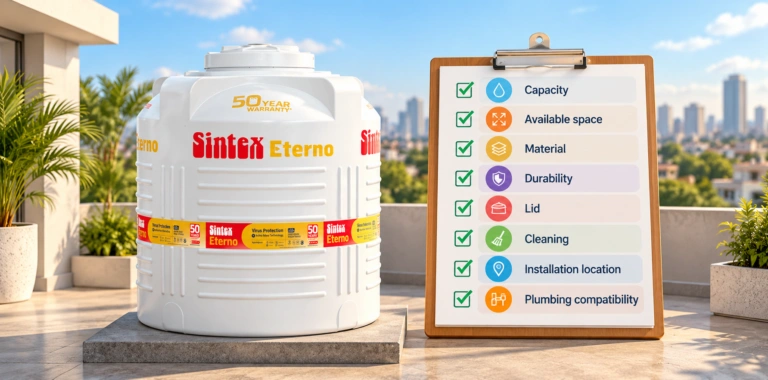
Your buying checklist should include:
- Capacity: Does it match your daily use and expected supply gap?
- Available space: Will the tank fit comfortably in the installation area?
- Material: Is the tank designed for safe household water storage?
- Durability: Will it suit the local weather and installation conditions?
- Lid: Can the tank be kept securely covered?
- Cleaning: Is the tank reasonably accessible for inspection and maintenance?
- Installation location: Is the position suitable for your plumbing arrangement?
- Plumbing compatibility: Can the tank work with your existing pipes and fittings?
Do not make the decision based on litres alone. A water storage tank that looks ideal on paper may not suit the space, plumbing or supply pattern of your home.
Sintex Water Storage Solutions for Homes
Homes dealing with irregular supply may need anything from compact additional storage to a larger, more flexible setup. Sintex Water Storage Solutions offers tanks across a wide range of capacities, so you can match the choice to the household’s actual storage needs rather than assuming one model suits everyone.
For homes with limited storage requirements, the Sintex Neo range is available in capacities from 200 to 1,000 litres. Sintex states that the range includes features such as a threaded lid, UV stability and anti-algae protection.
For larger storage needs, the Sintex Classic Double Wall range offers capacities from 500 litres to 25,000 litres.
Sintex also offers underground storage options for properties with limited surface space. Its underground FRP tanks are available in larger capacities and are designed for underground or on-ground installation.
The right Sintex tank should therefore be selected according to water consumption, available space, supply frequency and the home’s overall plumbing arrangement.
Conclusion
Living with an irregular water supply can make daily life difficult, but better storage planning can reduce some of that uncertainty.
The answer is not always a bigger tank. Start with your household’s water use, understand the gap between supply cycles and then plan a sensible reserve. Consider whether one tank, multiple tanks or a combination of ground-level and overhead storage makes more sense.
Regular cleaning and careful use matter too. A well-planned water storage for home setup should give you enough backup without leaving large quantities of water sitting unused for too long.
The amount of backup water storage depends on your daily household consumption and the usual gap between supply cycles. Start by estimating how much water the family uses in a day, then calculate the amount needed for the expected number of days without supply. Add a practical reserve for unexpected delays.
There is no single water tank size for home that suits every family of four. Daily consumption, the number of bathrooms and the length of the supply gap all matter. Calculate approximate daily use first, then multiply it by the number of days you need backup water.
There isn't one right answer here. If you have enough space, one large tank may keep the plumbing arrangement simpler. Smaller tanks can be easier to place around a property where space is tight. It is worth looking at cleaning access and pipe connections before settling on either option.
That depends on the water and the tank's condition. A clean, covered tank is different from one that has not been checked in months. Instead of focusing only on a set number of days, check the water regularly and avoid letting it sit unused for longer than necessary.
Start with the tank itself. Keep the lid closed properly so dust, insects and other outside matter do not get in. If water cuts continue for several days, use the stored water carefully and replace it with fresh water whenever possible. Regular cleaning helps as well.
There is no identical cleaning schedule for every home. It depends on the water source and what you find inside the tank during inspection. Check for sediment, dirt or anything unusual from time to time. If something seems off with the stored water, don't simply wait for the next scheduled cleaning.
They can be stored in the same system, but it is sensible to know the water's quality and source first. Tanker and municipal supplies may not be the same. This becomes particularly important when the stored water is used for drinking or cooking.
The answer for an irregular water supply solution will depend on how much water your home needs to keep in reserve and where the tank can be installed. Sintex offers domestic, overhead and underground water storage options in different capacities, so households can choose a setup that fits their available space.
First, get a rough idea of how much water your household uses in a day. Then look at the usual gap between two water supplies. These two figures will give you a much better starting point than simply choosing the biggest tank available.
It comes down to how your home receives and distributes water. Some properties use a ground-level tank to collect incoming water before pumping it into an overhead tank. Others may need a different arrangement. Look at the supply pattern, available space and plumbing before deciding on the setup.