
First-Time Buyer FAQs: Everything to Know Before Buying a Water Tank
Share
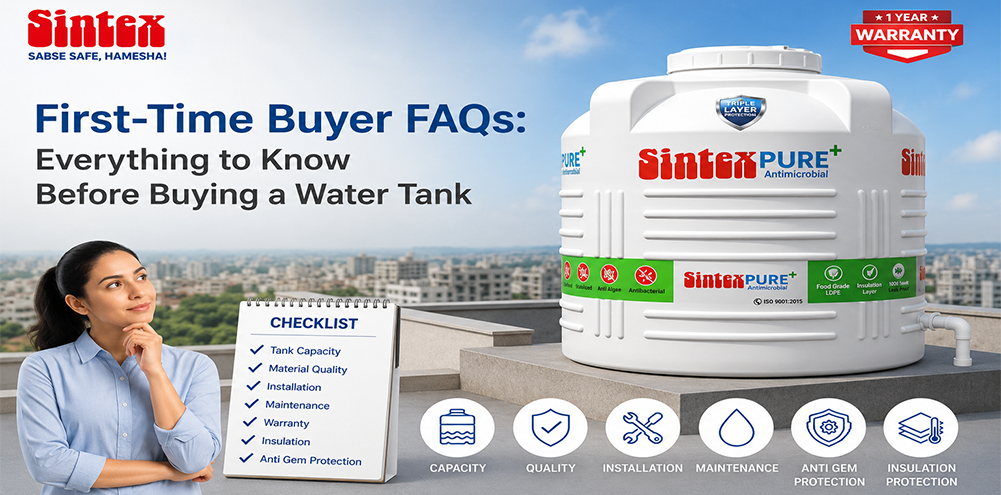
Table of Contents
Buying your first water tank? You start looking and get buried under capacities, materials, colours, ISI marks, food-grade claims, and a dozen brands all swearing theirs is the one to buy.
So here’s a plain-English run through the questions first-time buyers actually ask, roughly in the order they come up. Think of it as a shortcut to how to choose a water tank that suits your home and your budget, minus the showroom pitch.
Key Takeaways
- Work out the tank’s job first. Size, material, and spot all follow from it.
- Size around your family’s daily use and a buffer, not a round number.
- Food-grade, UV-stabilised material beats any colour choice for clean water.
- Check the warranty, the certification, and what fittings are included before paying.
- One size up now is usually cheaper than a second tank in five years.
What Will You Use the Water Tank For?
What’s the tank actually for? Answer that before anything else, because the job decides most of what comes next.
A water tank for home use, meaning drinking, cooking and bathing, needs food-grade plastic and a fairly modest size. Running a shop or a small office? You’ll want more volume and a tougher shell. Rainwater harvesting usually goes underground in a big, opaque tank that keeps light out. And if it’s for farm irrigation, go as large and cheap as you like, since nobody’s drinking it.
Get the purpose wrong and you’ll overpay or under-store, whichever way it breaks.
What Water Tank Capacity Do You Need?
This is where first-timers guess, and guessing is what ends up leading you into a situation where you’ve run out of water by mid-week. The planning figure most people in India use is 135 litres per person per day for everything a household gets through, though plenty of families run fine on 100 to 150.
To size water tank capacity for family use, multiply heads by daily litres, then pad it for guests and the days the supply just doesn’t turn up. Four people at 135 litres is roughly 540 litres a day. A 500 to 1000 litre tank buys you a day or two of cushion when the municipal line goes quiet.
| Family size | Daily need (approx) | Suggested tank size |
|---|---|---|
| 2 people | 270 litres | 500 litres |
| 3 to 4 people |
400 to 540 litres | 750 to 1000 litres |
| 5 to 6 people |
675 to 810 litres | 1000 to 1500 litres |
| 7 or more | 945 litres and up | 2000 litres or split tanks |
The pad is the part people skip. Supply is never as regular as the schedule pinned to the notice board. ( Add link of Tool calculator)
Where Will the Tank Be Installed?
Where the tank ends up decides its shape and how much support it needs underneath.
Rooftop overhead tanks feed your taps by gravity and suit most homes, as long as the base under them is solid and level. Underground sumps hold a lot, stay cool, and stay out of sight, but now you’re digging a pit and adding a pump to lift the water back up. Loft tanks are the slim rectangular ones that squeeze into an indoor ceiling void. Ground-level outdoor tanks are the easiest to fit and check on, though they eat garden space and sit out baking in the sun.
Pick the spot before you pick the tank. A tank that fits your pipes but not the space turns into an expensive redo.
Which Water Tank Material Is Best?
There’s no outright winner here. Every material buys you something and costs you something else.
Plastic is what most Indian homes settle on, for good reasons: roto moulded HDPE or LLDPE, no rust, light to carry, quick to put up, and easy on the wallet. FRP steps in for bigger or industrial jobs that need serious corrosion resistance. Concrete lasts for decades and keeps water cool, though it cracks eventually and costs a small fortune to build. Stainless steel is the handsome, long-lasting option almost nobody buys, because the price stings.
For plain domestic storage, a decent roto moulded plastic tank is hard to beat once you weigh price, hygiene and lifespan together.
Is the Tank Made from Food-Grade Material?
For drinking water, this one isn’t optional.
Food-grade plastic is virgin, BPA-free, and cleared for potable water. It won’t leach chemicals into what you drink, even after a few summers up on the roof. The cheap tanks are the worry. Some blend in recycled plastic to shave the price, and that recycled content can seep unpleasant compounds into the water as the months tick by.
Ask, flat out, whether the tank is food-grade and made of virgin material, and get it in writing on the product or its certificate. Anything your family actually use, don’t compromise.
Also, Read: Why to Switch to a 100% Virgin Plastic Water Tank?
Does the Tank Protect Water from Germs?
Food-grade material stops the tank from putting anything into your water. It does nothing about what the water brings in on its own.
That gap catches most first-time buyers out. Water sits still in a home tank for days at a stretch. Add warmth, a little stray light, some sediment settling at the bottom, and bacteria, fungus and algae find the place comfortable. You spot it late, usually as a faint smell or a green film on the inner wall, long after the growth started.
This is where an antimicrobial tank earns its price. Sintex Pure and Pure+ build Active Silver Technology into the inner layer, where silver ions release slowly and keep the surface hostile to microbes between cleans. Sintex calls it 4P Protection: anti-bacteria, anti-virus, anti-fungus and anti-algae, rated at up to 99% of harmful microorganisms.
The payoff with a Sintex Anti-Germ tank is unglamorous and worth having. Water holds its freshness longer. The inner walls stay clear of slime, so cleaning takes less scrubbing. And if there’s a toddler, an elderly parent, or anyone with a delicate stomach at home, your margin of safety goes up.
So ask the brand a direct question. Is the protection built into the material itself, or sprayed on as a coating that wears off? Built in is the one you want.
Can Your Roof Support the Tank’s Weight?
A full tank weighs a great deal more than the empty one you hauled up the stairs. Water runs about a kilo a litre, so fill a 1000-litre tank and you’ve parked over a tonne up there, with the tank and stand on top of that.
All that has to land somewhere safe. On a roof, that means sitting the tank over a beam or a load-bearing wall, ideally toward a strong corner, and never out in the middle of a bare slab. A flat, level base shares the weight around. A tilted or patchy one concentrates it, and the shell is what pays for that over the years.
Putting a big tank on an older roof? Get your builder or a civil engineer to confirm the slab can take it. Cheap check. It saves you from something genuinely dangerous.
What Accessories Should Come with the Tank?
A tank is only as good as the bits bolted to it, and those are exactly what people forget to check until there’s a puddle.
You want a lid that actually seals, against dust, insects and light. Inlet and outlet fittings sized to your pipes and set at heights that give you good flow with little dead storage. An overflow pipe to carry off the excess once it fills. A drain valve at the base so cleaning doesn’t mean bailing it out with a mug. Maybe a vent, so the tank can breathe as the level rises and drops.
Find out which of these sit in the box and which cost extra. A bargain tank stops being a bargain the moment you’re buying every fitting one at a time.
How Much Maintenance Will It Need?
Every tank needs cleaning. A good one just makes it painless. Reckon on two or three cleans a year for a home tank, and more if your water carries silt or you live somewhere dusty.
A clean means draining it, scrubbing the walls to shift the sludge and slime, then rinsing before you refill. In between, a monthly glance at the lid, the fittings and how clear the water looks does the job. That glance is what catches a loose lid or a weeping joint before either becomes real work.
Smooth inner walls and a wide, sealed lid make all of this easier, which honestly settles how often you’ll bother.
Also, Read: How Frequently Should You Clean Your Water Tank?
How Long Should a Good Water Tank Last?
A well-built plastic tank runs 15 to 20 years, and plenty go longer with a little care. What decides it is material quality, UV protection, and how well it went up in the first place.
Thin walls, weak UV treatment or recycled plastic can each drag the life down under ten years. A multi-layer, UV-stabilised tank on a proper base lasts, and keeps the water cleaner the whole time. Sun and a rough installation, truthfully, do more damage than a lifetime of ordinary use.
Warranty is your tell for what the maker really expects. A brand willing to put years on the tank body is backing itself. Read that cover before you read the price sticker.
What Should You Know About Water Tank Pricing?
Price rides on capacity, material, number of layers and brand, so two same-size tanks can sit worlds apart. Take this water tank price guide as a rough map rather than a quote, because rates shift with your region and the season.
The cheapest tanks are single-layer plastic, and they fade and weaken faster for it. Multi-layer, UV-stabilised ones cost more to start and hand it back as extra years. Bigger tanks cost more overall but usually less for every litre they hold. Established brands charge a premium, and most of the time that premium is paying for better plastic, tighter quality checks, and someone who actually answers the phone after the sale.
Judge cost across the whole life of the tank. A slightly dearer one that lasts twice as long is the cheaper tank, just spread out over more years.
Should You Buy a Bigger Tank for Future Needs?
Sizing only for today is the classic slip. This tank is going to sit on your roof for the next 15 years, and your household probably won’t hold still that long.
Think a bit ahead. A new baby, an extra bathroom, a supply that keeps getting patchier, all of it pushes your real demand up. Going one size bigger now is usually a small addition to the bill. Upgrading later means a fresh tank, new fittings, and the installer’s time all over again.
There’s a ceiling to it, mind you. An oversized tank for a two-person home leaves water standing too long and going stale. Aim for what you’ll plausibly need a few years out, add a buffer, and stop there.
What Warranty and Certifications Should You Check?
Certifications and warranty are what separate a serious tank from a risky one, and both take about thirty seconds to check.
Look for food-grade certification for drinking water, and an ISI mark where it applies. Those tell you an outside body actually tested the thing, instead of the label simply claiming it. On the warranty, check three points. How long it runs, what it truly covers, and whether the tank body is protected against manufacturing defects for a real stretch of years.
Get the terms in writing and hang on to your invoice. A warranty you can’t prove later is worth about as much as no warranty at all.
Water Tank Material Comparison
Pulling the material question together, here’s the quick side-by-side, a water tank material comparison across what a home buyer would realistically weigh up.
| Material | Durability | Lifespan | Maintenance | Cost | Best for |
|---|---|---|---|---|---|
| Roto moulded plastic (HDPE/LLDPE) |
High, rust-free |
15 to 20 years |
Low | Low to medium |
Most homes |
| FRP | High | 20+ years |
Low | Medium | Large and industrial |
| Concrete | Very high | 30+ years |
Medium | High | Permanent underground storage |
| Stainless steel | Very high | 20+ years |
Low | High | Premium, hygiene-focused setups |
For an ordinary Indian home, roto moulded plastic takes it on the balance of price, hygiene and years in service. The rest earn their keep only in heavier or more specialised jobs.
Common Mistakes First-Time Buyers Make
A handful of mistakes trip up first-timers again and again:
- Buying for a single day’s water instead of a few days’ buffer.
- Chasing the lowest sticker and landing thin, recycled-plastic walls.
- Skipping the food-grade check on a tank meant for drinking.
- Never asking whether the roof can hold the tank once it’s full.
- Forgetting the fittings, then paying for each one at the counter.
- Leaving the warranty terms unread until something goes wrong.
Every one of these is easy to dodge once you know to look for it.
Expert Tips Before You Finalize Your Purchase
A few habits from the fitting-and-upkeep side will get you more tank for your money.
Buy the tank and its stand as a pair, so the base fits the shape and carries the load properly. Insist on a level, fully supported platform before it goes up, because most early failures start with a bad base. Keep the outlet low and the overflow just under the lid, and more of the tank’s volume stays usable. Get the food-grade and UV promises in writing, not a nod across the counter. Then clean it on a schedule and eyeball the fittings once a month.
None of it’s hard. A little attention now buys you a quiet 15 years.
Wrapping Up Your Water Tank Buying Guide
Boil all of this down and it comes to three things: match the tank to your home, size it for what you actually use, and refuse to bend on food-grade, UV-stabilised material. Get those right and the warranty, fittings and brand mostly sort themselves out around them. Sintex builds its tanks for exactly that, durable, safe, and honest on capacity. Work through these questions once, and your first tank won’t be a decision you have to revisit for a long while.
Start with 135 litres per person per day, multiply by the people at home, and add a buffer for guests and no-supply days. A family of four lands near 540 litres daily, so a 500 to 1000 litre tank gives a comfortable day or two of storage.
For most homes, roto moulded plastic in HDPE or LLDPE. It's light, rust-free, hygienic when food-grade, and far cheaper than concrete or steel. FRP suits bigger loads, concrete lasts longest underground, and steel is the premium pick. Plastic just wins on all-round value.
It does. Light getting through pale or translucent walls feeds algae and spoils the water, so darker or opaque walls, often a black inner layer, keep it cleaner. Far more important than the shade, though, is a proper UV-stabilised body.
Check that it's food-grade, made from virgin BPA-free plastic, and certified for potable water. Ask for that in writing on the product or its documentation. Avoid tanks with recycled-plastic content, since those can leach compounds into water over time.
A good multi-layer, UV-stabilised plastic tank lasts around 15 to 20 years, sometimes more with regular cleaning and a solid base. Thin walls, poor UV protection and recycled plastic cut that short, occasionally to under a decade.
Food-grade certification for drinking water and an ISI mark where it applies are the main ones. They show the tank passed an independent standard rather than just a label claim. Pair that with a written warranty covering the tank body against manufacturing defects.
Usually, yes, within reason. One size up costs a little more today and saves a full replacement if your family or usage grows. Just avoid going so large that water sits stale, which matters most for small households.