

Best Direction for Water Tank as per Vastu: Myths, Facts & Practical Considerations
Share
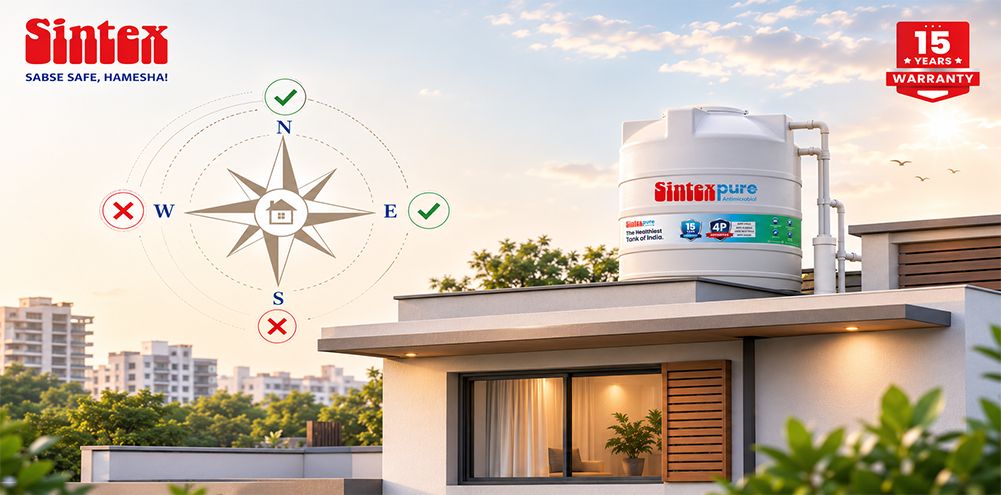
Table of Contents
Most people building a house in India hit the same snag when they reach the water tank. Between your local plumber and internet forums, you will find lots of different suggestions and this can feel overwhelming. The confusion usually comes down to one detail nobody explains clearly. An underground tank and an overhead tank follow opposite rules, and what suits a sump below the ground can be exactly wrong for a tank sitting on your roof.
Whether you’re building an independent house, duplex home, villa, or apartment in a gated community, choosing the right water tank placement is just as important as selecting the right tank. For homes across India’s diverse climatic conditions, proper placement also helps improve accessibility, maintenance, and long-term performance.
This guide sorts the tradition from the practical reality. By the end, you will know enough about water tank direction vastu to make a call you are comfortable with, without second-guessing every relative who visits.
Key Takeaways
- Underground tanks belong in the north or northeast, the water-element zone.
- Overhead tanks suit the southwest, where a full tank reads as weight.
- Avoid overhead tanks in the northeast and sumps in the southwest.
- Tank material and colour matter far less than direction and structure.
- Treat these vastu tips for water tank placement as guidance, not guarantees.
What Vastu for Water Tank Placement Actually Means
Vastu Shastra reads a home as a balance of five elements: earth, water, fire, air, and space. Each compass direction carries one of them, and water storage sits inside that system as a heavy, active presence. Vastu treats where you place it as something that either steadies a home or unsettles it.
The idea behind placing a tank this way is straightforward. Water ties to the northeast and to the flow of prosperity, so a tank aligned with its natural direction counts as auspicious. A tank that fights its direction, the tradition holds, stirs friction in health, money, or household peace. Every rule below grows out of that single belief.
Why Direction Matters: Myth vs Fact
Here is where the topic splits into two honest halves.
The traditional half rests on faith. Vastu shastra for water tank placement treats the northeast as sacred water territory, and it warns that a heavy tank in the wrong corner blocks the positive energy a home should hold. No laboratory has measured this. People follow it because generations have, and because a calm mind during construction has its own value.
Some Vastu rules survive because they line up with real building constraints, and you can check the overlap yourself. Weight makes the point. A 1,000-litre overhead tank holds a full tonne of water once you fill it, and the common 2,000-litre size doubles that before you count the tank body and the support frame. A 500-litre unit still parks half a tonne on the slab. In most Indian homes the southwest corner sits over the thickest walls and the deepest footing, so placing that load there is a structural call first and a traditional one second. Sump placement works on the same logic. Keep the sump well away from the septic pit and you cut the seepage risk that shows up in any water test. Load, water quality, access: those three constraints explain a fair share of what tradition already tells you to do.
Read the rest of this guide with that split in mind. Where belief and engineering agree, the advice is easy to follow. Where they part ways, you get to decide which one carries more weight for your family.
Underground Water Tank Vastu: The North and Northeast Rule
For an underground tank or sump, the tradition is unusually united. North, northeast, or the stretch between them is the recommended zone, and almost every school of Vastu agrees on it.
The reasoning ties back to the element. Water belongs to the northeast, the direction linked with clarity, wealth, and the morning sun. A sump placed there, the tradition says, keeps prosperity flowing into the home. The rule also carries a practical bonus in many Indian plots, since builders often keep the northeast lower and more open, which suits an underground structure that needs excavation and drainage.
Two corners get a firm no. The southwest is the earth corner and the seat of stability, so a hollow water-filled pit there supposedly weakens the foundation of family fortunes. The southeast belongs to fire, and mixing a water body into the fire zone reads as a clash of elements. If your only option is one of these corners, the remedy section later gives you something to work with.
One more point that people miss. Keep the sump and the septic tank apart. That single rule protects both your Vastu and your health.
Overhead Water Tank Vastu Direction
Overhead tanks flip the logic, and this is where most people go wrong.
You would expect a water tank to want the water corner, the northeast. It does not. Once you lift a few hundred litres onto the roof, Vastu stops treating it as water. That much mass, held high, behaves like earth, and the earth element wants the southwest. So the best direction for overhead water tank placement is the southwest, the same corner that carries the structural weight of the house comfortably.
The order of preference runs like this. Southwest is first choice, tied to earth and stability, the same corner we ruled out for underground water now becomes the best seat for the tank’s mass. South comes next, linked to fire and steady energy. West is a workable third, tied to air. The two corners to avoid are the northeast, where a heavy tank presses down on the home’s most sacred quarter, and the southeast, where water sits awkwardly against the fire zone.
| Direction | Element | Vastu verdict |
|---|---|---|
| Southwest | Earth | Best choice, matches structural strength |
| South | Fire | Second best, steady energy |
| West | Air | Acceptable third option |
| Northeast | Water | Avoid, burdens the sacred corner |
| Southeast | Fire | Avoid, water clashes with fire |
Best Direction for Water Tank: A Quick Decision Table
If you skimmed everything above, this table is the part to save. It puts both tank types side by side so you can match your situation in one look. Directions listed as best assume the rest of your layout allows it. When a recommended corner is already taken by a staircase, a bedroom, or a boundary wall, move to the next option in the row rather than forcing the ideal.
| Tank type | Recommended direction | Element | Why |
|---|---|---|---|
| Underground sump | North or Northeast | Water | Aligns water with its natural corner |
| Overhead tank | Southwest | Earth | A full tank behaves as weight, wanting the earth corner |
| Overhead, alternative | South, then West | Fire, Air | Backups when the southwest is unavailable |
| Terrace tank in flats | Southwest of terrace | Earth | The same earth logic scaled to the roof slab |
Treat the table as a shortlist, not a verdict. Your plot, your structural drawing, and the space you actually have will decide the final spot.
Vastu for Water Tank on Terrace
Flats and gated societies raise a question the old texts never imagined. When you live on the ninth floor and the tank sits on a shared terrace, whose Vastu are you even following?
The honest answer is that you control less here, and that is fine. Terrace placement works on the same earth logic as any overhead tank. If the society tank or your private terrace tank can sit toward the southwest of the roof, that is the preferred spot. The northeast of the terrace is the one to keep clear.
For most apartment owners, the builder fixes the tank position long before you move in. Rather than lose sleep over a corner you cannot change, focus on what you can influence inside your own flat, such as the direction your kitchen and pooja space face. If you are building an independent house with a terrace tank, though, you have full say, and the southwest rule is worth honouring from the drawing stage.
Also, Read: How Long Does a Water Tank Last?
Practical Considerations Beyond Vastu
Whatever you decide on the Vastu side, four practical things decide whether the tank serves you well.
Load comes first. A full overhead tank is one of the heaviest single loads on your roof, so your engineer has to size the slab and columns under it for that weight. This is why the southwest earns its place twice over, since it usually sits above the strongest part of the frame.
Access matters more than people expect. You will clean the tank, check the float valve, and chase the odd leak, so leave enough room to reach the lid safely.
Sunlight is the quiet enemy of stored water. A tank in constant sun grows algae faster and heats up through summer, so a shaded spot or a UV-stable tank body pays for itself. Good roto moulded tanks handle Indian sun far better than thin, cheap ones.
Then there is pipe routing. The shorter and straighter the run between the tank and your taps, the better your pressure and the fewer joints you maintain. Get these four right and the tank behaves, wherever the compass points.
Conclusion
Vastu gives you a sensible starting point for placing a water tank, and in the cases that matter most, it agrees with plain engineering. Put the sump in the northeast and the overhead tank in the southwest, and you have honoured both tradition and structure in one move. Beyond direction, the tank has to survive years of harsh sun and hard water, which is where a well-built tank earns its keep. Pick the corner with care, then pick the tank the same way.
Also, Read: How to Choose the Right Water Tank?
The north, northeast, or the zone between them. Vastu links water to the northeast, so a sump there supposedly supports health and prosperity. Keep it away from the southwest and southeast, and never place it beside the septic tank.
Because a full tank is heavy, and tradition treats the northeast as the home's sacred, light-filled corner. Pressing that weight onto the northeast supposedly blocks positive energy. Structurally too, the load belongs over the sturdier southwest side of the house.
According to tradition, a poorly placed tank can invite friction in money, health, or relationships. No scientific proof backs this. The real risk is structural, since heavy tanks on weak corners strain the frame, so the practical stakes hold up even when people still argue about the spiritual ones.
No. No study has validated Vastu outcomes for tank placement. Some of its rules still make sense because they match engineering logic, such as putting heavy loads over strong corners. Follow it for the structural overlap and for peace of mind, not for proven results.
In flats, the builder usually fixes the tank position, so you have limited control. Where you do have a say, prefer the southwest of the terrace and keep the northeast clear. Otherwise, focus your Vastu attention on the interior of your own unit.
Underground tanks follow the water element and belong in the northeast. Overhead tanks hold so much water that Vastu treats them as weight, so they shift to the southwest earth corner. One rule points north, the other south, which is why people mix them up.