
How to Choose the Right Water Tank Based on Your Family’s Water Consumption
Share
Table of Contents
Most people buy a water tanks the way they buy a ceiling fan. They pick a size that seems about right and hope it works out. Water tanks are not fans, though. The wrong water tank capacity for home use affects your family every single day: dry taps by mid-morning, water sitting stagnant longer than it should, or a tank that never quite fills before the next supply cycle.This guide helps you make the decision based on actual numbers.
Why the Right Water Tank Capacity for Home Makes All the Difference
Think about how water moves through your home on a typical day. Morning routines, cooking, washing, flushing, water demand is constant, and in most Indian cities and towns, supply is not.
A tank that is too small means running out before the next fill. A tank that is oversized keeps water unused for days at a stretch, which affects quality over time. Neither works in your favour.
The right capacity covers your daily consumption, bridges the supply gap, and leaves a sensible buffer for days when water arrives late or at reduced pressure. That balance is what good tank selection looks like, and most households underestimate how important getting it right actually is.
Start Here: A Straightforward Water Tank Capacity Calculation
Before you look at any product, do this water tank capacity calculation. It takes under two minutes.
The Bureau of Indian Standards benchmarks urban domestic water use at 135 litres per person per day. That figure covers drinking, cooking, bathing, sanitation, and general cleaning. If your household runs a washing machine, waters a garden, or has other high-usage habits, add 10–20% on top.
The formula:
Daily requirement = Number of family members × 135 litres
Tank size = Daily requirement × Number of days between supply cycles
A family of four with daily supply needs 4 × 135 = 540 litres per day. A 750-litre tank covers them comfortably with buffer. If supply comes every alternate day, the need doubles to roughly 1,080 litres, which puts a 1,500-litre tank in the right range.
Write your numbers down before you read further. It makes every subsequent decision easier.
What Is the Ideal Water Tank Size for Family Households in India?
Household water consumption India-wide varies with city size, climate zone, and lifestyle. Based on the 135-litre daily benchmark, Sintex recommends the following capacities by household type:
| Household Size | Recommended Capacity |
| 1–2 people | 500–750 litres |
| 3–4 people | 1,000–1,500 litres |
| 4–6 people | 1,500–2,000 litres |
| Joint families | 2,000–3,000 litres |
| Societies and Apartments | 5,000–25,000 litres |
These assume daily or near-daily supply. For areas with irregular schedules, which describes a significant chunk of Tier 2 and Tier 3 cities in India Sintex recommends adding a 10–20% buffer on top of the calculated figure. The ideal water tank size for family homes in water-stressed zones is almost always one bracket above what the base formula gives you.
If supply arrives every two days or less reliably, plan for at least two full days of storage. Spare capacity is a convenience. Running short is a crisis.
Choosing Water Tank Capacity for Home: Apartments vs Independent Houses
Living situation shapes tank selection almost as much as family size does.
Apartments
Most residential apartments manage water through a centralised overhead tank on the terrace, shared across floors. Individual units sometimes add smaller supplementary tanks for unit-level storage. When buying a water tank size for apartment use, check first whether your building society already runs a shared tank sized for the entire complex. Societies with 20 or more flats typically need tanks in the 5,000-25,000 litre range. If adequate common storage already exists, a smaller unit-level tank in the 500-750 litre range may be all you need as a supplement.
Independent Houses
These homes have greater flexibility and more to plan for. The standard setup pairs a ground-level sump with a rooftop overhead tank. The sump absorbs incoming municipal supply and acts as the primary reserve. The overhead tank feeds the house by gravity and should hold at least one full day’s requirement for your household. Your sump can hold considerably more.
Other Factors That Affect How Much Water Tank Capacity You Need
The formula gives you a baseline. These variables adjust it.
- Supply frequency and reliability: This matters most. Municipal supply can be daily, alternate days, or completely unpredictable depending on your area. Knowing your supply schedule tells you how much water tank capacity you actually need, more directly than any other factor.
- Inlet pressure: Low pressure at your inlet means slower filling. A larger tank gives you more room to work with before the tank runs dry during the fill window.
- Appliances: A washing machine uses 50–100 litres per cycle. A garden hose or car-washing routine adds more. Build these into your estimate.
- Climate: Households in hot, arid regions of India consume more water through summer. Residents of such areas generally benefit from going one size above their calculated need.
- Building height and sun exposure: For rooftop tanks on upper floors with direct sun all day, thermal load matters. This influences which model to choose, not just the capacity.
Which Sintex Tank Should You Actually Buy?
Once you know your required capacity, the next step is matching it to the right product for your environment. Sintex maps its lineup to specific conditions:
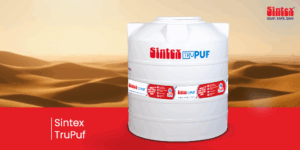
- Top floor with strong sun exposure: Tatva (ARPS) or TruPuf (PUF). The Tatva carries Anti-Rodent Protection System technology. The TruPuf uses Polyurethane Foam insulation that keeps stored water measurably cooler, a real advantage for rooftop tanks in harsh climates.
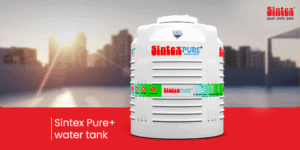
- Premium hygiene requirements: Pure and Pure+. Ideal for households where water quality is a priority, families with young children, elderly members, or anyone with specific health needs.
- Mid-range budgets with reliable performance: Hero and Titus. A solid choice for standard residential use without the premium add-ons.
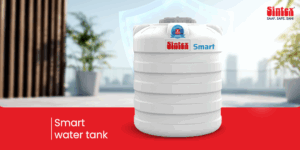
- Budget-first buyers: Smart and Reno. These cover the fundamentals well and make sense for rental properties or secondary storage.
- Large projects, societies, and commercial applications: Sintex DW (Classic) and ISI-marked tanks. Built for high-volume requirements and institutional standards.
Roto-moulded vs Blow-moulded: What the difference means for you
Every tank in the Sintex range uses 100% virgin, food-grade plastic. The manufacturing process, however, differs by product line and it affects what the tank can do.
Roto-moulded tanks go through a biaxial rotation process using LLDPE powder, which produces a seamless, single-piece body with high impact resistance. This process supports premium features like Active Silver antimicrobial protection, ARPS, and PUF insulation. These tanks cover capacities up to 25,000 litres and sit in the medium-to-high price bracket. Blow-moulded tanks use HM-HDPE through a faster extrusion process. The output is a lighter, more economical tank well-suited for domestic capacities up to 2,000 litres. If your requirement is straightforward household storage and cost matters, a blow-moulded tank delivers solid value.
Before You Buy
Run the calculation. Match the output to the household size table. Adjust for supply frequency, climate, and any specific requirements your home has. Then line up your capacity against the Sintex product range for your environment.
A water tank sits on your rooftop for ten to fifteen years. Thirty minutes spent on the right sizing decision today is thirty minutes very well spent.
Categories
Year
Related blogs