
Table of Contents
nswer:
A water storage solution has to match how water reaches the home. Urban households store against fixed supply hours in limited rooftop space. Rural households often store longer because supply is seasonal, so capacity matters more. In both, a tank meeting IS 12701, a locking lid and routine cleaning protect what is stored.
Water needs protection after reaching the home. How it is stored can affect its condition, and urban and rural households have different storage needs. City homes may have limited tank space and depend on water supplied at fixed times. Rural households may face seasonal changes in supply, so water can remain stored longer. Hygiene needs attention when water stays in a tank for extended periods. Tank size, location and cleaning requirements depend on these conditions. A suitable water storage solution should match household demand, available space and supply patterns. This guide covers urban and rural water storage side by side: what each setting demands, how much capacity to plan for, and what the Indian Standard for these tanks actually requires.
Key Takeaways
- Urban homes often need storage that fits limited rooftop or service space.
- Rural households may require more capacity when supply changes by season. Jal Jeevan Mission plans rural supply at a minimum of 55 litres per person per day, against 150 to 200 litres in large cities under IS 1172.
- Secure covers help keep dust, insects and debris away from stored water. IS 12701 requires a locking lid with no gap wide enough to pass a 1.6 mm wire.
- Choose tank size and material based on household use and installation conditions.
- Regular inspection, cleaning and hygienic handling are the water safety solutions that matter most once water is already in the tank.
Why Does Safe Water Storage Matter for Water Quality?
Water can pick up dirt after it enters a storage tank. An open tank allows dust, insects, leaves and other material to fall into the water. Gaps around pipes can cause the same problem. A loose, cracked or missing lid leaves the tank exposed. The overflow and vent pipe is the opening most often forgotten. IS 12701 shows it fitted near the top of the tank with a mosquito and insect proof cap, and a bare overflow pipe is an open invitation into an otherwise sealed tank.
Sediment can settle at the bottom as well. Water often carries small particles that collect inside the tank over time. Without checks, this buildup can remain there until the tank needs a more thorough clean.
The condition around the tank also counts. Dirt, waste and stagnant water near the installation can create additional contamination risks. A neglected tank is harder to keep clean and easier to contaminate.
Some basic checks should support preventing water contamination in storage tanks as part of routine care:
- Keep the lid closed and check that it fits properly.
- Examine pipe joints and fittings for damage or gaps.
- Check that the overflow and vent pipe still has its insect-proof cap in place.
- Look inside for visible dirt or sediment.
- Keep the area around the tank clean.
- Use a tap or outlet for drawing water where possible.
Clean handling also helps. Cups, containers or other objects should not be placed directly into stored water unnecessarily. A storage tank cannot remove contamination already present in the incoming supply, so source-water quality still needs attention.
Properly maintained water storage tanks help protect stored water from avoidable contamination and support safer water use at home.
What Are the Water Storage Challenges in Urban Areas?
Urban households often depend on a storage tank because municipal water may arrive at set times. The tank must hold enough water between supplies. Household size and daily consumption should guide capacity, rather than choosing a tank based only on the largest size that can fit.
There is a published basis for that calculation. IS 1172:1993, the code of basic requirements for water supply, drainage and sanitation, sets minimum per-capita rates by community size:
| Community | Minimum supply per person per day |
| Population up to 20,000, no flushing system, house service connection | 70 to 100 litres |
| Population 20,000 to 100,000 with full flushing | 100 to 150 litres |
| Population above 100,000 with full flushing | 150 to 200 litres |
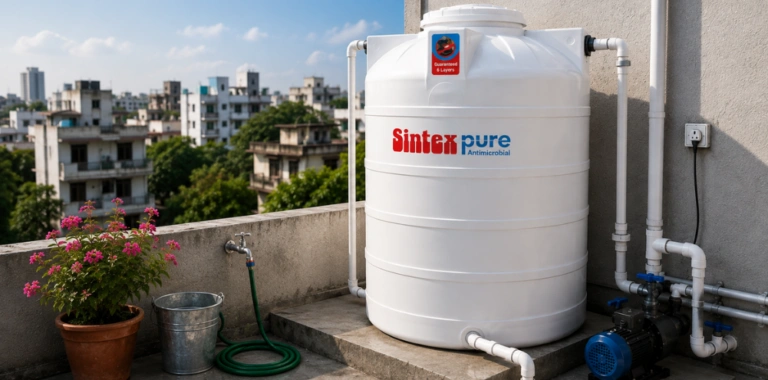
Space is another practical constraint. Many urban tanks are installed on rooftops or in compact service areas. The installation point must support the tank safely and leave enough room to inspect connections and clean the tank. A large tank that blocks access to other equipment can create maintenance problems.
When water remains in a tank for longer periods, the lid, fittings and internal surfaces need regular checks. Dust, insects and other material can enter through small openings if the tank is not properly secured.
Cleaning access is easy to overlook during installation. Position the tank so routine inspection and cleaning can be carried out without unsafe climbing or awkward access. Covers should also be easy to remove when maintenance is required.
The main urban water storage challenges are therefore linked to:
- Limited installation space
- Rooftop or elevated placement
- Intermittent municipal supply
- Higher household demand in some homes
- Longer gaps between water supplies
- Restricted access for inspection and cleaning
- Rooftop heat. IS 12701 rates these tanks for a nominal service temperature of +1°C to +50°C, and an exposed rooftop in an Indian summer is heavily exposed to the upper end of this range, frequently.
Good water storage in urban areas should balance capacity, available space and maintenance needs. The tank should hold enough water while remaining practical to inspect and clean.
What Are the Water Storage Challenges in Rural Areas?
Rural households can face longer, less predictable gaps between water supplies. Depending on the location, water may come from borewells, community sources, tankers or local schemes. Seasonal changes can also affect availability, making dependable storage important.
When water has to be stored for longer periods, capacity becomes a key consideration. Before selecting a tank, consider household demand, the number of users and the time between supplies. Oversizing can waste space, while a small tank may run out before the next supply becomes available. Jal Jeevan Mission plans rural piped supply at a minimum service level of 55 litres per person per day, which is a useful floor for sizing. A five-person household at that level uses roughly 275 litres a day, so storage for three days between supplies means planning for well over 800 litres.
Water may also pass through collection and transport containers before reaching the household tank. Each handling step can introduce contamination if the containers are dirty or left uncovered. Keeping collection and storage containers clean and covered helps reduce this risk.
The tank location should offer protection from dust, animals and other external contaminants. Covers, pipe openings and fittings should be checked regularly. A practical tank should also allow inspection and cleaning, especially when water remains stored for several days.
One installation point is worth stating plainly. IS 12701 states that the rotomoulded polyethylene tanks it covers are not meant for underground applications. Burying an overhead-type tank to save space puts it under soil loading it was never designed for. Underground storage needs a tank built as a sump.
The main rural water storage challenges include:
- Seasonal or inconsistent supply
- Longer storage periods
- Greater dependence on local water sources
- Distance between collection points and homes
- Higher capacity requirements in some communities
- Contamination during collection, transport and storage
Safe water storage in rural India should reflect local supply conditions. Capacity, durability, secure covers and straightforward maintenance are more useful than choosing a tank without considering how and when water reaches the household.
How Can You Choose the Right Water Storage Solution?
Choosing a storage tank starts with the household’s water requirement. Consider the number of people using the water, daily consumption and how often fresh water becomes available. Storage period is also important. A household with frequent supply interruptions may need more capacity than one with a regular supply.
Check the installation site before buying the tank. Measure the available space and consider access for inspection and cleaning. Rooftop sites require suitable support and safe access.
Material and construction should suit the intended use. Look for durable construction and a cover that closes securely. The tank should limit external contamination while remaining easy to maintain.
Useful checks include:
- Capacity: Match the tank to household demand and supply intervals.
- Material: Choose a material suitable for long-term water storage.
- Cover: Look for a secure lid that limits dust and insect entry.
- Construction: Check that the tank is sturdy and reliable.
- Maintenance: Make sure the tank can be inspected and cleaned.
- Installation: Confirm that the location can support the tank and allow access.
For Urban Homes
Urban selection should prioritise available space, rooftop conditions, supply frequency and household consumption. Urban water storage solutions should provide adequate capacity without making inspection or cleaning difficult. Where the tank sits in direct sun for most of the day, insulated construction is worth the cost, since stored water in an uninsulated rooftop tank can get uncomfortably warm through an Indian summer.
For Rural Homes and Communities
Rural selection should account for longer storage periods, local water availability and the amount of water needed between supplies. Rural water storage solutions should also offer durable construction, secure protection and practical access for maintenance. Where the tank will sit in the open, it needs to be an outdoor-rated tank rather than an indoor one pressed into service outside.
Also Read: How to Choose the Right Tank Capacity Based on Usage Patterns
What Are the Best Practices for Maintaining Safe Stored Water?
Water tank cleaning needs to be part of routine care to keep stored water protected. Start with the lid and make sure it remains closed and fits securely. Repair or replace cracked or poorly fitting covers and check for leakage to help with preventing water contamination in storage tanks.
Sediment should also be monitored. A layer at the bottom of the tank indicates that cleaning may be needed. Clean the tank when buildup, dirt or other conditions show it needs attention. No single interval suits every tank because cleaning needs depend on the water source, tank condition, use and local conditions.
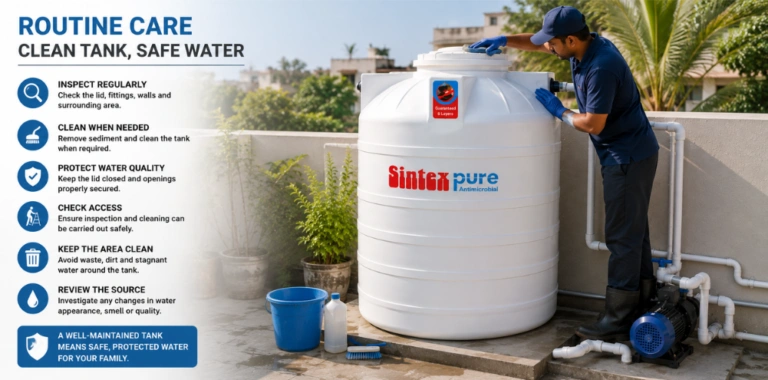
A practical maintenance routine can include:
- Inspect: Check the cover, fittings, walls and surrounding area.
- Clean: Remove sediment and clean the tank when required.
- Protect: Keep the lid closed and openings properly secured.
- Check access: Make sure inspection and cleaning can be carried out safely.
- Keep the area clean: Avoid waste, dirt and stagnant water around the tank.
- Review the source: Investigate changes in water appearance, smell or quality.
The way water is taken out also affects hygiene. A tap or controlled outlet reduces the need to dip hands, cups or other objects into stored water. The reason a lid matters is written into the standard itself: IS 12701 requires the lid to rest evenly on the tank rim specifically to prevent the ingress of insects, mosquitoes and dust, and to carry a locking arrangement. A lid resting loose on the rim meets neither condition.
Use the tank only for its intended purpose. Do not reuse containers previously used for fuel or chemicals for drinking-water storage.
These practices help keep the storage system in good condition. They do not remove contamination already present in the source water, so treatment may still be needed where the source is unsafe.
Urban vs. Rural Water Storage: What Are the Key Priorities?
Urban and rural households need protected storage, but their practical priorities can differ. Supply pattern, available space and expected storage time often shape the choice. The table highlights the main differences.
| Factor | Urban | Rural |
| Supply pattern | Often follows municipal schedules | May vary by season or local availability |
| Storage duration | Often linked to supply interruptions | Can be longer between supplies |
| Installation space | Often restricted, especially on rooftops | May offer more space in some locations |
| Capacity | Based on household demand and available space | May need more capacity for longer gaps |
| Contamination risks | Dust, insects and exposed rooftop conditions | Collection, transport, storage and external exposure |
| Cleaning access | Can be restricted by rooftop placement | Should allow practical household or community maintenance |
| Site exposure | Tanks may face direct sunlight, heat and rooftop weather conditions | Tanks may face dust, open surroundings and greater exposure to outdoor conditions |
For urban rural water storage, the priorities are not identical. Urban homes usually need efficient use of limited space, suitable rooftop installation and easy access for maintenance. Rural homes may place more emphasis on capacity, durability and protection during longer storage periods.
- Urban priority: Limited space, safe installation, adequate capacity and easy maintenance are key considerations for urban water storage solutions.
- Rural priority: Suitable capacity, durable construction, secure protection and practical cleaning access are key for rural water storage solutions.
How Can Modern Storage Solutions Support Water Safety?
Modern tank design can improve storage through durable materials, secure covers and practical construction. These features can reduce exposure to dust, insects and other external contaminants.
A well-fitted lid supports protected storage. Tank construction should also make inspection and cleaning practical. Accessible internal surfaces can make cleaning easier, while durable material can support longer service.
Blocking light is the one of the most useful things a tank wall does beyond holding water. Algae need light to grow, so a wall that lets daylight through will grow algae inside a tank holding otherwise clean water. IS 12701 addresses this directly: tanks meant for outdoor use must be manufactured from carbon black compounded polyethylene, with carbon black content between 2 and 3 percent. The same requirement applies to the lid. However, tank design is not a treatment method. A storage tank cannot remove bacteria, chemicals or other pollutants already present in unsafe source water.
Modern water storage tanks can be selected around the conditions of the site:
- Urban homes: Space-efficient designs can suit rooftops and compact service areas.
- Rural homes: Larger capacities and durable construction can suit longer storage needs.
- All settings: Secure covers and practical maintenance access support cleaner storage.
Modern water safety solutions can make storage more reliable and easier to maintain. A tank remains one part of a wider system that includes the source, treatment where needed and hygienic use.
Water Storage Solutions for Urban Settings
Urban options need to work with restricted space, rooftop installation and changing household demand. Capacity should be sufficient for supply gaps without making access difficult.
Water Storage Solutions for Rural Settings
Rural options should reflect local water availability, longer storage periods and expected demand. Durable construction, suitable capacity and easy maintenance can support reliable storage in homes and communities.
Also, Read: Types of Water Tanks for Homes and Commercial Spaces
Conclusion
Safe storage must fit how water is supplied and used. Urban homes may prioritise space, rooftop installation and access for maintenance, while rural households may need greater capacity and stronger protection during longer storage periods. In both settings, a suitable tank, secure cover and regular care help reduce avoidable contamination risks.
A tank is one part of household water safety. The source, handling, storage conditions and maintenance routine all contribute to the quality of water at the point of use.
Store drinking water in a clean, covered tank made from suitable material. Keep the tank protected from dust, insects and other contaminants, and inspect the lid, fittings and surrounding area regularly. Regular cleaning and hygienic handling also help keep stored water safer. These water safety solutions reduce contamination risks during storage.
Keep the tank securely covered and check the lid, inlet, outlet and other openings during inspections. Remove sediment when needed and keep the surrounding area clean. Using a tap or narrow outlet can reduce contact with the stored water. These steps support preventing water contamination in storage tanks.
Urban homes often face limited space, rooftop installation and scheduled water supply. Rural households may deal with seasonal availability, longer storage periods and greater capacity needs. The urban rural water storage approach should therefore reflect local supply patterns, household demand, installation conditions and access for maintenance.
There is no single cleaning interval for every tank. Water tank cleaning depends on the incoming water, sediment buildup, tank condition, usage and local conditions. Regular inspection helps show when cleaning is needed. Follow manufacturer instructions and local guidance when they specify maintenance requirements.
A suitable tank should have durable construction, a secure cover, enough capacity and practical access for inspection and cleaning. The material should be suitable for water storage, while the design should limit unnecessary exposure to external contaminants. These features support safer storage when combined with regular maintenance.
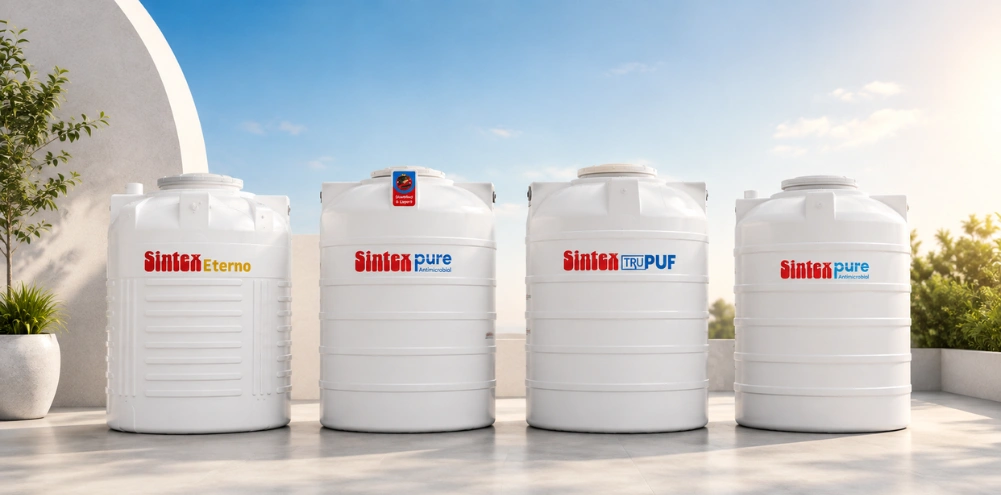
Sintex offers rotomoulded LLDPE tanks and blow-moulded HM-HDPE tanks for households, in capacities from 200 to 25,000 litres, plus underground sumps from 1,000 to 6,000 litres. For societies and institutions, SMC panel tanks reach up to 16,00,000 litres. Urban homes can choose urban water storage solutions based on space. Rural homes can consider rural water storage solutions for site needs.
Sintex water storage tanks use 100% food-grade virgin plastic, UV protection and, in selected models, antimicrobial or anti-algae features. These construction features help protect stored water and support hygienic storage when the tank is properly maintained.
The suitable Sintex tank depends on family size, expected water use, storage duration, available space and installation conditions. A household with regular supply may need less capacity, while a home facing longer gaps may require more. These factors should guide the choice of household water storage solutions.