
Table of Contents
A family of four today may not have the same water needs a few years from now. A new family member, an extra bathroom, more frequent washing or even a change in the water supply schedule can increase how much water a household needs to keep stored.
That is why choosing a water tank for home is not just about picking the biggest tank that fits on the terrace. You need to consider how much water your family uses, how often the supply comes in, and how much space is actually available for installation.
Planning the storage capacity around both present and likely future needs can save you from replacing the tank later or running short during supply gaps.
Key Takeaways
- Figure out tank capacity based on how many people live at home and what they actually use daily for bathing, cooking, washing, and cleaning.
- Check your area’s water supply schedule. Homes that get water less often usually need more storage to get through the gaps comfortably.
- Leave some room for change: a new family member, an extra bathroom, guests over the holidays, or just using more water than you do now.
- Measure the installation spot before buying, and make sure the surface underneath can actually hold the tank’s full weight once it’s filled.
- Bigger isn’t automatically better. Match the tank to what your household needs, the space you have, your area’s supply pattern, and your budget.
How Much Water Does a Family Need Every Day?
There’s no single number here. It really comes down to how many people live in the house, their habits, how big the home is, and how water gets to them in the first place.
Day to day, that water goes into drinking, cooking, bathing, washing clothes, mopping, cleaning dishes, flushing toilets, and pretty much everything else that keeps a home running.
The water supply pattern matters too. If your home receives water several times a day, you may not need to store as much as a household that gets a limited supply once a day or every few days.
For this reason, it is useful to look at your actual consumption rather than simply copying the tank size used by a neighbour.
A practical starting point is to track how much water your household uses over a few days. This gives you a better idea of the storage buffer you need when choosing a tank.
How to Calculate the Right Water Tank Capacity for Your Family
The basic calculation is quite straightforward:
Required tank capacity = Number of people × Estimated daily water use per person × Number of days of storage required
For example, suppose a family has four members and estimates its daily household requirement at 150 litres per person. That gives:
4 × 150 = 600 litres per day
If the household wants enough stored water for roughly two days:
600 × 2 = 1,200 litres
So a tank of around 1,200 litres would provide the calculated storage, subject to the home’s actual supply pattern and available tank sizes.
This is where a water tank calculator can speed up the calculation. However, treat the result as a planning estimate, not an exact amount.
You should also consider water used for guests, occasional higher consumption and changes in the household. At the same time, choosing a tank much larger than your real requirement can take up unnecessary space and may not offer much practical benefit.
When working out water tank capacity, look at both daily consumption and how long you need the stored water to last.
What Size Water Tank Is Best for a Family of 4?
There is no single water tank size for home that is automatically right for every four-member family.
Take two families of four. One may receive municipal water twice a day and have a relatively low daily requirement. Another may receive water for only a short period each day and need a larger backup.
Using the earlier example, four people consuming around 150 litres each per day would require about 600 litres for one day’s use. For two days of backup, the calculation comes to about 1,200 litres.
The tank you choose will depend on the available product capacity, installation space and supply pattern.
Sintex currently offers several household tank capacities, including 500, 750, 1,000, 1,500 and 2,000 litres in some of its ranges.
So rather than asking which tank size is “best” for every family of four, calculate your household requirement first and then choose the closest suitable capacity.

Should You Choose a Bigger Water Tank for a Growing Family?
Extra capacity can make sense if you expect your household’s water needs to increase.
Perhaps your family is likely to grow, you’re planning another bathroom, or your children are getting older, and household water use is changing. You may also have relatives or guests staying regularly.
In these cases, choosing a tank with extra capacity can reduce the need for an early replacement.
But bigger isn’t automatically better. An oversized tank takes up more space and may cost more without providing a useful advantage if your water supply is already regular.
The idea is to leave a reasonable buffer, not to store several times your normal requirement.
When considering water tank capacity, think about what your household is likely to look like over the next few years, not just today’s headcount.
Factors to Consider When Choosing Water Tank Capacity
Getting the right water tank capacity isn’t just about counting heads. A few other things matter just as much.
- Number of occupants. More people in the house usually means more water gets used, so this is where the calculation starts, but it’s rarely the whole picture.
- Daily water use. Drinking and cooking are only a small part of household consumption. Bathing, laundry, cleaning, and flushing toilets use far more water than most people expect.
- Supply frequency. If water comes into your home daily, you can get by with less backup. Homes dealing with irregular or infrequent supply need a bigger buffer to bridge the gaps.
- Available space. Measure where the tank will actually sit before you buy one. A tank might have the perfect capacity on paper, but if it doesn’t physically fit or can’t be installed safely, it won’t work.
- Climate and local conditions. Hot weather tends to increase water use, whether it’s more frequent bathing or extra drinking water. Local supply conditions in your area also shape how much backup makes sense.
- Future requirements. Think ahead a little. A growing family, a new bathroom, more appliances, or just changes in how the home gets used can all shift your water needs over time.
- Budget. Don’t just look at the tank’s price tag. Installation and any plumbing work that comes with it add to the real cost, so factor that in before deciding.
How Much Water Storage Is Enough for a Family of 6?
For six people, use the same calculation instead of choosing a tank based only on the family size.
For example, if each person uses an estimated 150 litres per day:
6 × 150 = 900 litres per day
For two days of storage:
900 × 2 = 1,800 litres
That gives you a starting point. Your actual requirement could be lower or higher depending on household habits and the local water supply.
This also shows why a fixed recommendation doesn’t work. A six-member household with frequent daily water supply may need a different water tank size for home from one where supply is available only on certain days.
If you’re planning for future changes, you can add a reasonable buffer after calculating your basic requirement.
Choosing Between a Single Large Tank and Multiple Tanks
A single large tank isn’t the only way to increase household storage. Depending on the building and plumbing arrangement, two or more tanks may be more practical.
| Single large tank | Simple storage arrangement | Needs enough space and suitable structural support |
| Multiple smaller tanks | Can work around space restrictions | More connections and maintenance points |
| Overhead tank | Convenient for gravity-fed distribution | Requires proper structural support |
| Ground-level tank | Useful where terrace space is limited | May need pumping equipment |
| Underground tank | Keeps storage out of sight and saves surface space | Installation requires suitable site conditions |
For a water tank for home, the choice should also take the plumbing layout into account. A large tank isn’t useful if the building cannot safely support it or if the plumbing needs extensive changes to accommodate it.
Sintex also offers underground FRP water tanks in capacities from 5,000 to 50,000 litres for larger storage requirements and suitable installations.
How to Make Your Home Water Storage Future-Ready
Future-proofing water storage is mainly about leaving enough room for sensible changes.
Start by looking beyond the current number of occupants. If you are planning an additional bathroom, expect a family member to move in or know that your local water supply is becoming less predictable, these changes should form part of your planning.
You can also review your storage requirement when your water usage changes. A family that once needed a smaller tank may need more capacity after an extension or a change in household size.
At the same time, don’t assume that future-proofing means buying the largest tank available. A better approach is to calculate your current requirement, add a reasonable buffer and check whether the installation area and plumbing can accommodate it.
That makes Future-Proofing Water Storage a planning exercise rather than simply a decision to buy a bigger tank.
Where Should You Install a Water Tank at Home?
The right location depends on the building and the plumbing design.
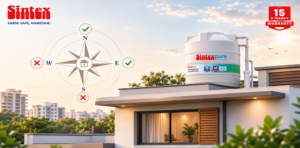
An overhead tank is common in Indian homes because stored water can be distributed through gravity. But the supporting structure must support the weight of a full tank.
A ground-level tank can work where terrace installation isn’t practical. Underground storage is another option when there is enough suitable space and the installation is properly planned.
Before installing a water tank for home, check:
- Whether the supporting surface can carry the filled tank
- Ease of access for cleaning and inspection
- Distance from plumbing connections
- Exposure to direct sunlight
- Space around the tank for maintenance
- Whether the location allows safe installation and replacement
The tank should be installed on a proper, level and adequately supported base. Avoid choosing a location based on available space alone.

How to Maintain Your Water Tank for Long-Term Use?
Even a good-quality tank needs sensible upkeep.
Clean the tank periodically according to your household’s usage and local water conditions. Check the lid regularly and make sure it stays properly closed so dust, insects, and other contaminants cannot enter.
It’s also worth looking at the inlet, outlet and other fittings for leaks or signs of damage. If you notice cracks, deformation or a loose connection, have the issue checked instead of waiting for it to become a larger problem.
Keep the area around the tank reasonably clean. Overhanging branches, accumulated dirt, and standing water around the installation area can create avoidable maintenance issues.
For long-term storage, hygiene depends on both the tank and the way the water system is maintained.
Why Choose Sintex Water Tanks for Your Home?
Once you know roughly how much storage your household needs, the next step is picking a water tank for the home that actually fits your capacity, space, and how you plan to use it.
Sintex has a broad range of water storage tanks for different household needs. Its current range includes products such as Sintex Pure, Pure Plus, Classic Double Wall, Neo, Smart and other models, with capacities varying by product.
For example, Sintex Pure Plus is available from 500 to 2,000 litres on its current product page and features 100% food-grade virgin plastic, a multi-ribbed design, a UV-protected threaded lid, and a 15-year warranty.
The Classic Double Wall range covers a much wider capacity range, with options listed from 500 litres upwards and larger capacities available for bigger requirements. It also carries a 10-year warranty.
For households looking for a more economical option, Sintex Neo is currently available in capacities from 200 to 1,000 litres. It includes features such as a multi-ribbed design, UV stability, anti-algae protection and food-grade virgin plastic.
You can browse Sintex’s water storage tank range and compare different models and capacities before deciding.
At the end of the day, the best water tank for home comes down to one that actually gives you the capacity you need, fits the space you’ve got, and matches what your household really uses.
Conclusion
Choosing the right water tank capacity starts with one question: how much water does your household need, and how many days should that stored water last?
Start with your family size, how much water you go through daily, and how often supply comes in. From there, factor in what might change down the road, how much space you’ve got, and what you’re willing to spend.
Sintex offers tanks across a range of capacities and models, making it easier to find something that fits your situation.
Multiply the number of people in your household by estimated daily water use per person and then by the number of days of backup you want. A water tank calculator can make this easier, but use the result as a planning estimate and adjust it to your actual water-use pattern.
There isn't one fixed size for either household. Calculate daily consumption first and then consider how often water is supplied. A family of four with frequent supply may need less storage than a family of six facing longer gaps. Your water tank size for home should reflect both factors.
The amount depends on household consumption and how long you need the stored water to last. Start with your daily requirement and multiply it by the number of backup days you want. Then consider guests, future household changes and the available installation space when finalising water tank capacity.
A slightly larger tank can be worth it if you're planning for more family members, another bathroom, or just heavier water use over time. That said, don't go oversized just to have extra storage sitting around. A water tank for the home should give you a reasonable buffer, not extra weight and space you didn't need to take on.
Look at the number of occupants, daily water consumption, local supply schedule, installation space and likely future requirements. Budget and plumbing layout matter too. Together, these factors give you a more useful estimate of water tank capacity than family size alone.
There isn't one best water tank for home that fits every growing family; it depends on your situation. Work out the capacity you need first, then look at Sintex's options based on how much space you have, what your household actually uses, and which features matter to you. The right water tank for the home is the one that fits your real requirements, not necessarily the biggest one on the shelf.