
Table of Contents
Many water tanks are described as food-grade, but the label alone gives buyers little information about the material, manufacturer, or certification behind the claim. Non-certified tanks often don’t comply with health guidelines, putting your water supply at risk for chemical contamination. Luckily, empowered buying is only a few practical steps away. Knowing how to verify food grade water tank details requires a few checks that can be completed in-store or before delivery. The five checks in this article explain how to locate and verify the BIS Standard Mark, examine material and batch information, inspect the tank’s smell and surface, and review the supporting documents before the purchase or installation.
Key Takeaways
- Locate the BIS Standard Mark, IS 12701, and a verifiable CM/L number.
- Verify the material declaration and manufacturer details.
- Inspect colour, odour, texture, and batch information.
- Match every certificate to the exact tank, factory, model, and current valid licence status.
What Does “Food-Grade” Actually Mean?
Food-grade plastic is material considered safe and suitable for contact with drinking water. It should not introduce substances that create a health risk or cause unacceptable changes in the water’s composition, taste, colour, or smell.
- Drinking water may remain against the tank walls for hours or days during normal household use.
- The resin, pigments, and additives therefore need to suit potable-water storage.
Learning how to identify food grade plastic tank construction begins with the material declaration and supporting test evidence. Food-grade status mainly addresses contact safety and migration. Finished-tank certification also checks construction, capacity, strength, finish, lid design, and product marking.
Check #1: Where Is the BIS Mark on a Water Tank?
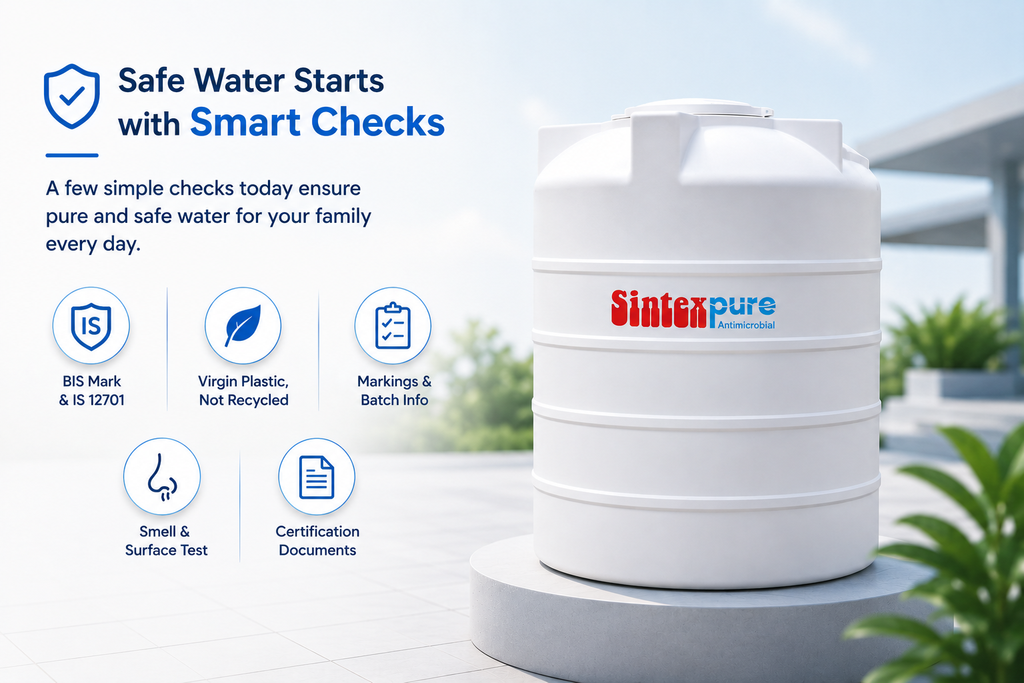
IS 12701 is the Indian Standard for rotational-moulded polyethylene water storage tanks. A BIS certified water tank check should begin with the BIS Standard Mark, the text “IS 12701,” and a licence number written in the CM/L format.
- Inspect the exterior wall, shoulder below the lid, moulded branding panel, and the area near the capacity marking.
- The exact position can vary by manufacturer and mould.
- The manufacturer name or trademark and declared capacity should appear permanently on the outer surface.
- Batch or lot details and the production year may appear nearby or on the product identification panel.
After locating the mark, record the CM/L number and verify it through BIS Care. Check that the licence belongs to the named manufacturer, covers IS 12701, matches the relevant factory, and remains valid. Phrases such as “made as per IS 12701” or “BIS quality” do not replace a verifiable Standard Mark and licence number.
Check #2: Confirm Virgin Plastic, Not Recycled
A virgin plastic vs recycled plastic tank check can begin with three visible signs: colour consistency, odour, and surface finish. Compare tanks of the same model under good light. Uneven colour, unexplained dark specks, gritty inclusions, patchy gloss, or rough areas deserve further questions.
- Open the empty tank in a ventilated space and check for a strong burnt, solvent-like, detergent, perfume, or musty smell.
- These odours may point to contamination, processing problems, or residue.
Note that visual and smell checks alone cannot prove the resin type absolutely, they are simply for preliminary guidance. A well-processed recycled material may appear consistent, while a manufacturing fault can affect virgin material. Ask for a written material declaration tied to the manufacturer and exact model.
Also, Read: Top 5 Reasons to Switch to a 100% Virgin Plastic Water Tank
Check #3: Inspect the Manufacturer Markings & Batch Information
If a tank’s certification relies on a sticker rather than being moulded into the plastic, be cautious. Genuine food-grade tanks carry permanent, moulded-in markings. The manufacturer’s trademark, model number, holding capacity, production year, lot/batch code, and BIS license number should be available.
For a food grade water tank certification check, compare every piece of on-tank data against your invoice, warranty documentation, brochure, and online BIS records. The company name, manufacturing site, and model specs must match without exception. Missing details and obscure product history make future warranty claims difficult. Spot any missing details? Pause delivery and demand confirmation from the seller first.
Check #4: Smell & Surface Test
Use this two-step inspection to look for signs of a genuine food grade water tank before purchase.
- Check the smell. Open the empty tank in a ventilated area. A strong solvent, burnt-plastic, detergent, perfume, or musty odour needs further investigation. A light new-plastic smell may occur, but does not confirm food-grade status.
- Inspect the surface. Examine the inner and exterior walls in bright light. Look for consistent colour, an even finish, and the absence of gritty particles or rough patches.
These checks can identify initial concerns, which can be investigated further with certification and traceable documents.
Check #5: Ask for the Certification Document
Knowing how to check if water tank is food grade includes reviewing the documents before payment. Ask the dealer for the BIS licence details for IS 12701, the CM/L number, product data sheet, material declaration, relevant migration or compliance report, warranty, and an invoice naming the manufacturer and model.
- Check that each document relates to the same company, factory, tank category, material, and current product.
- A report for another model or an expired licence does not verify the tank in front of you.
- Enter the CM/L number in BIS Care rather than relying on a photocopy, website badge, or loose sticker.
- A reliable seller should help complete this check before the purchase.
Common Misconceptions About Food-Grade Tanks
Choosing a food-grade water tank starts with separating marketing claims from real health standards. Let’s clear up some common misconceptions.
| Misconception | Correction |
| Are all plastic water tanks the same? | No. Tanks can differ in resin source, pigments, additives, wall construction, finish, and certification. Similar colour or shape does not confirm that two tanks meet the same requirements. |
| Does BPA-free automatically mean food-grade? | No. BPA-free addresses one substance. Food-grade suitability considers the complete material formulation, intended use, additives, and possible migration into stored water. Finished-tank certification also covers construction and performance requirements beyond a single chemical claim. |
| Does a clean or new appearance prove food-grade status? | No. A clean surface helps reveal visible defects, but it cannot confirm food-grade status. Learning how to know water tank is safe for drinking water requires permanent manufacturer details, batch traceability, a verifiable BIS licence where claimed, and supporting documents. Safe installation, a secure lid, clean source water, and regular scheduled maintenance also affect the quality of stored water. |
Conclusion
Verifying a food-grade water tank takes only a few minutes when you know where to look. Check the BIS mark and CM/L number, review the manufacturer details, and inspect the material and surface. These steps provide stronger evidence before the tank enters household use. Explore Sintex Pure for an example of a water tank that aces these material and construction checks.
Food-grade describes whether the material is suitable for contact with drinking water. BIS certification to IS 12701 assesses the finished tank across wider requirements, including construction, capacity, wall thickness, strength, finish, overall migration, lid design, traceability, and mandatory product markings.
Yes. A manufacturer may use food-grade material without holding BIS certification for the finished tank. Buyers should then request credible material declarations and test evidence. A food-grade claim by itself does not establish complete conformity with the construction and performance requirements of IS 12701.
Yes. Food-grade construction does not remove cleaning needs. Sediment, biofilm, insects, damaged lids, and contaminated incoming water can still affect storage. To avoid these, cleaning of the tank is required at regular intervals.
No. Price and branding alone cannot confirm suitability. A food grade water tank certification check should review manufacturer details, batch records, BIS licence information, and supporting documents. Signs of a genuine food grade water tank include traceable markings, consistent paperwork, and clear seller information.
Yes. Learning how to verify food grade water tank details after installation starts with the manufacturer name, capacity, batch number, IS 12701 marking, Standard Mark, and CM/L number. Complete a BIS certified water tank check through BIS Care and request matching documents from the seller.
No. Tank colour alone cannot prove material safety. Learning how to identify food grade plastic tank construction requires markings, material declarations, and certification evidence. A virgin plastic vs recycled plastic tank check can use colour consistency, odour, and surface texture only as preliminary indicators.