
UV-Stabilized Water Tanks vs Ordinary Plastic Tanks, Which Lasts Longer?
Share
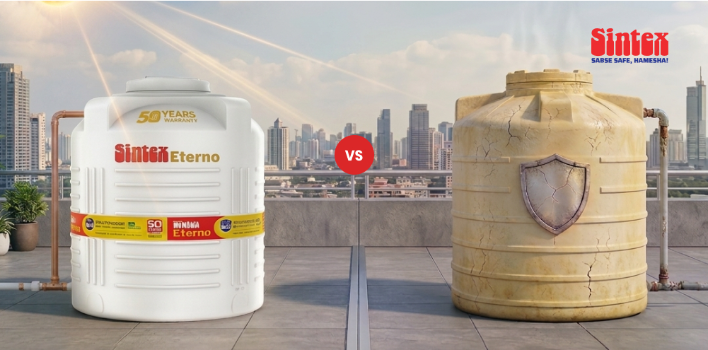
Table of Contents
Put any plastic object under an Indian rooftop sun for three straight summers and it’ll tell you everything about itself. The cheap chair that turned chalky by October. The bucket that cracked somewhere around its second monsoon. Plastic degrades under UV exposure, and a water tank sitting on a terrace takes that punishment every single day, year after year, without a break.
That deterioration isn’t just cosmetic. It’s structural. And it directly affects the water inside.
Key Takeaways
- UV radiation attacks polymer chains at a molecular level, causing brittleness and micro-cracking that leads to tank failure years before most buyers expect it.
- Built-in UV stabilizers run through the plastic itself and don’t degrade over time, unlike external covers that protect only the outer surface.
- Algae grows inside tanks partly because light penetrates ordinary plastic walls; UV-blocking layers reduce that light, slowing internal biological growth.
- A UV-stabilised water tank can outlast a regular plastic tank by nearly a decade under comparable sun exposure.
What UV Radiation Actually Does to Plastic
Plastics like HDPE, the material in most water tanks, consist of long polymer chains. UV-B radiation carries enough energy to snap those chains. Each break generates a reactive molecular fragment called a free radical, and that fragment immediately attacks neighbouring chains, setting off a cascading process called photo-oxidation.
Heat accelerates all of it.
A rooftop tank in Rajasthan, Maharashtra, or Tamil Nadu faces both forces simultaneously: sustained UV exposure through the day and surface temperatures that push well past 60°C on peak summer afternoons. Under those conditions, an unstabilised plastic tank starts accumulating damage almost from the moment it’s installed.
The chalking you see on an ageing tank isn’t grime. It’s degraded polymer migrating to the outer surface. By the time that shows up, the wall has already been structurally compromised for months.
How UV Stabilization Works
UV stabilizers aren’t a surface coating. They’re compounded into the plastic material during manufacturing, which means they run through the entire wall thickness.
Two mechanisms do the work. UV absorbers intercept incoming UV radiation and convert it to harmless heat before it can reach the polymer chains. Hindered Amine Light Stabilizers, commonly called HALS, handle what gets through: they scavenge the free radicals UV has already created and neutralise them before the chain reaction escalates.
Quality UV-stabilised tanks combine both. The result is that UV hits the outer wall and essentially stops there.
This isn’t proprietary technology; it’s industrial chemistry that’s been standard practice in automotive plastics and agricultural films for decades. What separates a UV-stabilised water tank from a regular one is simply whether the manufacturer built it in.
Watching a Regular Tank Age (Year by Year)
Year one, you genuinely can’t tell the difference. Both tanks look fine.
Somewhere in year two or three, ordinary plastic starts showing the early signs. Slight surface discolouration. A rougher texture on the outer wall. Water temperature inside the tank runs noticeably hotter on summer afternoons, though most people blame the weather rather than the tank itself.
Year four or five is where it gets costly. Micro-cracks develop near fittings and at the base, which are already the highest-stress points in the structure. The lid might start warping. Seals weaken. In some cases, you notice a faint smell that cleaning doesn’t fully resolve.
A UV-stabilised tank at the same age typically looks and performs close to how it did at installation. The divergence between the two isn’t subtle by this point.
Sintex backs its UV-stabilised models with a ten-year warranty. That’s a manufacturer staking a claim on performance, which matters more than marketing language.
The Algae Connection Nobody Talks About Enough
Algae needs two things: nutrients and light. Tank water supplies nutrients constantly. And ordinary plastic lets enough light penetrate its walls to support algae growth inside, especially in thinner-walled tanks or lighter-coloured models without UV-blocking pigmentation.
This is actually part of why the classic black tank earned its reputation. Carbon black pigmentation blocks light so effectively that algae couldn’t get the photosynthesis it needed. But black tanks absorb heat aggressively, which creates its own problem in summer.
UV-blocking construction in white or coloured tanks solves both sides of this. Sintex’s entire range of tanks is UV stabilized. The Sintex Eterno is one of our premium offerings, featuring advanced UV stabilization and high-durability construction specifically designed around longevity and ease of use. You get the light-blocking properties of a black tank without the heat absorption that comes with a fully black exterior. The tank is also ROHS-compliant, which means it meets European standards for restricted substances in materials, and boasts of NSF certification 61 and 372, ensuring lead-free and non-toxic water storage.
Dedicated antimicrobial tanks like the Sintex Pure Antimicrobial go further with active silver-based 4P protection targeting bacteria, viruses, fungi, and algae directly. But UV-blocking construction contributes meaningfully to hygiene even before you add any antimicrobial layer on top.
What About External UV Covers?
Some buyers ask about UV protection water tank covers: external wraps, shading structures, or reflective blankets placed over the tank to reduce sun exposure. They’re not useless. For a tank already in place that can’t be replaced, a cover offers some protection.
But it doesn’t replicate what built-in stabilization does.
A cover works on the outer surface. Heat still builds up inside. Light still enters through fittings, the lid seal, and inlet connections. And covers are themselves a maintenance item: they degrade, they blow off, they collect debris, they need replacing. The thing you bought to protect your tank now needs protecting.
Built-in UV stabilization runs through the material and doesn’t wear off. There are no gaps.
Water Quality: The Slow Consequence
Here’s one most people don’t consider. As plastic degrades under UV, the breakdown products don’t stay neatly inside the wall. Small oligomers and degradation compounds can leach into stored water, particularly in tanks that have been weathering for several years and already show visible surface changes.
The volumes involved are small. But for drinking water, the direction matters.
UV-stabilised tanks resist this degradation substantially over their lifespan. Less wall breakdown means less that can potentially reach the water. It’s one of those factors that’s invisible in daily use but compounds over years of consumption.
Which Sintex Tanks Carry UV Stabilization?
All of them, as a baseline. Sintex treats UV stabilization as a standard construction requirement rather than a premium tier. Several models extend this with additional protection suited to different needs.
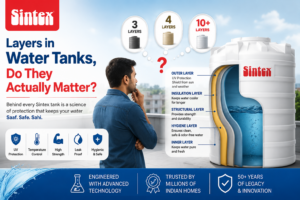
The Sintex Hero, as mentioned, uses a multi-layer construction with a dedicated light-blocking middle layer, 100% UV stability throughout, and even a UV-protected threaded lid. It’s available in 500L, 1,000L, 2,000L, and 5,000L capacities. For buyers whose main concern is rooftop heat rather than light penetration, the Sintex Trupuf adds 50mm PUF insulation alongside UV stabilization, which keeps stored water temperature significantly lower during peak summer. The Sintex Titus pairs UV protection with a multi-ribbed exterior structure that adds physical strength to the wall, useful for tanks at larger capacities. And for conditions beyond just UV, the Sintex Tatva targets broader extreme-weather resilience.
The full Sintex water tank range covers household capacities well beyond 10,000 litres, all with UV-stabilised construction standard.
The Actual Bottom Line
A regular plastic tank isn’t a bad product in year one. It just has a much shorter useful life when it lives on an Indian rooftop.
The price gap between a UV-stabilised water tank and a regular water tank at the point of purchase is relatively modest. The gap in how long each one lasts is not. Add in water quality considerations and the cost of a mid-decade replacement, and the choice becomes fairly clear.
UV stabilization matters because the conditions Indian rooftop tanks face are among the harshest in the world. A tank built to handle that will still be performing a decade after an ordinary one has cracked, chalked, and been carried down from the roof.
A UV-stabilized water tank uses UV stabilizers compounded directly into the plastic during manufacturing, not as a coating. These additives, including UV absorbers and HALS, neutralize UV-B radiation before it breaks down polymer chains. Ordinary tanks lack this protection entirely. Sintex builds every tank with UV stabilization as a standard requirement, never a premium add-on. That single difference decides whether a tank chalks and cracks within years or holds its strength for a decade.
A UV-stabilized water tank built to standard like Sintex's range can last well over a decade under regular rooftop exposure. Compare that to an unprotected tank, which often shows cracking and discoloration by year four or five. Sintex backs its UV-stabilized models with a ten-year warranty, a number that reflects real-world testing rather than marketing optimism. The actual gap often runs even wider. Indian summers are brutal on rooftop plastic, and stabilized tanks handle that punishment by design.
Yes, and the difference shows up fast once both tanks face real sun exposure. A UV-stabilized water tank resists chalking, cracking, and the slow leaching of degraded plastic into stored water. A regular tank starts breaking down within two or three years under Indian rooftop conditions. The price difference at purchase is small. The difference in lifespan, performance, and water safety is not. For anyone keeping a tank exposed to direct sunlight, UV stabilization isn't optional. It's the deciding factor.
Absolutely, sunlight damages plastic water tanks consistently, not occasionally. UV-B radiation breaks down polymer chains inside the tank wall, triggering a chain reaction called photo-oxidation. Heat speeds this up further, and rooftop surface temperatures in India routinely cross 60°C in summer. The damage starts long before you notice chalking or discoloration on the surface. By the time symptoms show, the wall has already weakened structurally. UV-resistant water storage tanks prevent this entire process from the inside out.
Yes, though the effect builds slowly rather than appearing overnight. As UV radiation degrades the tank wall over years, small amounts of broken-down plastic compounds can leach into the stored water. This matters most in older, unstabilized tanks that already show surface wear. A UV protected water tank slows this degradation, which keeps the wall intact and limits what reaches the water. The volumes involved stay small. But for drinking water consumed over years, that direction matters.
For Indian heat, a UV-stabilized water tank with added insulation works best. The Sintex Trupuf combines UV stabilization with 50mm PUF insulation, which keeps stored water noticeably cooler during peak summer afternoons. The Sintex Hero suits buyers more worried about algae and light penetration, thanks to its multi-layer construction. Either option beats a standard tank by a wide margin. Hot climates punish unprotected plastic fast. A UV resistant water storage tank handles exactly that fight.