

Table of Contents
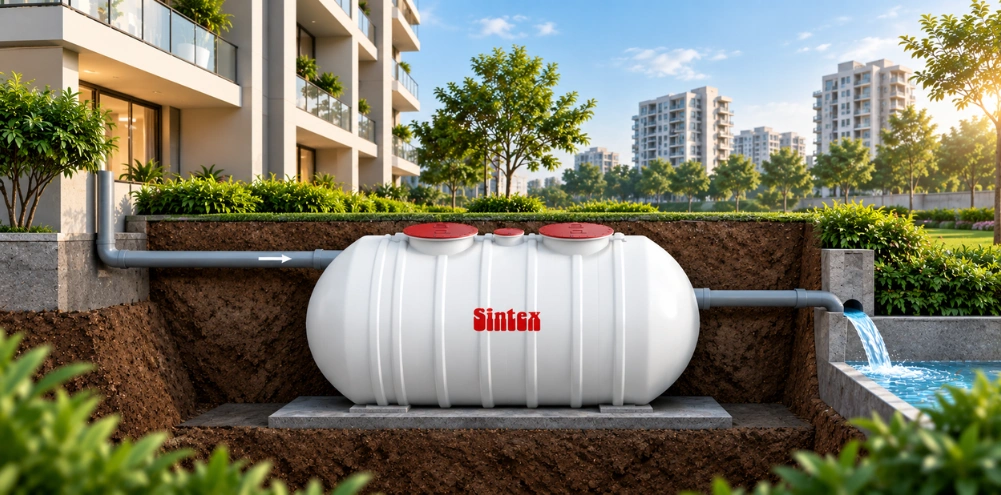
Managing sewage at building level involves more than moving wastewater out of sight. Space, treatment quality, reuse goals, maintenance access, operating cost and compliance all affect the choice of system. A packaged sewage treatment plant offers one on-site approach where decentralised treatment suits the project. It combines key treatment stages in a pre-engineered arrangement that can reduce the amount of treatment infrastructure built entirely on site. The right wastewater treatment approach ultimately depends on sewage generation, required outlet quality, available space, discharge or reuse plans, and the building’s ability to operate the system consistently. In this article, we explain how packaged STPs work and what to consider before selecting a wastewater treatment system for a building.
Key Takeaways
- A packaged STP treats building sewage on site through a defined sequence of treatment stages.
- Capacity should be based on occupancy, sewage generation and peak conditions, rather than building area alone.
- Footprint must include access for equipment, ventilation, cleaning and future maintenance.
- Treated water may support approved non-potable reuse when required quality limits are met.
- Long-term performance depends on regular operation, monitoring and maintenance.
What Is a Packaged Sewage Treatment Plant?
A packaged sewage treatment plant is an on-site system designed to treat domestic sewage close to where it is generated. Its treatment stages are arranged in a pre-engineered unit or group of units, with the aim of producing treated effluent that meets the requirements applicable to the project and intended discharge or reuse.
- Compared with a larger conventional civil-built treatment plant, a packaged system generally reduces the amount of treatment infrastructure that must be designed and constructed entirely on site.
- Tanks, biological treatment components, pumps, blowers, controls and disinfection equipment may be integrated into a compact sewage treatment plant configuration, depending on the technology.
The term “packaged” describes how the system is configured and supplied. It does not mean that every plant is small, requires little maintenance or suits every building. Capacity, treatment process, footprint and operating needs vary by project.
A packaged system is most useful when the design matches the expected sewage load, required treated-water quality, available installation area, operating capability and local regulatory conditions. The building team should also understand who will operate the plant and how routine service will be managed after commissioning.
How a Packaged STP Treats Building Wastewater
A packaged STP treats sewage through a sequence of physical, biological and, where required, disinfection steps. The exact process varies by technology, but the treatment journey commonly includes the following stages.
- Collection: Sewage from toilets, wash areas and other connected fixtures reaches the treatment system through the building drainage network.
- Screening and pre-treatment: Screens or similar components remove larger solids and debris that could clog pumps, pipes or downstream treatment equipment.
- Biological treatment: Microorganisms break down biodegradable organic matter in the wastewater. Many systems use aeration to supply the oxygen needed for this process.
- Separation: Treated water is separated from biological solids. The method may involve settling, filtration, media or membranes, depending on the wastewater treatment technology.
- Disinfection: Treated water should undergo chlorination, ultraviolet treatment, ozonation or another disinfection process, as per end use requirements.
- Sludge handling: Solids generated during treatment need to be collected, stabilised or removed according to the system design.
- Treated-water storage: The final effluent may be stored for approved reuse or directed to the permitted discharge route.
Each stage has a practical purpose. If screening is neglected, equipment can clog. If biological treatment is overloaded or poorly aerated, outlet quality can deteriorate. A packaged system therefore depends on correct loading, operation and maintenance.
Where Packaged STPs Make Sense in Buildings
A sewage treatment plant for building projects can be appropriate where sewage needs to be treated on site because of project requirements, limited access to central sewerage, planned water reuse or the scale of the development.
Typical applications can include apartment complexes, gated communities, commercial buildings, hotels, hostels, hospitals, educational campuses, malls and mixed-use developments.
- Sewage treatment systems for offices and malls need to handle stronger day-night peaks and swings.
- An STP for residential complex projects may need decentralised treatment where a large resident population generates a steady daily sewage load and treated water can be reused for approved non-potable purposes.
- Hotels and hostels generate wastewater across longer operating hours, and hospitals, schools and campuses may have distinct flow patterns linked to their activities and occupancy.
Suitability also needs to be assessed for each site. A residential tower, office building and hotel can have very different daily flow patterns even when their built-up area is similar. Occupancy, water consumption, peak use, wastewater characteristics and required outlet quality all influence the design.
A packaged system also needs adequate access for installation, equipment servicing, sludge removal and future maintenance. Projects with limited plant-room space may benefit from a compact configuration, provided access is preserved. The decision should therefore consider both treatment capacity and the building’s ability to support the system throughout its operating life.
Also Read: Types of Drainage Pipes: Which Is Right for You?
Also Read: Types of Drainage Pipes: Which Is Right for You?
Key Benefits of a Packaged STP
A packaged STP can offer practical advantages in scenarios where a decentralised treatment system fits the project requirements.
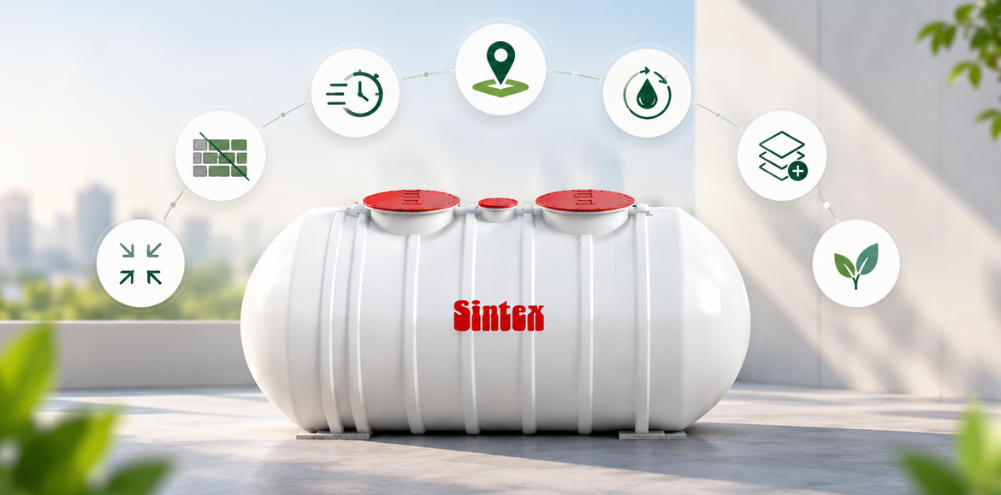
- Compact footprint: Pre-engineered treatment stages can reduce the space needed compared with layouts that rely on larger site-built treatment structures.
- Reduced on-site civil work: Factory-built or pre-engineered components can limit the amount of treatment infrastructure constructed entirely at the project site.
- Faster deployment: Where site readiness and approvals are in place, pre-engineered equipment can shorten installation compared with highly civil-intensive construction.
- On-site treatment: Sewage can be treated close to the point of generation, which can support local discharge or planned reuse arrangements.
- Potential water reuse: Treated effluent can be reused for approved non-potable applications when it meets the required water-quality limits.
- Modularity: A modular sewage treatment plant can allow staged capacity or future expansion where the selected technology and site layout support it.
These benefits are project-dependent. A packaged system still requires correct sizing, utility connections, access, operation, monitoring and maintenance. It also needs an appropriate discharge or reuse route for the treated water and a practical plan for sludge removal.
How to Plan the Right STP Capacity for a Building
The capacity of a sewage treatment plant for building use should be based on expected wastewater generation, not the building’s floor area alone. Two projects of similar size can need different capacities because occupancy and water-use patterns differ.
- Start with the design population and the water-consumption basis applicable to the project.
- Estimate how much of that water returns to the sewer as wastewater, then account for daily variation, peak flows, future occupancy and the assumptions required by the relevant authority or design standard.
- For residential projects, sewage generation is often estimated using per-capita water consumption and the proportion expected to return as wastewater.
- The final packaged sewage treatment plant capacity should be based on the approved project design assumptions, expected occupancy, and site-specific requirements.
Residential Buildings
For a sewage treatment plant for residential building projects, resident count, expected occupancy and daily wastewater generation are central inputs. A partially occupied development may generate much less sewage initially than it will at full occupancy, so both current and future loads need consideration. Low-load operation can also affect biological treatment performance.
Commercial and Institutional Buildings
A packaged STP for offices, hotels, malls, hospitals, schools or institutions must reflect their different wastewater patterns. Hotels and hospitals may operate throughout the day, while offices can have stronger daytime peaks. Kitchens, laundries or other facilities may also change wastewater characteristics. Capacity should therefore be based on expected flow and load profiles, not a generic building-size rule.
Space, Installation and Site Planning
A compact sewage treatment plant can reduce the treatment footprint, but the equipment layout is only one part of the space requirement. The installation also needs safe access for operation, servicing and sludge handling.
Site planning should check:
- the footprint of tanks and treatment units
- access around pumps, blowers, filters and control panels
- ventilation for enclosed or underground areas
- inlet and outlet levels so wastewater can move through the system as designed
- electrical supply and safe cable routing
- access for cleaning, inspection and desludging
- space for chemical or disinfection equipment where applicable
- routes for replacing major equipment
- allowance for future expansion where required
A modular sewage treatment plant may offer flexibility in layout or capacity, but modules still need adequate service clearance and interconnections. Underground installation can save visible surface space, but access covers, ventilation and equipment removal routes remain necessary.
It is useful to assess the operational footprint as well as the structural footprint. A plant that fits on a drawing may still be difficult to maintain if operators cannot safely reach valves, blowers, pumps or desludging points. Site planning should therefore be completed with long-term maintenance in mind. Provision for drainage, safe lighting and access during equipment failure can also make routine operation easier for the facilities team.
Treated Water Reuse: What Can the Output Be Used For?
One benefit of wastewater treatment at building level is the potential to reuse treated effluent instead of using fresh water for every purpose. The permitted use depends on the quality achieved and the requirements that apply to the project.
| Non-Potable Use | Treated Water Application | Requirements |
| Toilet flushing | Supplying WCs and urinals in apartments, offices, hotels and institutions | Disinfection quality, separate non-potable distribution network |
| Landscaping and horticulture | Irrigating lawns, gardens, green belts and planted common areas | Irrigation-quality and suitability for the vegetation |
| Cleaning and washing | Washing paved areas, parking zones, service yards and selected common outdoor surfaces | Quality for cleaning and potential human contact |
| Vehicle exterior washing | Washing facility vehicles, service fleets or vehicles in designated wash areas | Controls around spray or operator exposure |
| Construction and dust control | Dust suppression and other approved non-potable construction activities | Project requirements for intended construction use |
| Fire protection | Supplying designated fire-water storage or hydrant systems where permitted | Fire-safety requirements, storage arrangements |
| Cooling and utility systems | Cooling-tower make-up or other suitable facility utilities | Water chemistry, scaling, and corrosion |
| Non-contact water features | Ponds or water features where people are not expected to come into direct contact with the water | Odour, mosquito-control and public-exposure |
The required quality can differ by end use as treated sewage is not automatically potable water. Passing sewage through sewage treatment solutions does not automatically make the output suitable for drinking, cooking or other potable uses unless it undergoes the additional treatment. Reuse planning should therefore begin with the intended end use and the water-quality standards that apply to it.
Also Read: Benefits of Using UPVC Piping to Supply Reclaimed Water
Operating and Maintenance Requirements
A packaged STP needs routine attention to maintain treatment performance. Its operating plan should cover the biological process, electromechanical equipment, sludge handling, water-quality checks and maintenance records.
Typical tasks include
- inspecting screens and pre-treatment units
- checking pumps, vents, and blowers
- monitoring tank levels
- cleaning filters or media where required
- removing accumulated sludge
- checking disinfection equipment
- testing treated-water quality at the required intervals.
Operators should also record faults, maintenance work, consumable use and test results. Manufacturers should provide operating instructions, recommended service intervals and desludging guidance for the selected sewage treatment solutions. The building team also needs to know which tasks require trained service personnel. A packaged system is therefore not maintenance-free. Long-term performance depends on consistent operation and service.
Energy Use
Electricity use depends on plant capacity, treatment technology, operating hours, aeration demand, pumps and equipment efficiency. Aeration can be a significant load in biological systems. Instead of relying on a generic figure, ask the supplier for the expected kWh per day at stated operating conditions, along with the connected load and operating assumptions.
Odour and Noise Management
Odour can increase when sewage becomes septic, aeration is inadequate, solids accumulate, or maintenance is delayed. Good ventilation, correct loading and timely sludge removal help manage these conditions. Noise is usually associated with equipment such as blowers and pumps, so equipment location, isolation and maintenance should be considered during design.
Common Operational Problems to Watch For
A packaged sewage treatment plant can show early signs when its process or equipment is not operating as intended. Responding early can prevent a minor fault from becoming a larger wastewater treatment problem.
| Warning Sign | Possible Issue |
| Persistent odour | Low aeration, septic conditions, excess solids or delayed maintenance |
| Cloudy or poor-quality outlet | Process upset, solids carry-over or overloading |
| High-level alarms | Pump failure, blockage or hydraulic problem |
| Excess sludge | Inadequate sludge removal or process imbalance |
| Blower fault | Reduced aeration and weaker biological treatment |
| Frequent clogging | Poor screening or excessive solids entering the plant |
| Sudden performance decline | Hydraulic or organic overload, equipment failure or process disturbance |
Isolated warning signs do not necessarily prove one specific cause. The operator should check the system conditions, equipment status, flow pattern and treatment parameters before deciding on corrective action.
Hydraulic overloading deserves particular attention. If more wastewater enters than the system is designed to treat, retention time can fall, and solids may be carried into later stages. Repeated overloading can reduce outlet quality and increase stress on pumps, blowers and sludge-handling systems.
Compliance and Water-Quality Considerations
A sewage treatment plant for building projects must be planned around the discharge, reuse and building requirements that apply to that specific site. These requirements can vary by state or Union Territory, local authority, project type, plant capacity, discharge route and intended treated-water use.
The required outlet parameters may also differ according to whether treated sewage is discharged, reused for flushing, used for landscaping or directed to another approved application. A single generic water-quality figure should therefore not be used as the compliance target for every project.
- Before finalising the plant, the project team should identify the relevant pollution-control authority, municipal or building authority and any project-specific environmental conditions.
- Consent to Establish, Consent to Operate or other permissions may apply depending on the project and jurisdiction, but the exact approval route should be confirmed locally.
- The supplier’s performance specification should then be checked against the applicable limits.
- Sampling points, testing frequency, laboratory requirements and record-keeping expectations should also be established before operation begins.
When assessing sewage treatment plant environmental impact, the project should consider treated-water quality, sludge handling, energy use, odour control and the final discharge or reuse route. Compliance is easier to manage when these requirements are incorporated into the design instead of being addressed after installation.
Packaged STP vs Conventional STP: Which Approach Fits the Project?
A packaged sewage treatment plant and a conventional civil-built STP can both treat building wastewater, but they differ in how the treatment system is configured, constructed and expanded. The right approach depends on capacity, site conditions, treatment requirements and project constraints.
| Factor | Packaged STP | Conventional/Civil-Built STP |
| Footprint | Often compact | Depends on process and site layout |
| Civil work | Generally lower for treatment structures | Greater site-built civil component |
| Modularity | Often available where designed into the system | Usually project-specific |
| Installation | Pre-engineered components can reduce site work | More construction occurs on site |
| Maintenance | Routine O&M still required | Routine O&M still required |
| Scalability | Possible with suitable modular design and available space | Can be engineered for expansion |
| Typical suitability | Decentralised or building-level projects where capacity and site conditions fit | Bespoke, larger or highly site-specific treatment requirements |
A compact sewage treatment plant can be attractive where space and installation time are constrained. Pre-engineered units can also simplify coordination where a project prefers a defined equipment package with known interfaces. The available footprint still has to include access for maintenance, ventilation, sludge removal and equipment replacement.
A conventional civil-built plant can provide greater freedom to configure tanks and treatment stages around a larger or highly site-specific requirement. That flexibility can be useful where the influent load, hydraulic pattern, site geometry or expansion strategy calls for a bespoke arrangement. It can also involve more design coordination and site construction.
- Operating responsibility deserves equal attention in both approaches.
- Pumps, blowers, biological treatment, sludge handling and water-quality monitoring still require routine management.
- A packaged system may arrive in a more integrated form, but its performance remains tied to loading, utilities and maintenance.
The comparison should therefore focus on the project. Review treatment capacity, civil requirements, available space, outlet quality, operator capability, energy use, maintenance access, expansion plans and lifecycle service before deciding which configuration fits better. Ask suppliers to explain the assumptions behind footprint, installation time and scalability so that comparisons are made on equivalent project conditions.
Also Read: STP vs ETP: What’s the Difference and Which One Do You Need?
How to Choose the Right Packaged STP
Choosing a packaged STP starts with defining what the system must achieve over its operating life. A low purchase price or small footprint is not enough if the plant cannot consistently handle the expected sewage load or meet the required outlet quality.
Use the following decision checklist:
- Design capacity: Confirm average flow, peak conditions, occupancy assumptions and future load.
- Influent characteristics: Check whether kitchens, laundries, commercial activities or other sources change the expected wastewater load.
- Treatment technology: Understand the process used and whether it suits expected flow variation and operator capability.
- Required output quality: Match the process to the intended discharge or reuse requirement.
- Footprint and access: Include maintenance clearance, ventilation, desludging and equipment replacement routes.
- Energy use: Ask for expected daily electricity consumption and the assumptions behind it.
- Maintenance requirements: Understand routine checks, service frequency, consumables and operator involvement.
- Sludge handling: Confirm how often sludge is expected to be removed and how it will be managed.
- Automation and alarms: Check what the control system monitors and what happens during faults.
- Service support and expansion: Review warranty, spare parts, technical support and whether capacity can be expanded.
- Compliance: Confirm that the proposed sewage treatment solutions can meet the project’s required outlet standards.
Also ask what operating conditions the supplier’s performance commitment assumes. Flow, influent quality, aeration, power availability and maintenance can all affect results.
Questions to Ask an STP Supplier Before Finalising the System
Before ordering a packaged sewage treatment plant, ask the supplier for enough detail to test whether the proposal matches the real project conditions.
Useful questions include:
- What average and peak flow is the design based on?
- What occupancy and sewage-generation assumptions have been used?
- What treatment process is proposed, and why is it suitable for this wastewater?
- What treated-water quality is expected under the stated design conditions?
- What total footprint is required once service access is included?
- What connected load and expected daily electricity consumption are assumed?
- How often are sludge removal, routine servicing and water-quality tests required?
- Which consumables and replacement parts are needed?
- What happens during low occupancy, sudden peak loads or power interruptions?
- What warranty applies to tanks, controls and electromechanical equipment?
- What service support and annual maintenance options are available?
- Can the system be expanded later if occupancy increases?
- Are comparable reference installations available for review?
These questions help compare proposals on design assumptions and long-term operating requirements, rather than equipment price alone. It is also useful to ask who is responsible for commissioning, operator training and performance checks during the initial stabilisation period after start-up.
Sintex Packaged Sewage Treatment Plants
Sintex Packaged Sewage Treatment Plants provide a compact, decentralised approach to sewage treatment for residential, commercial and institutional projects. The range covers capacities from 10 KLD to 650 KLD, making it suitable for projects with different daily sewage loads.
Built using FRP, Sintex packaged STPs can be configured for on-ground or underground installation, helping project teams work around different site and space constraints.
- Applications include townships, hotels and resorts, hospitals, educational institutions, commercial complexes, malls, IT parks, data centres and public utilities.
- The treatment configuration combines stages such as solid separation, anoxic treatment, MBBR aeration, sedimentation and tertiary treatment.
- A variety of capacity options help scale and accommodate different project requirements.
- The system can support on-site treatment of domestic wastewater, with treated effluent potentially reused for approved non-potable applications such as irrigation and cleaning, subject to the required water-quality standards.
When selecting a packaged sewage treatment plant, match the required capacity with the project’s sewage load, available footprint, treatment target, reuse plan and operating needs. For detailed capacity, configuration and technical information, explore Sintex Packaged Sewage Treatment Plants and Sintex product range catalogues.
Conclusion
A packaged STP can be a practical wastewater treatment option when its design is matched to the building rather than selected from a generic capacity rule. Sewage load, available space, outlet-quality requirements, planned reuse, energy use, sludge handling and maintenance capability all influence long-term performance. Project teams should also confirm the applicable discharge, reuse and approval requirements before installation. Comparing suppliers on design assumptions, operating needs and documented performance helps identify a system that can support the building throughout its expected occupancy and operating conditions.
A packaged sewage treatment plant does not have one fixed lifespan. Tank material, corrosion exposure, treatment technology, operating conditions and maintenance all affect service life, while pumps, blowers and controls may need replacement earlier than structural components. Ask the supplier for expected service life and replacement intervals for each major component.
A packaged STP’s electricity consumption varies with capacity, treatment process, aeration demand, pump duty, operating hours and equipment efficiency. Rather than using a generic figure, ask the supplier for the expected kWh per day under stated loading conditions, together with the connected electrical load and assumptions used to calculate consumption.
A packaged STP needs routine monitoring and scheduled maintenance throughout operation. Screens, pumps, blowers, controls, disinfection equipment and sludge levels may require checks at different intervals. The exact maintenance frequency should follow the manufacturer’s O&M schedule, plant loading, treatment technology and the water-quality monitoring requirements applicable to the project.
Yes, treated STP water can be reused for toilet flushing and landscaping when it meets the water-quality requirements for those intended uses. The required treatment and disinfection can vary by application. Reused water should also be kept separate from the building’s potable-water distribution system.
Odour problems in a packaged sewage treatment plant can develop when wastewater becomes septic, aeration is inadequate, solids accumulate, the plant is overloaded, or maintenance is delayed. Poor ventilation can make the problem more noticeable. Persistent odour should prompt checks of loading, sludge levels, aeration, pumps and the biological treatment process.
An overloaded packaged STP may experience reduced treatment time and an unstable biological process when inflow or pollutant load exceeds its design basis. This can lead to poorer outlet quality, solids carry-over, odour or equipment stress. Repeated overloading may require operational changes, load management or additional treatment capacity.
The capacity of a packaged STP can sometimes be expanded later. Expansion depends on whether the original system is modular, whether the site has enough space and whether hydraulic, electrical and treatment components can support additional flow. If future occupancy may rise, expansion should be considered during the initial design.
Sintex offers packaged STP options for residential, commercial and institutional buildings, with capacities from 10 KLD to 650 KLD. The range includes on-ground and underground configurations. Check the official Sintex product page or technical literature for the treatment process, footprint and specifications of the required capacity.
The right Sintex packaged STP capacity depends on the building’s design population, expected sewage generation, peak conditions, future occupancy and required treated-water quality. Compare these requirements with the documented Sintex capacity range, while also considering site space, treatment process, reuse or discharge needs, maintenance access and applicable project approvals.
Sintex packaged STP specifications, maintenance requirements and technical details are available on the official Sintex Packaged Sewage Treatment Plant page and in available catalogues and brochures. Review the capacity, installation configuration, treatment process and operating requirements for the selected model before finalising the specification.


