
Benefits of Using UPVC Piping to Supply Reclaimed Water
Share
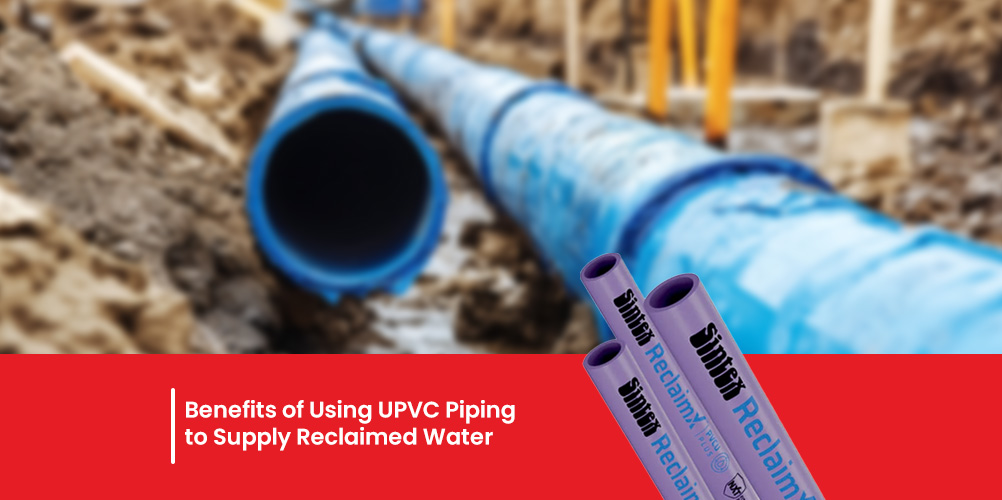
Table of Contents
Water recycling has moved well past the stage of being a sustainability talking point. Across Indian cities, commercial complexes, residential townships and industrial facilities are building dual-supply systems where treated wastewater handles non-potable loads separately from the drinking water network. Toilet flushing, cooling systems and landscape irrigation are all workloads that don’t need potable-grade water.
But reclaimed water isn’t simple to transport. The treated effluent in these pipelines carries residual chlorine, variable pH, and trace organic compounds, all of which affect pipe materials differently over time. Sintex’s ReclaimX UPVC pipes are built specifically for these conditions. As part of a broader range of plastic pipes designed for water infrastructure, ReclaimX pipes provide the chemical resistance, surface hygiene, and long service life that reclaimed water distribution genuinely demands.
Key Takeaways
- Reclaimed water carries residual chlorine, variable pH, and trace organic compounds that corrode metal pipes and degrade standard PVC over time; UPVC is chemically inert to all of these.
- Dual-supply systems using reclaimed water for non-potable loads can cut a building’s potable consumption by 30 to 40 percent, with ongoing cost savings that offset the infrastructure investment.
- Purple is the recognised colour designation for reclaimed water pipelines, and using it in dual-supply systems prevents cross-connection with the potable network.
- CPVC’s higher temperature rating offers no advantage in reclaimed water systems and only adds cost per metre; UPVC is the correct specification here.
Why Reclaimed Water Matters?
Not every water application needs drinking-water quality. Flushing a toilet, running a cooling tower, or watering a municipal park works just as well with treated wastewater, and routing reclaimed water to these uses avoids drawing from the potable supply for functions that don’t require it.
The efficiency gains are real. Dual-supply systems can cut a building or estate’s potable consumption by 30 to 40 percent. For water-stressed regions across peninsular India, where seasonal shortages are a practical reality rather than a distant risk, that kind of reduction has genuine operational value.
Cost is a factor too. Reclaimed water is typically cheaper to access than treated potable supply. For projects where long-term water costs matter housing complexes, industrial estates, civic bodies, a well-built reclaimed water network delivers ongoing savings that offset infrastructure investment over time.
Why Choosing the Right Pipe Material Matters?
Reclaimed water has a different chemical profile from tap water. Treatment processes leave residual chlorine, dissolved organics, sulfates, and occasional turbidity in the supply. These don’t disappear between the treatment facility and the delivery point.
Different pipe materials respond to this chemistry differently, and not all of them hold up well. Galvanised steel corrodes under sustained chlorine contact. Standard PVC grades can soften or crack when pH fluctuates outside a narrow range. Concrete systems develop internal scaling from mineral deposits, steadily narrowing the bore over years of use.
The consequences of a poor material choice aren’t always visible immediately. Degradation is gradual. By the time it shows up as reduced flow, burst sections, or failed joints, the damage has been building for years. Correct material selection at specification stage is what determines long-term maintenance costs, system reliability, and water quality at the point of use.
What are the 5 Key Benefits of uPVC Piping for Reclaimed Water?
uPVC has been a standard pipe material in water supply, drainage, and industrial applications for decades. In reclaimed water systems, its characteristics are particularly well-matched to what the application actually puts the pipe through every day.
1. Chemical Resistance Suited to Treated Effluent
Treated wastewater carries chlorine residuals, sulfates, sodium hypochlorite, and trace organic compounds as standard. uPVC is chemically inert to a wide range of these substances. The pipe doesn’t thin, develop internal deposits, or lose structural integrity under the chemical conditions typical of reclaimed water. That’s one of the core benefits of using uPVC pipes in this context. Metal pipes carrying the same water show measurable corrosion within years. uPVC shows none.
2. Smooth Bore for Hygienic Water Transport
The internal surface of a uPVC pipe is smooth and non-porous. In reclaimed water lines, where biological content in the supply is higher than in potable networks, this matters considerably. Rough or corroded pipe interiors give biofilm a surface to grip. Once biofilm establishes itself, clearing it typically requires chemical treatment and system downtime. The smooth bore of uPVC makes that attachment significantly harder, keeping the pipeline cleaner through normal operating cycles and reducing how often chemical flushing becomes necessary. Sintex ReclaimX pipes are designed with this surface characteristic as a core property.
3. Long Operational Life and Corrosion Immunity
Put a metal pipe in contact with chlorinated or mineralised water for long enough and it will corrode. Protective linings slow this down but don’t stop it entirely. uPVC doesn’t rust, doesn’t oxidise, and doesn’t react with the soil conditions around buried sections. A correctly specified uPVC installation typically runs for 50 years without losing meaningful flow capacity. On a full lifecycle basis, few recycled water transportation pipe materials can match that combination of longevity and minimal ongoing maintenance.
4. UV Stability for Outdoor and Exposed Installations
Plenty of reclaimed water networks run above ground, particularly across agricultural irrigation schemes, municipal parks, and landscaped residential estates. Prolonged sun exposure degrades many plastics through photooxidation surface embrittlement followed eventually by cracking. Sintex uPVC pipes carry UV stabilisers within the pipe compound itself rather than relying on an external sleeve or coating. Mechanical properties and dimensional stability hold whether the pipe is exposed or buried, which keeps specification straightforward across mixed installation environments.
5. Lower Installation and Lifecycle Costs
uPVC is lighter than metal pipe alternatives and considerably easier to handle on site. Solvent cement jointing needs no specialist equipment and sets fast, which matters on larger projects where installation speed affects the programme. These site efficiencies translate directly to lower labour costs and shorter timelines. After installation, the absence of corrosion removes the maintenance items that come with metal pipework: no periodic coating inspections, no rust treatment, no early replacements. Across 25 to 30 years, the benefits of uPVC pipes on a total cost basis become very difficult to argue against.
Also, Read: How to Identify Quality PVC Pipes?
Why Purple Pipes Are Used for Reclaimed Water
Purple is the recognised colour designation for reclaimed water pipelines, adopted across Australia, the United States, parts of Europe, and increasingly across Indian urban infrastructure.
It solves a specific, practical problem. In dual-supply systems, potable and reclaimed water lines run through shared corridors, the same trenches, the same building shafts, the same plant rooms. If a maintenance engineer or contractor can’t distinguish between the two pipe types on sight, cross-connection risk rises. And a cross-connection in a dual-supply system is a public health issue, not just a maintenance problem.
Purple doesn’t overlap with any other standard utility designation. Blue is potable water, green covers sewer and drainage, and purple sits entirely apart. Bureau of Indian Standards guidelines and several municipal framework documents are increasingly specifying this colour-coding for dual-supply installations in urban development projects.
Sintex ReclaimX uPVC pipes are available in the standard purple finish. Project engineers can meet colour-coding requirements without relying on secondary pipe markings or additional site labelling. For commercial or civic contractors, that keeps installation documentation straightforward.
Comparison: UPVC vs CPVC Pipes
UPVC and CPVC come from the same base polymer but serve different applications. The practical difference comes down to temperature handling and what that costs per metre.
| Feature | UPVC Pipes | CPVC Pipes |
| Temperature Resistance | Cold and ambient temperature water | Hot and cold water up to approximately 93°C |
| Chemical Resistance | Excellent across most reclaimed water constituents | Excellent, with slightly broader pH tolerance |
| Rigidity | More rigid | Slightly more flexible |
| Cost | More affordable per metre | Moderately higher per metre |
| Primary Application | Reclaimed water, irrigation, drainage, cold supply | Domestic hot water, potable hot supply |
| Potable Hot Water Use | Not recommended | Suitable |
For reclaimed water systems, UPVC is the correct specification in most cases. CPVC is designed for hot water handling, and its elevated temperature rating isn’t needed in a reclaimed water distribution network. Specifying CPVC here adds cost per metre without adding any relevant performance benefit. Knowing this distinction upfront prevents over-specification.
Also, Read: What Are CPVC Pipes?
Final Thoughts
A reclaimed water network is long-term infrastructure. The pipe material chosen at the start shapes how that system performs across decades of continuous use, seasonal variation, and exposure to treated effluent.
uPVC’s advantages for reclaimed water aren’t theoretical. Chemical resistance, a biofilm-resistant bore, UV stability, and a service life that regularly exceeds 50 years are the reasons it’s widely specified for recycled water transportation pipe applications across residential, commercial, and civic projects.
Sintex’s ReclaimX uPVC pipes and CoolX UPVC range build on this foundation with additional engineered properties: antimicrobial compound formulations, quality brass fittings for leak-free jointing, UV-stabilised materials for outdoor runs, and fire-resistant ratings for commercial and industrial building compliance. For any reclaimed water distribution project, these products deliver the technical reliability and long-term value that conventional pipe materials can’t match at the same cost point.
The advantages cover several areas. uPVC doesn't corrode, rust, or react with the chemical profile of most water supply and drainage applications. The bore is smooth, so flow rates stay consistent over time and scaling doesn't accumulate the way it does in metal pipes. Installation is relatively quick since the pipes are light and joint with solvent cement rather than welding or mechanical couplings. Maintenance requirements are genuinely low. A properly installed uPVC system typically runs for 50 years or more without significant intervention.
Typically 50 years or more under standard installation conditions. The actual figure depends on installation quality, soil chemistry for buried sections, operating pressure, and whether the specification is correct for the application. A pipe that's right for the job and properly installed rarely needs replacement within a standard building or infrastructure lifecycle.
Cold and ambient temperature water only. uPVC softens under heat and loses dimensional stability, making it unsuitable for hot supply lines. Where hot water handling is required, CPVC is the correct choice as it stays structurally stable up to around 93°C. uPVC is widely used for cold supply, drainage, irrigation, and reclaimed water distribution.
The main categories are pressure pipes for water supply and distribution, drainage pipes for stormwater and waste management, conduit pipes for electrical cable protection, and specialised reclaimed water pipes. Within each category, products are available across different pressure classes and wall thicknesses. Sintex manufactures uPVC pipes across these types, with the ReclaimX range specifically formulated for reclaimed water distribution.
Yes, and it's one of the most suitable materials for this application. uPVC's chemical resistance covers the chlorine, sulfates, and organic compounds typically present in treated effluent. The material doesn't leach harmful substances into the water it carries, which matters for reuse applications including landscape irrigation, industrial cooling, and toilet flushing circuits.
Yes. The ReclaimX range carries the pressure ratings and dimensional specifications required for larger distribution networks, including commercial complexes, industrial estates, and municipal water reuse schemes. The standard purple pipe finish supports compliance with dual-supply colour-coding requirements increasingly specified across commercial projects in India, which reduces documentation complexity for project engineers and contractors.
Categories
Year
Related blogs