
How to Test Your Home’s Water Quality: A Simple Guide
Share
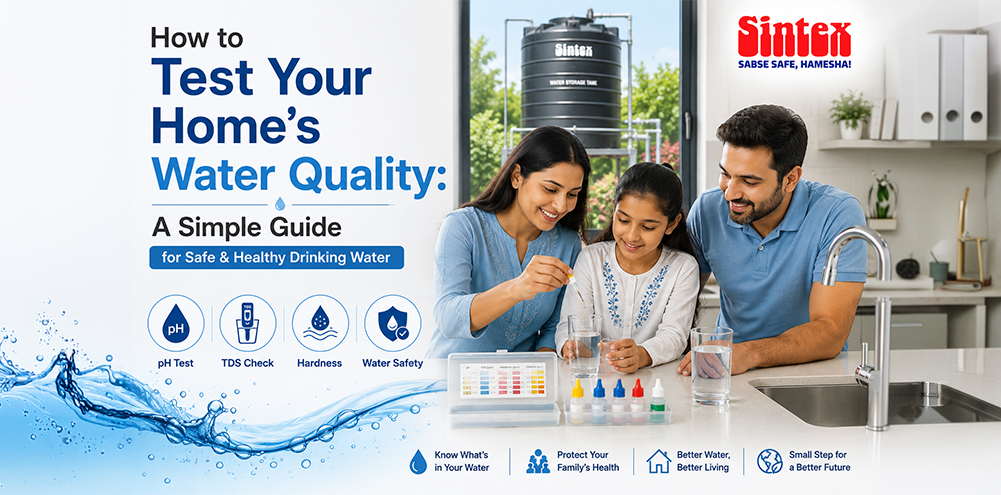
Table of Contents
Clear water isn’t the same as clean water. Bacteria, dissolved salts, and heavy metals rarely change how water looks or tastes, which is exactly why so many households only find out something’s wrong after someone falls sick.
This guide walks you through how to test water quality at home, from the free checks you can do in your kitchen right now to knowing when a lab report is worth the money. By the end, you’ll know exactly if your tap or tank water is contaminated or not, and what to do about it.
Key Takeaways
- Clear, odourless water can still carry bacteria, heavy metals, or excess dissolved salts.
- TDS, pH, hardness, chlorine, and bacteria are the five parameters worth checking.
- TDS meters and test strips cover most home needs; labs handle the rest.
- Storage tanks can quietly undo good source water, so tank hygiene matters too.
Why Water Quality Testing Matters in Indian Homes?
Most Indian homes draw water from municipal supply, a borewell, or a mix of both, and neither source is guaranteed to stay consistent.
Municipal water quality shifts with the season and pipeline age, letting contaminants seep in through cracked joints. Borewell water carries its own risks, too, since groundwater picks up fluoride, nitrates, and excess salts depending on local geology, with no treatment step to remove them.
Then there’s storage. Water that tested fine as it left the treatment plant can still sit for days in a tank, where heat, sediment, and a cracked lid do their damage. This is where a lot of the water contamination health risks in Indian households actually originate, somewhere between the source and the tap. Regular testing is the only way to catch this drift early.
Signs Your Water May Be Contaminated
Not every problem needs a lab to spot. Your senses catch more than you’d expect if you know what to look for.
Visual Signs
Cloudy or hazy water usually points to suspended sediment or turbidity. If the water has a yellow or brownish colour, it may be due to rust from old pipes, and greenish water may be due to algae in the tank that has not been cleaned. White, chalky residue left on tiles or utensils is one of the clearest signs of contaminated water due to excessive hardness.
Smell and Taste Signs
A strong chlorine odour indicates over-treatment upstream, while a rotten-egg smell usually indicates hydrogen sulphide or bacterial activity. A metallic taste often traces back to corroding pipework or fittings, and any sweetish or oddly flat taste is worth a second look, too.
Everyday Household Clues
Soap that won’t lather properly is a classic hardness giveaway. White, crusty scale building up around taps, showerheads, or your kettle points the same way. Laundry coming out dull or stiff and skin or scalp feeling dry after a shower are both signs worth tracking over a few weeks rather than dismissing as one-offs.
None of these signs confirms exactly what’s wrong, but they do tell you that it’s time to test rather than assume.
Key Water Quality Parameters
Before testing, it helps to know what you’re actually measuring. These five parameters cover most of what matters for a typical Indian household.
| Parameter | Definition | Why It Matters |
| TDS | The total salts, minerals, and metals dissolved in your water | Affects taste and may indicate contamination |
| pH | How acidic or alkaline your water is, on a 0 to 14 scale | Ideal drinking range: 6.5-8.5; extreme values corrode pipes and affect taste |
| Hardness | The calcium and magnesium sitting in your water | Causes scaling and poor lathering |
| Chlorine | The disinfectant left behind after treatment | Too little risks bacteria; too much affects taste and may irritate |
| Bacteria | Coliform or E. coli present in a sample | Indicates possible contamination and health risks |
Most home test kits measure these water quality parameters, and understanding each helps clarify the results.
7 Step-by-Step Testing Methods
Here’s how to test water quality at home, starting with what needs nothing more than your own senses.
- Visual check. Fill a clear glass and hold it against natural light, looking for cloudiness, floating particles, or discolouration.
- Smell test. Take a sample right after drawing it and note any chlorine, sulphur, or musty odour.
- TDS meter. Dip the probe into a sample and read the digital output in ppm within seconds.
- pH strips. Dip a strip for a few seconds and match the colour change against the pack’s reference chart.
- Hardness test kit. Use titration drops or a strip designed specifically for calcium and magnesium levels.
- Chlorine test strips. Dip and compare colour to check whether residual chlorine sits in a safe range.
- Home water testing kit or lab test. For a fuller picture, especially bacteria and heavy metals, use a multi-parameter kit or send a sample to a certified lab.
Running through even the first five takes about fifteen minutes and covers most everyday concerns without spending a rupee on lab fees.
How to Check If Your Tap Water Is Safe to Drink?
If you’re wondering about how to check if tap water is safe to drink, then run through this checklist, since no single test tells the whole story alone.
- Look and smell: clear, odourless, free of particles or film.
- TDS: under 500 ppm, per BIS drinking water standards.
- pH: between 6.5 and 8.5.
- Hardness: under 200 mg/l for comfortable daily use.
- Chlorine: a faint residual is fine; a strong bleach smell isn’t.
Clear all five, and it’s reasonably safe. Even if one check fails, then test further.
TDS Meter vs. Testing Kit vs. Lab Test: Which Should You Choose?
Each method suits a different level of concern, and picking the right one saves you both time and money.
| Method | Best For | Turnaround | Limitation |
| TDS Meter | Quick daily or weekly checks on dissolved solids | Seconds | Doesn’t detect bacteria or specific contaminants |
| Testing Kit | Broader home screening across several parameters | 5-10 minutes | Less precise than lab equipment |
| Lab Test | Full analysis including bacteria, heavy metals, pesticides | 2-5 days | Costs more, needs sample collection and courier |
In most cases, this water testing methods comparison is simply a matter of routine or reassurance for most households. A TDS meter is good for weekly testing, a TDS kit is good after moving to a new home, and a lab test is good once a year or when something feels off.
What to Do If Your Water Test Shows a Problem?
Depending on the type and level of contamination, the appropriate water contamination solutions may vary, so follow up based on the test results.
- High TDS or high hardness: use an RO purifier or a water softener depending on which parameter is off
- Low or no residual chlorine: boil water before drinking until the supply issue is resolved
- Bacterial presence: stop drinking untreated water immediately and switch to a UV or RO system with disinfection
- Persistent odour or discolouration: get the storage tank inspected; in most cases, the problem often sits closer to home than the source
Recurring odour or bacteria often trace back to the tank itself, not the source, making the tank you store water in matter just as much.
Also, Read: Keeping water tanks clean & safe
The Role of Your Water Storage Tank in Water Quality
Your storage tank matters more than most people realise. Water leaving the treatment plant or a borewell can test perfectly fine, but if it sits in an overhead or underground tank for days, that stillness is exactly what lets algae, sediment, and bacteria take hold.
This is exactly the problem Sintex tanks are engineered to address every day. They’re made with UV-stabilised, food-grade material and a tight-sealing lid that keeps light and dust out where a cheaper tank can’t. Our ranges, like the Sintex Pure Antimicrobial tank, carry built-in antimicrobial protection to slow bacterial growth between cleanings, since bacterial buildup is often one of the biggest challenges in long-term water storage.
Your water tank hygiene deserves the same attention as the testing itself. Pair a Sintex tank with a proper cleaning kit every six months, a checked lid seal, and no standing water near the base, and your source water’s quality stays intact all the way from the source to the glass.
Expert Tips for Accurate Home Water Testing
A few simple habits separate a reliable reading from a misleading one, helping you avoid false alarms and unnecessary fixes.
- Use a fresh sample, not water sitting in a bottle, which picks up its own quirks.
- Rinse equipment with distilled water before each use to avoid cross-contamination.
- Test at the same time of day when tracking changes, since usage shifts tank water.
- Store strips away from humidity and check expiry dates, since degraded strips can misread colour.
- Test both source and tap, since the gap often says more than either reading alone.
Also, Read: Why is Water Tank Hygiene Important for Health?
Conclusion
Water that looks fine and water that is fine aren’t always the same thing, and that gap is exactly what testing closes. A few minutes with a TDS meter, some strips, and a clear glass tell you more than most people ever bother checking.
If the results point towards a storage issue rather than a source one, that’s usually the easier fix, and a well-built Sintex tank keeps tested, clean water clean until it actually reaches your glass.
Also, Read: How Frequently Should You Clean Your Water Tank?
Test monthly if you're on municipal supply, and more frequently, closer to biweekly, if you rely on a borewell, since groundwater quality shifts with the seasons. Retest immediately after any visible change in taste, smell, or colour, and always after cleaning or refilling a storage tank.
You can do basic checks at home using a clear glass, your senses, and simple tests. Cloudiness, unusual smells, soap lather, or white residue after boiling may indicate problems, but only a test kit or lab analysis can accurately confirm water quality.
Under 500 ppm is considered acceptable as per BIS drinking water standards, with anything under 300 ppm generally tasting best. A reliable TDS meter for drinking water gives you this reading in seconds, making it the easiest parameter to monitor regularly at home.
Hard water causes scale buildup in tanks, geysers, and pipes over time, reducing efficiency and shortening appliance life. A simple water hardness test using strips or titration drops tells you early whether softening or more frequent tank cleaning is worth adding to your routine.
A TDS meter only measures dissolved solids in seconds, giving no information on bacteria, pH, or heavy metals. A full water quality test, whether a multi-parameter kit or a lab panel, covers a much wider range and is worth doing periodically alongside routine TDS checks.