
Which Pipe is Best for High-Rise Buildings? What Changes at Height
Share
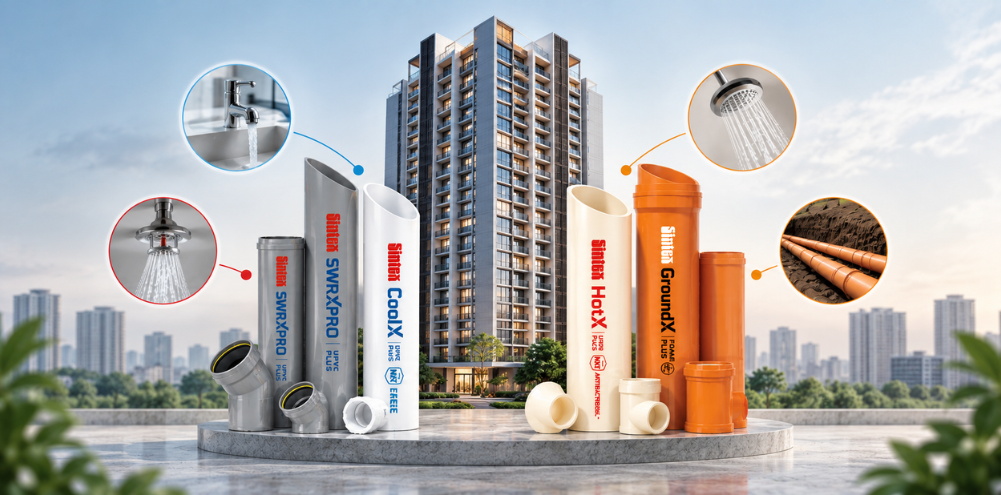
Table of Contents
Water doesn’t behave the same way on the 25th floor as it does in a two-storey house. Higher pressure, constant temperature changes and pipes hidden behind walls all place extra demands on a plumbing system. Once the building is occupied, repairing a leaking pipe can involve breaking walls, disrupting residents and adding significant maintenance costs. That’s why the pipe material is decided long before the first tap is installed. When choosing pipes for high rise plumbing pipe, ensure it meets the specific pressure, temperature, and concealment requirements of each system. This guide covers how those demands change at height and which pipe material is best suited where.
Key Takeaways
- Water pressure increases by approximately 0.1 bar per metre of height; at lower floors of a 30-storey building, working pressure can reach 15 bar or more, including pump pressure.
- High-rise buildings are divided into pressure zones of 8 to 12 floors, with pressure-reducing valves at each zone boundary.
- CPVC handles temperatures up to 93°C, making it suitable for both hot and cold water risers in residential towers.
- Multilayer composite pipes reduce the need for fittings in concealed runs, lowering the risk of buried joint failures that are expensive to access and repair.
Why Is High-Rise Plumbing Different From Low-Rise?
The challenges that make pipes for high rise buildings a different specification exercise from low-rise come down to four things.
Static pressure at lower floors. Water exerts roughly 0.1 bar per metre of vertical height. In a 30-storey building, the static pressure at the lowest floors from the overhead tank alone is approximately 9 bar. At lower levels, pump pressure and total working pressure can reach 15-25 bar, depending on the system design. A pipe or fitting not rated for that load will fail, and it won’t fail visibly on the surface.
Thermal expansion in vertical risers. Hot water risers heat up and cool down with every use cycle. CPVC, for instance, has a thermal expansion coefficient that results in meaningful dimensional change along the length of a tall riser. Left unmanaged, that expansion stresses clamps, fittings, and joints. In a pipe for tall building applications, this has to be engineered in, not assumed away.
Concealed installation. In a high-rise, most pipes run inside walls, ceiling voids, and service shafts. There are no exposed runs to inspect after handover. A joint failure in a concealed riser on the 18th floor doesn’t announce itself until water appears on the 16th floor ceiling. The number of joints in the system, and the reliability of each one, matters enormously.
Construction schedule pressure. High-rise projects run floor by floor. The plumbing contractor gets a fixed window per floor before the next trade moves in. Pipe systems that are slow to join or require specialist equipment create real problems on site. Ease and speed of installation are a legitimate technical consideration, not just a convenience.
How Does Pressure Change at Height, and Which Pipe Handles It?
High-rise buildings don’t rely on one continuous water line from the ground floor to the terrace. The plumbing network is usually split into pressure zones so that the pipes serving lower floors aren’t exposed to the same operating pressure as those supplying higher levels. In many projects, each zone covers roughly 8 to 12 floors, although the final layout depends on the building’s height and plumbing design.
This zoning also influences the pipe pressure rating for tall buildings. Pipes installed in booster pump lines or higher-pressure zones are selected to withstand greater operating pressure, while lower-pressure sections may use a different rating. The plumbing drawings prepared during the design stage specify the pressure class for each zone, helping ensure the entire system works safely without overspecifying every pipe.
| Pressure Rating | Where It’s Commonly Used |
| PN 10 | Low-pressure plumbing networks and shorter vertical runs |
| PN 16 | Residential and commercial pressure zones in many high-rise buildings |
| PN 20 and above | Booster pump lines and high-pressure sections where required by the design |
Using the same pressure rating throughout a tall building isn’t always necessary. Matching the pipe to the operating pressure in each zone is usually the more practical approach.
Also, Read: Drainage Pipes vs. Plumbing Pipes
Does the CPVC vs uPVC Choice Change at Height?
The choice between CPVC and uPVC in a high-rise building is not decided simply by the number of floors. Both materials can be used in tall buildings, with the selection based on the type of plumbing system, pressure requirements, design specifications and installation conditions.
For cold water supply, uPVC is commonly used across residential and commercial buildings. CPVC is also suitable for water supply systems and is widely used where the project specification calls for it. The pipe’s pressure rating and the working conditions of the system should be checked before finalising the material.
Height does, however, make proper pipe support more important. Longer vertical runs need suitable brackets, spacing and allowances for movement so that the pipe and its joints remain secure during operation. These installation details apply to both CPVC and uPVC systems.
So, for CPVC pipe for high-rise buildings and uPVC pipe for high rise buildings, the decision should come from the plumbing design rather than the building height alone. The required application, pressure rating and project specifications should guide the final selection.
Is CPVC Suitable for High-Rise Hot Water Risers?
Yes. CPVC is the most widely used material for hot water risers in Indian residential high-rises, and it’s technically appropriate for this application when installed correctly.
CPVC for high rise hot water service is rated for continuous operating temperatures up to 93°C. Its solvent-cement joints, when correctly applied, are stronger than the pipe body itself. It resists chlorinated water, which matters because hot water systems in tall buildings often run higher chlorine concentrations for Legionella control.
The thermal expansion point is real but manageable. CPVC expands more than steel per degree of temperature rise. For a 30-metre hot water riser with a 60°C temperature differential, CPVC expansion runs to approximately 113 mm. That movement needs to be accommodated through riser clamps and, on longer runs, expansion loops. Buildings that have had CPVC hot water riser failures have almost always had inadequate expansion management, not a material failure in the pipe body itself.
Properly installed CPVC hot water risers have documented service lives of 50 years. The material is code-compliant under the National Building Code of India 2016 for hot and cold water supply in multi-storey buildings.
Also, Read: Different Types of Pipes Used in a House and Their Applications
Why Do Multilayer Composite Pipes Matter for Concealed High-Rise Plumbing?
Concealed branch lines in high-rise plumbing pose a specific risk that doesn’t apply to exposed or surface-mounted runs: any joint failure is invisible until water damage appears elsewhere. Minimising the number of joints in a concealed run directly reduces the probability of a concealed failure.
This is where multilayer composite pipe (MLCP), specifically Sintex HotX PRO, offers a genuine engineering advantage for plumbing pipe for multi storey building projects. HotX PRO combines PEX and aluminium layers, providing a flexible and corrosion-resistant solution. Its flexibility allows long runs with fewer fittings, which means fewer joints inside finished walls.
Why does HotX PRO suit concealed high-rise branch lines?
- Fewer joints: Flexibility means the pipe bends around corners and through wall chases without a fitting at every turn. Fewer fittings means fewer potential failure points buried in concrete.
- Low thermal expansion: MLC pipe expands significantly less than CPVC under the same temperature change, because the embedded aluminium layer restrains the plastic’s natural movement. In practice this means less accommodation is needed at concealed joints and bends in hot-water branch lines.
- Oxygen barrier: The aluminium layer acts as an oxygen barrier, which reduces internal corrosion in hot water recirculation systems over time.
- Hot and cold rated: HotX PRO handles both hot and cold water supplies in a single product, simplifying specification for concealed branch lines serving both applications.
For concealed branch line work in high-rise residential and commercial projects, the combination of a CPVC riser and MLC branch piping represents current best practice in Indian multi-storey construction.
Drainage and Noise: What Changes at Height?
Drainage pipes for high rise buildings isn’t only about carrying wastewater safely. It also affects how much noise travels through the building. When several apartments discharge water into the same vertical stack, the sound of flowing water can travel through pipe walls and service shafts, especially if the system isn’t designed with acoustics in mind.
The choice of pipe material also influences indoor noise levels. PP and UPVC pipes offer good sound-dampening characteristics, helping reduce the transmission of water flow noise through walls and floors. Combined with acoustic clamps, insulated service shafts and careful pipe routing, they create a quieter living environment for occupants.
Along with smooth wastewater flow and long-term durability, a well-designed drainage system should also improve everyday comfort. Addressing these acoustic considerations during construction is far more practical than trying to solve noise issues after the building is occupied.
System-by-System Recommendation
Different plumbing systems place different demands on the pipe network. A hot water line requires heat resistance, while a drainage stack needs smooth wastewater flow and long-term durability. Choosing the right product for each application helps improve system performance and simplifies maintenance over the building’s life. Sintex offers dedicated pipe systems for a wide range of plumbing applications.
| System | Recommended Sintex Product | Why it fits |
| Hot Water Supply | Sintex HotX CPVC Plus | Engineered for both hot and cold water systems, commonly used in residential, commercial and industrial plumbing applications. Rated to 93°C, with low thermal expansion, chemical resistance, and UV protection. |
| Cold Water Supply | Sintex CoolX UPVC Plus | Used for internal and external cold water plumbing systems in residential and commercial buildings. Lead-free, antimicrobial, high-pressure rated for multi-storey use. |
| Concealed Branch Lines | Sintex HotX PRO (MLCP) | Flexible multilayer construction reduces joints inside walls, making them well suited for concealed plumbing layouts. |
| Drainage & Wastewater | Sintex SWRX UPVC Plus | Built for soil, waste and rainwater systems with smooth internal surfaces, corrosion resistance and anti-rodent protection. |
Conclusion
No single pipe material covers all systems in a high-rise, and the right approach isn’t picking one brand’s flagship product everywhere. It’s matching each system to the material engineered for it, which is where Sintex’s range works well as a set, not a single product.
For hot and cold water supply risers, CPVC is the technically correct, code-compliant choice, and Sintex HotX CPVC Plus is built for exactly this application. On the cold water side, Sintex CoolX UPVC Plus offers the same lead-free, antimicrobial construction, rated for the higher static pressures multi-storey risers see at lower floors.
For concealed branch lines, where joint count needs to be minimised, Sintex HotX PRO delivers the flexibility, low expansion, and oxygen resistance that buried hot water lines need. For drainage stacks, Sintex SWRX UPVC Plus is purpose-built for soil, waste, and vent applications. Get the system-by-system specification right, and the building will perform without maintenance surprises!
Also, Read: Difference Between PVC, CPVC, and UPVC Pipes
uPVC can handle cold water supply in lower pressure zones of a high-rise when correctly rated and zoned. It is not suitable for hot water service above 60°C and should not be used in pressure zones where the working pressure exceeds its rated capacity. For most high-rise hot water applications, CPVC is the correct specification.
Yes. Lower floors experience higher static pressure due to the water column above them. Buildings are divided into pressure zones of 8 to 12 floors, with PRVs at the zone boundaries to keep working pressure within safe limits for the piping and fixtures. Within each zone, the pipe specification is typically the same, but the zone pressure management differs significantly between lower and upper floors.
The consequences depend on what was wrong. An underrated pipe in a high-pressure zone can fail at joints or along the pipe body, causing concealed water damage that only becomes visible after significant damage has occurred. uPVC used for hot water risers will degrade faster than its rated service life. In either case, the repair involves accessing pipes buried within finished walls, which entails significant disruption and costs incurred well after handover.
HDPE is not commonly used for internal plumbing supply or as drainage pipes for high rise buildings in India. It's primarily specified for underground water mains, borewell casing, and external distribution pipework. Inside a building, CPVC and MLC composite pipe handle supply lines, and structured-wall SWR handles drainage.
The industry standard in India and internationally is 8-12 floors per pressure zone. The exact zone sizing depends on the floor-to-floor height and the pressure rating of the pipe and fixtures being used. Each zone boundary has a PRV to reduce incoming pressure to within the safe operating range for that zone.
There is no single answer because different systems need different materials. CPVC is the standard for hot and cold water risers. MLC composite pipe is suitable for concealed branch lines. Structured-wall SWR handles drainage. GI is required for fire protection risers. Specifying one material across all systems in a high-rise is a design error that will show up during or after construction.
Categories
Year
Related blogs