Table of Contents
Waste is a topic we often bypass. Whether it’s about the garbage truck from the municipal corporation skipping collection for a few days or limited source separation of waste types, it’s not a glamorous topic that one’d prefer to dwell on. The fact, however, is that 20 per cent of the world’s human-related methane emissions come from waste, as the UN Environment Programme states.
Urban centres in developing countries like India are key contributors to the rising figure. Increased urbanisation, industrialisation, and rising consumption in such regions contribute heavily to waste. The notable upside here is that good waste management through efficient planning, collection through reliable services, management of landfills, and proper day-to-day operations on a granular level can make a real difference.
In this article, we break down waste management solutions for buildings that can promote hygiene and improve health from the grassroots up. We discuss smart, environmentally friendly solutions that serve communities and the planet in the long run. Let’s get into it.
Key Takeaways
- A robust waste management system involves segregation of waste, collection planning, proper storage, on-site processing, and timely external handling
- Residential buildings can rely on composting methods and on-site processing for maximum organic waste management
- Commercial buildings need to pay special attention to hazardous waste, electronic waste, and special waste streams
- Waste transportation and collection through authorised vendors, good waste management companies, and local municipal authorities ensures safe disposal of waste residue
What Types of Waste Do Buildings Need to Manage?
The world generates over 2 billion tons of municipal solid waste annually. Unlike wastewater, which is essentially water mixed with pollutants or toxic chemicals, solid waste management in buildings is a challenge. It’s diverse and stationary, so it cannot be transported through centralised pipeline networks for treatment.
Here’s a non-exhaustive list of waste streams you’ll be looking at before planning waste management solutions:
- Wet/Organic Waste
Wet or organic waste is essentially waste made up of organic compounds. It can decompose and return to nature or generate energy as biogas and electricity. Food waste, flowers from gardens and temples, vegetable waste from farmers’ markets, and animal waste all fall within this category.
- Dry Recyclables
Dry waste or dry recyclables are solid items that neither decompose nor return to nature. They remain in their natural form for a long time, rendering them non-biodegradable. Think plastic, paper, glass, metal, and food packaging materials. While some of these can be recycled, reshaped, and reused in industry, they need to be disposed of with more care than wet waste.
- Sanitary/Biomedical Waste
Improper disposal of sanitary waste is a major public health challenge in India. Any waste contaminated by blood or body fluids, such as sanitary pads, tampons, diapers, or incontinence sheets, falls within sanitary waste. Biomedical waste includes waste generated from hospitals, laboratories, diagnostic test centres, etc. It includes human tissue, syringes, bandages, and the like.
- Domestic Hazardous Waste
Any type of waste from homes that is reactive, flammable, corrosive, or emits a high amount of toxic chemicals is considered domestic hazardous waste. Motor oil, bug sprays, oven cleaners, bleach, and drain cleaners contain dangerous chemicals that can harm the environment and threaten your health when managed poorly.
- E-Waste
A category of waste that needs immediate attention, e-waste or electronic waste contributes heavily to India’s water pollution. According to a UN report, India is the fifth-largest producer of electronic waste globally. Computers, mobile phones, large household appliances, cameras, toys, DVD players, drills, laboratory equipment, etc., are considered e-waste.
How Does a Building Waste Management System Work?
Effective building waste management systems can be challenging to plan and implement. However, the health and environmental benefits compound over time. These focus on maximising waste value while minimising adverse effects. Here’s a step-by-step process that ensures maximum energy reclamation and legal compliance:
Step 1: Segregation
The immediate step succeeding waste generation is identification and segregation. Categorise waste from different sources/departments of the building into non-biodegradable, repurposeable, compostable, hazardous and general waste.
A thorough waste audit helps determine the different types of waste being generated within a community or facility. It’s mostly a one-time activity that enables efficient management for months to come. For example, if you know the bulk of your building waste is plastic waste, you can seek out a befitting disposal or recycling company for waste management.
Step 2: Internal Collection
Internal collection in a waste management system involves moving different types of waste from each point of generation to a single facility for internal storage. Volumes are logged, and tracking systems are updated for each waste stream. This isn’t just a step in the waste management system, but it also helps waste management teams assess and optimise current waste disposal methods.
Step 3: Temporary Storage
The third step can be combined with the second or treated independently, depending on what suits your organisation/community best. Temporary storage of waste is critical, especially if the waste is hazardous or biomedical. It ensures safe containment and prevents odour, leaks, and environmental contamination. Gathering small amounts of waste into batches and storing them by type also makes transportation easier.
Step 4: On-Site Processing
If landfill disposal is not required for all types of waste, buildings and facilities can use on-site processing to manage waste. Categorise what can be reused, recycled, repurposed, or recovered. Organic food scraps can be turned into compost or nutrient-rich fertilisers and used for local gardening. Cardboard and plastics can be compressed and repurposed. On-site processing, therefore, helps reduce the volume of garbage being handed over to the disposal company. You can also cut costs on transportation and disposal.
Step 5: Authorised Disposal
ISO 14001 is an international standard for designing and executing an Environmental Management System. Naturally, it includes waste management and outlines sustainable disposal practices. Select waste management partners that comply with the standard or equivalent guidelines as laid out by the Central or State Pollution Control Boards in India (CPCB/SPCB).
The disposal service should have regulatory approval and process waste through controlled methods such as secure waste facilities and licensed incinerators. Controlled combustion, engineered disposal of waste residue, and energy recovery methods shouldn’t be skipped either.
Also Read: Biogas Vs LPG For Commercial Kitchens
Segregation at Source: The Foundation of Better Waste Management
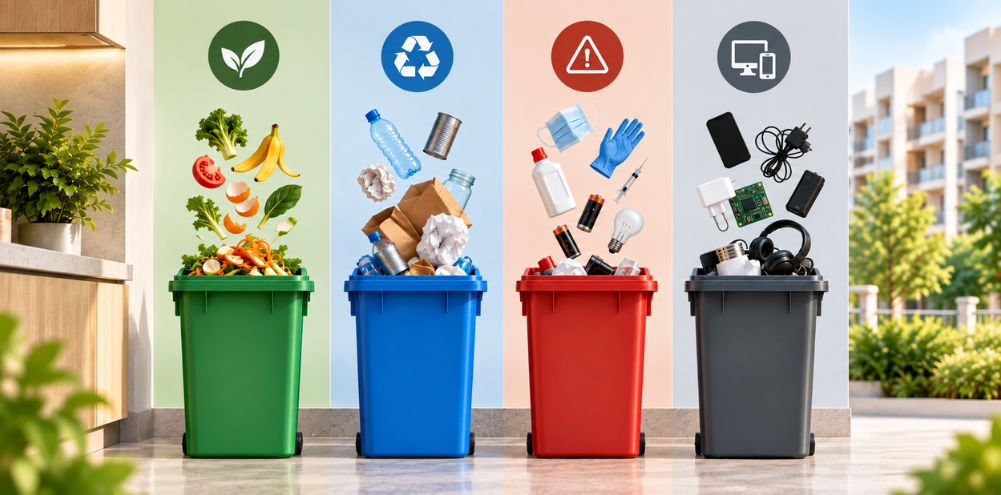
A fundamental activity in tackling waste, especially when a single source generates different types of waste, segregation is the foundation of waste management for apartments. In fact, India’s New Solid Waste Management Rules 2026 make on-site four-stream segregation of waste mandatory.
Domestic spaces are a common hub for organic waste, recyclables, electronic waste, demolition debris, and miscellaneous materials. Good segregation practices limit stress on the environment and reduce exposure to toxins and pathogens. Simple practices help:
- Use labelled or colour-coded bins for disposing of different types of waste
- Educate flatmates, family members or colleagues on the importance of waste segregation
- Rinse and clean plastic or glass containers before disposing of them
- Consider reusing or repurposing items whenever possible
- Put aside organic waste so it can be used as compost and reduce the burden on municipal waste management systems
- Stay informed on your local waste management authority’s instructions and guidelines
- Partake in waste collection drives to support a pollution-free community
Lack of segregation can lead to soil, water, and air contamination. The subsequent ecological damage and expanding pollution loopholes can lead to disease and health disasters. Solid waste management for apartments through segregation is the step where your community and its environment begin to heal.
Planning Waste Storage and Collection Areas in a Building
Marking out centralised collection points for waste collection and storage can help organisations and communities reduce labour costs, improve recycling habits, and prevent leakages or environmental contamination.
For Apartment Buildings
Apply key design and location principles to determine collection areas when building water management systems for apartments.
| Collection Point | Detail |
| Utility Rooms on Every Floor | Different colour-coded bins can be used on every floor to hold high volumes of general waste and recyclables |
| Central Holding Areas | Storage spaces in basements or close to collection points make transportation and stowing easy |
Resident participation and good hygienic practices in collection and storage areas are a non-negotiable part of waste management for apartments. Proper airflow helps prevent gas build-up and washable surfaces prevent creation of breeding grounds for pathogens.
For Commercial Buildings
In commercial waste management, pedestrian pathways, workspaces, and waste collection schedules need attention for efficient, hygienic disposal.
| Collection Point | Detail |
| Tenant Spaces | Multi-stream waste bins in high-traffic areas such as cafeterias, banquets, conference rooms, and break rooms help localise accumulation. |
| Designated Waste Collection and Storage Areas | Waste storage areas should be designated, ventilated, and accessible for collection. It is important to consider fire safety, odour and hygiene before designating a waste collection area. |
| High Footfall Spaces | Lobbies, playgrounds, printing rooms, medical test centres, grocery stores, pantries, and water coolers generate high domestic and solid waste |
Accessible storage areas for staff and waste collectors ensure safe wheeling out, and sealed containers for odorous waste are recommended for pest control.
Which Waste Can Be Managed or Processed On-Site?
Sustainable waste handling combines on-site processing efforts and authorised external handling. Most buildings follow an integrated waste management system that includes both for compliance and environmental reasons. Moreover, innovative technologies and appropriate systems can also help localise efforts.
On-Site Waste Management
Food waste includes pre-consumer wastes, post-consumer wastes, and bulk generator waste. Think vegetable peels, organic scraps, food leftovers, and similar waste produced by residential and commercial buildings. Natural and controlled composting helps break them down on-site, while organic waste converters can help shred tough portions.
Modern waste management tech can also help commercial facilities manage and process waste on-site before they are handed over for intensive treatment.
- Smart bins with IoT sensors notify saturation and reduce truck runs
- AI-based sorting systems can increase segregation efficiency
- Biological digesters and biogas plants can help process food and turn it into manure
- Pyrolysis tech helps break down plastic and rubber waste at high temperatures
External Handling of Waste
Hazardous waste, electronic waste, and biomedical discards cannot be managed within communities or commercial spaces. Segregation and storage until a licensed waste management company takes over are simple yet sustainable waste management solutions to ensure no harmful residue passes into the environment without being treated.
Licensed waste carriers carry authorisation from regulatory authorities and document transfers to maintain a waste trail. Treatment and disposal facilities are required to be legally compliant and use specialised operations for neutralising harmful substances.
Managing Dry, Recyclable and Special Waste Streams
Paper, cardboard, plastics, metals, glass, biomedical materials, chemical waste, and e-waste require special attention. Largely non-biodegradable, dry, and recyclable, they require stringent solid waste management in buildings. Skip on it, and you’re looking at soil and water contamination, fire risks, pest breeding, and toxin exposure.
A suitable waste management system designed to tackle special waste streams is the ultimate guardrail.
- Incineration: Incineration involves controlled thermal treatment of suitable combustible waste in specialised facilities. It can reduce waste volume and, in certain facilities, enable energy recovery. The process must follow applicable environmental emission and residue management requirements.
- Waste-To-Energy: These technologies process suitable waste to recover energy. Methods such as gasification and pyrolysis can be used depending on the waste composition and technology. Materials such as metals and glass should instead be segregated for material recovery and recycling.
- Landfilling: It involves careful disposal of waste residue in designated areas integrated with leachate management systems as well as those for methane capture.
Industries or waste management services engaged in processing and recycling dry and industrial hazardous waste are required to comply with CPCB/SPCB guidelines. Manifest tracking for off-site transportation of waste, waste audits, designation of dangerous waste storage areas, and record-keeping of inspections are mandatory.
Residential vs Commercial Waste Management: What Changes?
Waste management in commercial and residential spaces differs primarily due to their different contributions and required collection consistency. The comparison table below explores it in detail:
| Parameter | Residential Waste Management | Commercial Waste Management |
| Typical Waste Volume | Generated by individual households and therefore, low | Moderate to high, depending on the scale of business/commercial operation |
| Waste Composition | Food waste, paper, plastic, glass, steel, etc. | Plastic, cardboard, metal, office waste, and specialised waste types. |
| Collection Frequency | Once or twice a day | Few times a day |
| Food Waste Content | High | Depends on the nature of the business |
| Storage Space Requirements | Colour-coded bins and limited storage facilities in the basement or on the apartment floors | Large dumpsters and compactors for efficient management |
| Operational Responsibility | Municipal corporation or any other local authority | Facility manager or waste management company |
While residential buildings can reduce their carbon footprint and ensure environmental safety through standard waste disposal practices on a household level, commercial buildings usually require external assistance for ensuring safe and hygienic operations.
How to Choose the Right Waste Management Solution for a Building?
It’s easy to find value in every segregation practice, every storage method, and multiple processing techniques. But not every solution is the best one for your building. Here’s how you can narrow down the list:
Assess Waste Quantity and Composition
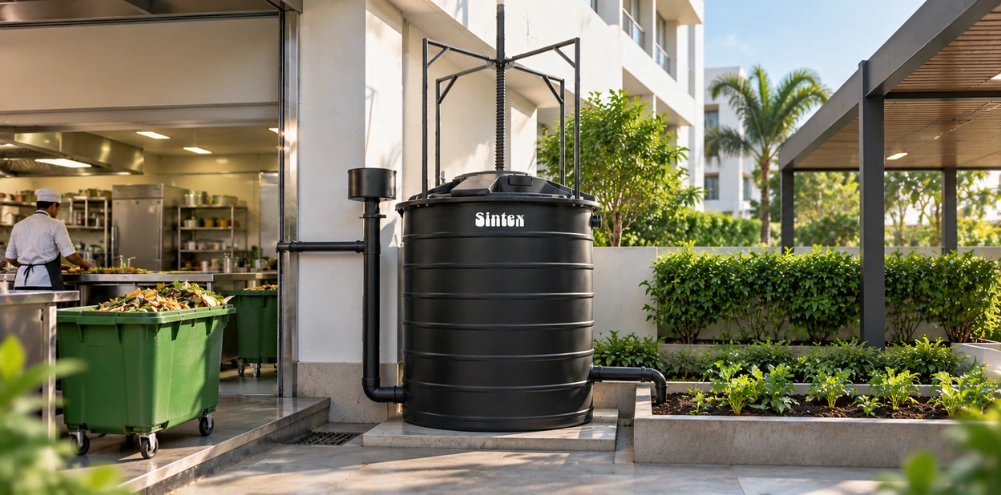
A four-storey building generates a low volume of waste when compared to a gated community with multiple ten-storey buildings. Moreover, the types of waste generated have to be factored in. For example, Sintex’s Biogas Plant is a durable solution for organic waste processing and energy recovery. Customisable for residential & commercial uses, it is highly suitable for on-site processing of waste in restaurants, resorts, hospitals, and communities.
Check Available Space and Infrastructure
Collection areas, processing space, wheeling routes, and essential utilities have a direct bearing on the type of waste management solutions for buildings. Areas with high-density waste generation can make optimal use of incinerators while in low-volume ones automated sorting systems will be efficient. Access to power grids and the distance from storage units also influence the type of tech you should choose.
Plan for Operations, Not Just Installation
Consider the scope of operation when building waste management systems. While installation may seem simple, an incinerator or biogas plant may end up underused or fall short if they are inaccessible and difficult to maintain. Your building should have the manpower equipped to clean and maintain the equipment to ensure maximum returns.
Common Waste Management Problems in Buildings
Even meticulous planners and facility managers may sometimes miss lesser-known or fresh problems in waste management for apartments. A compact list helps you steer clear of a public health emergency:
| Problem | Corrective Measure |
| Mixed Waste | Segregation ensures proper disposal and prevents ecological damage |
| Overflowing Bins | Bins with IoT sensors that notify fill levels positively impact air quality and prevent the spread of dangerous diseases |
| Odour | Odour management through smart storage can help prevent respiratory issues in vulnerable people |
| Pest Breeding | Use of sealed bins and timely collection prevents breeding of pests |
| Inadequate Storage Space | Spills, leakages, and waste clutter can be avoided by expanding storage space based on requirements |
| Irregular Collection | Maintain proper household schedules for taking out trash and ensure operational delays by the local authorities are fixed at the earliest |
| Poor Resident Participation | Encourage resident participation through community activities, incentives, awareness campaigns, and cleaning drives for efficient commercial waste management |
| Poor Upkeep of Maintenance Systems | Maintain waste processing systems through regular cleaning and inspection to prevent safety hazards in the future |
How to Make Building Waste Management More Sustainable
According to the UN Environment Programme, municipal solid waste generation is predicted to grow to 3.8 billion tonnes by 2050. Sustainable waste management solutions are the only way we can prevent health catastrophes and the collapse of ecosystems.
- Limit the Use of Non-Biodegradable Materials
Find out which plastics can be recycled and reused. Opt out of plastic packaging wherever possible and turn to biodegradable materials such as corrugated paper, starch-based plastics, and bagasse for containers and boxes.
- Opt for Household Composting
Promote household composting within communities and workspaces. Install centralised waste management solutions to improve soil health and organise vermicomposting workshops to help communities develop sustainable habits.
- Choose Sustainable Equipment
Biogas plants promote a circular economy by breaking down organic waste to produce biogas, a renewable energy source and a nutrient-rich digestate which doubles as manure. It closes the nutrient loop in a sustainable fashion, ensuring maximum waste management.
Waste Management Checklist for Builders and Facility Managers
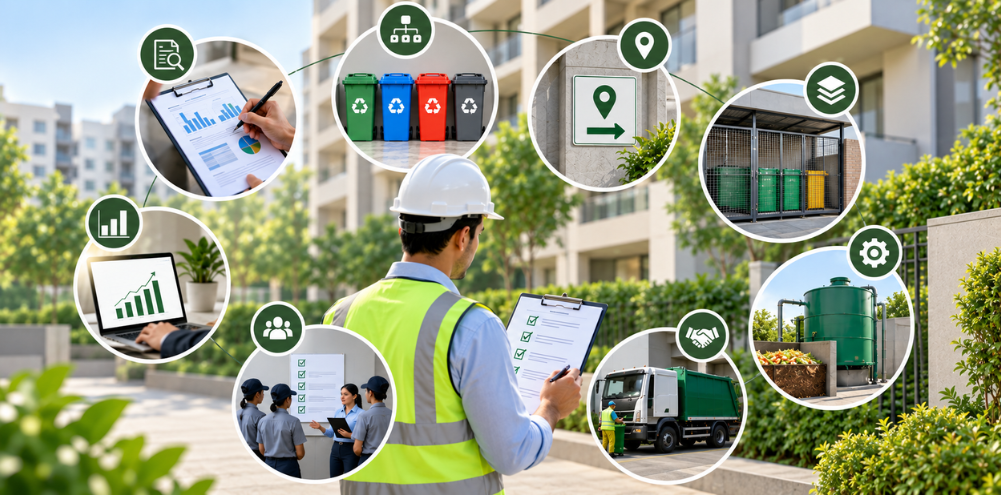
Constructors and facility managers engaged in building waste management solutions for buildings can ensure legal compliance and proper implementation through routine processes. A practical checklist looks like this:
- Conduct a waste audit periodically based on the volume and scale of the facility
- Pre-determine a segregation plan and inform staff/occupants of the same
- Ensure collection points are marked strategically through signage
- Build or demarcate storage areas away from healthy spaces but ensure accessibility
- Consider on-site processing solutions for locally manageable waste
- Wheel out hazardous or non-treatable waste through authorised vendors
- Distribute housekeeping SOPs for uniform waste management across spaces
- Monitor results and make changes to optimise the building waste management solutions over time
Also Read: How To Set Up a Biogas Plant: A Technical Guide
Sintex Waste Management Solutions for Buildings
Good waste management solutions are the cornerstone for lasting environmental and health benefits. They lower emissions, reduce our carbon footprint, keep our neighbourhoods and communities safe, and may even go as far as enriching the environment. In a warming world like ours, they become more pressing.
Sintex’s environmental solutions are engineered to convert waste into wealth. Focused on reducing organic waste disposal and ensuring a circular economy, the Sintex Biogas Plant helps convert waste from residential communities, restaurants, hotels, resorts, institutions, and industrial canteens into biogas. Easy to maintain and occupying limited space, it’s an economical investment toward a hygienic and sustainable future.
Conclusion
An impactful waste management system records the entire lifecycle of regularly discarded materials. Source reduction, classification of waste types, proper processing, energy recovery, and recycling are crucial parts of that lifecycle. This means that a good strategy has to be preceded by a clear understanding of waste streams and how they ought to be managed. When occupants, builders, and facility managers remain cognizant and act with care, communities grow healthier as well as more prosperous.
An ideal waste management system for a residential building includes source segregation of waste, on-site processing of organic waste through biogas plants, and centralised dry waste recycling systems. Authorised vendor tie-ups with local municipal collectors can help dispose of hazardous waste such as bleaching items, medical equipment, and household appliances safely, too.
Colour-coded bins for wet, dry, and hazardous waste are a good start. Centralised collection of waste and segregation from the ground level ensures that processing or transportation is simpler. Multi-bin sorting stations are also common in commercial building waste management systems.
Commercial buildings such as hospitality businesses, hospitals, and logistics businesses need large segregation bins, centralised storage rooms, heavy composting units, trash compactors, and e-waste collection points for efficient waste management and disposal.
Yes. Setting up energy recovery plants and composting facilities within residential complexes or in isolated grounds close to apartment societies can help communities process food and wet waste in a sustainable manner on the site itself.
Space requirements for waste storage and collection in any building will depend on the regular volume of waste generated and composition. A rule of thumb generally involves providing one-fourth cubic yard of container capacity to each resident.
In-house waste processing tackles waste where it is generated, while municipal waste collectors transport waste to processing units or landfills for further treatment. The former involves using home composting bins, mini food processors, or smart tech to segregate and break down organic waste into fertiliser. Therefore, it reduces the carbon footprint and is a more sustainable waste management option.
Residential and commercial buildings can reduce the amount of waste sent to landfill significantly by cultivating sustainable methods such as reuse and repurposing of non-biodegradable waste. Dedicated waste segregation and organic composting centres are highly valuable investments too.
Sintex’s Biogas Plant is a durable and highly reliable waste management solution that converts organic waste such as food, plant, and animal waste into biogas, a renewable energy source. Biogas can be used for cooking and electricity generation, promoting maximum use of waste in residential and commercial spaces.
To choose the right Sintex waste management solution, determine the waste quantity, collection frequency, and composition of waste for the facility. Assess the space as well as how the building may benefit from a specific environmental solution before deciding on the equipment.