
Types of Pipe Fittings and Their Usage: A Comprehensive Guide
Share
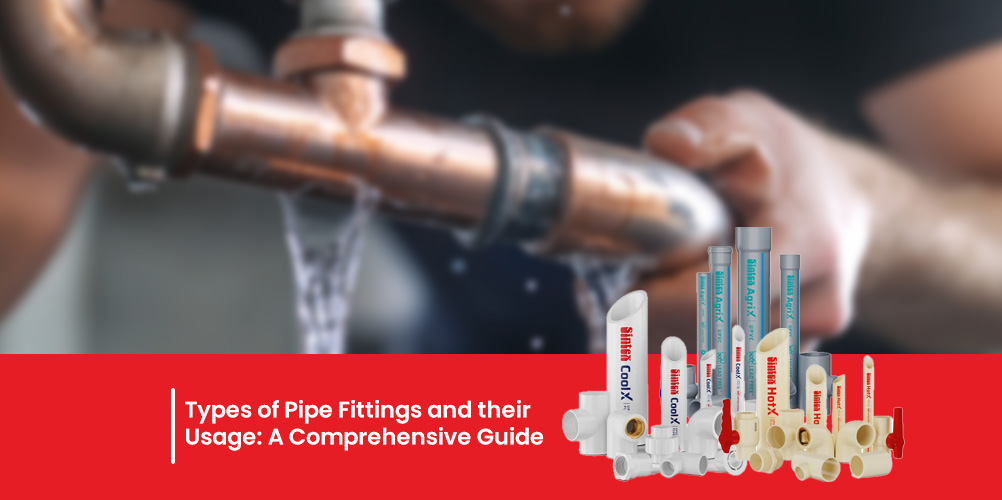
Table of Contents
Every plumbing system leans on two things doing their job: the pipes, and whatever ties them together. Fittings are that second half. They are what lets a network turn a corner, branch off, step down a size, or stop dead at an outlet. A single flat or a twenty-storey tower, the principle does not change.
Specify them well and the system runs quietly for decades. Specify them badly and you inherit the other outcome: a slow leak here, a pressure drop there, a joint that lets go behind the plaster or three feet under the driveway. Fixing that means breaking open a wall or digging up a buried run.
So this guide goes through the lot. What a fitting actually is, why the material you pick matters, the dozen fitting types you will run into and what each one does, and how to land on the right one for a given line. Renovation, new build, or a factory floor, the same thinking applies.
Key Takeaways
- Pipe fittings are what make a plumbing layout possible, handling every direction change, branch, size shift, and termination in the system.
- Failures in plumbing almost always start at the joints, not along the pipe itself, so choosing the right fitting matters as much as choosing the right pipe.
- Material selection comes down to the application: PVC and UPVC for cold water supply and drainage, CPVC or metal for hot water lines.
- Fitting pressure rating must match or exceed the pipe class; going lower builds a weak point into the system that will fail before anything else does.
- There are twelve main fitting types, from elbows and tees to flanges and wye fittings, each designed to solve one specific problem in a layout.
- Mixing metals without a proper transition adapter causes galvanic corrosion at the joint, particularly in hard or mineral-heavy water conditions.
- ISI certification is the baseline for quality, not a bonus; it confirms the fitting was tested against independent benchmarks, not just the manufacturer’s own spec.
What is a Pipe Fitting?
A pipe fitting is any part that connects a pipeline, sends it in a new direction, branches it, or closes it off. The pipe itself just carries water from one point to the next. The fitting is what makes the route in between possible at all.
No pipeline in the real world runs dead straight from tank to tap. A wall sits in the way. The line has to drop through a floor. One incoming supply has to feed half a dozen outlets spread across different rooms or floors. Every one of those moments, a change in direction, a change in bore, a split in the flow, needs a fitting to make it happen.
And fittings are built for a specific pipe material, a specific pressure rating, and a specific way of joining. Get any one of those three wrong and you have built a weak point into the line. It will not announce itself straight away, but it will fail in time.
Why Pipe Fittings Matter More Than You Think?
A pipe system is only as good as its joints. That is not a line meant to sound clever, it is just how these systems fail. Pipe rarely bursts along its length. The trouble starts at the connections.
Think about what a joint actually puts up with. Pressure swinging up and down, the pipe expanding and contracting with temperature, water hammer slamming through every time a tap shuts fast, and corrosion or chemicals quietly working away in the background. All of that stress lands on the joint. A badly chosen fitting cracks, or works loose, or corrodes well ahead of the pipe on either side of it. By the time you spot a wet patch or notice the pressure has dropped, the thing has been degrading for months.
On a PVC water pipe run, that comes down to matching the fitting to the pipe material, to the pressure class, and to the kind of job it is doing, with no shortcuts. There are different types of pipe joints, and it’s important to use the right one to ensure your pipe system is functioning optimally. A fitting is not the afterthought it often gets treated as. It carries the same weight as the pipe.
Understanding Materials: PVC vs. Metal vs. Plastic
Fittings come in several materials, and the right one is decided by the job in front of you, not by habit. Here is how the three main families stack up across home, commercial, and industrial work.
| Feature | PVC / UPVC Fittings | Metal Fittings (Copper / Galvanised Steel) | HDPE / Other Plastic Fittings |
| Corrosion Resistance | Excellent. Unaffected by moisture, chlorine, and most water chemistry | Copper resists corrosion well; galvanised steel corrodes over time, particularly in acidic water | Good, though material grade varies widely |
| Durability | 50+ years under correct installation conditions | Copper: 50+ years. Galvanised steel: 20 to 40 years before corrosion becomes significant | Varies by grade; generally lower than PVC or copper |
| Temperature Tolerance | UPVC: cold water only. CPVC: up to approximately 93°C | Copper handles both hot and cold. Steel varies by grade | Generally limited to low-temperature applications |
| Chemical Resistance | Broad resistance to acids, salts, and chlorinated water | Limited. Copper can pit in aggressive water chemistry; steel corrodes readily | Moderate, depends on formulation |
| Weight | Light. Easy to handle and install without specialist equipment | Heavy. Copper manageable; steel requires more effort at larger diameters | Light |
| Cost | Low to moderate. Most cost-effective over a full lifecycle | High. Copper is expensive; steel cheaper but shorter-lived | Low, though quality varies significantly |
| Primary Applications | Cold water supply, drainage, irrigation, reclaimed water | Hot water supply, gas lines, industrial pressure applications | Low-pressure drainage, agricultural, temporary runs |
| Maintenance | Very low. No rust treatment, no coating inspection | Moderate. Copper requires periodic checks; steel needs corrosion monitoring | Low, though some grades degrade under UV without protection |
For most water supply and drainage in homes and commercial buildings, PVC and UPVC fittings hit the sweet spot. They perform well, they last, and over the full life of the system they cost the least. Metal still owns the hot water and gas lines, the places where PVC simply cannot take the temperature.
Also, Read: Types of PVC Pipes
What are the Common Types of Pipe Fittings?
Fittings are sorted by what they do. Each type exists to solve one particular problem in a layout. Run through the main ones below.
1. Elbows
An elbow turns the line. The two you reach for constantly are the 90 and the 45, though odd angles do exist for special work. A 90 takes the pipe round a full right angle. A 45 makes the gentler turn, and because the bend is softer you lose less to turbulence and pressure at the joint. There is also the street elbow, with one male end and one female end, which lets you join straight on without a coupling when space is tight. Of every fitting on this list, the elbow is the one you will handle most.
2. Tees
A tee is shaped exactly how it sounds. It splits one run into two outlets, or pulls two lines back into one. When all three ports are the same size, that is an equal tee. When one outlet is narrower, it is a reducing tee, handy because the branch steps down to a smaller line without you adding a separate reducer. Supply or drainage, wherever a line has to branch, a tee does it.
3. Couplings
A coupling joins two pipes of the same size end to end on a straight run. You use them laying fresh lengths, or patching a damaged stretch. The slip coupling has a bit of give along its length, which earns its keep on repairs, where you have to drop in a short replacement piece without disturbing everything around it. There is a reducing coupling too, joining two different sizes in a straight line. Same result as a reducer, just in a tighter package.
4. Reducers
When the bore has to change size, up or down, a reducer is the fitting that manages it. The concentric type keeps the centreline of both pipes lined up, which suits most runs, vertical or horizontal. The eccentric type shifts the centreline so the bottom of the pipe stays flat and level. That matters on certain drainage and pump lines, where you do not want air getting trapped or sediment settling out. Fit the wrong one on a drain and you end up with air pockets and a line that will not flow properly.
5. Unions
A union does the same job as a coupling, joining two pipes, but with one big difference: you can undo it and put it back without ever cutting the pipe. It comes in three parts. Two threaded ends screw onto each pipe, and a central nut pulls the pair together. Anywhere a system needs opening up now and then, for maintenance or cleaning or swapping out a piece of kit, that is where a union goes. Look at most valves and pumps and you will find a union sitting on either side, put there for exactly that reason.
6. Adapters
An adapter bridges two things that otherwise would not connect, whether that is a connection type or a different material. A threaded adapter turns a plain pipe end into a threaded one. A material adapter lets a PVC line tie into copper or galvanised steel, which comes up all the time in retrofit jobs, where an old metal system is being patched or extended with PVC. The male version carries external threads, the female version internal ones.
7. End Caps and Plugs
An end cap goes over the outside of a pipe to seal it shut. A plug works the other way, threading into a fitting socket to close it off from within. Both shut a line down, sometimes for good, sometimes just through construction and testing while a system is being commissioned in stages. They also cap off a spare outlet on a tee, the kind left for a branch you are not running yet but might bring into use later.
8. Bushings
A bushing shrinks the opening inside a fitting socket you already have. Instead of pulling out a whole fitting just to take a smaller pipe, you thread a bushing into the socket and it gives you a narrower opening. It takes up far less room than a full reducer, which makes it the go-to in tight, crowded assemblies.
9. Nipples
A nipple is a short piece of pipe threaded on both ends, made to join two fittings straight together with no proper pipe length in between. A close nipple has no bare centre at all, threaded right across. A short nipple leaves a small unthreaded gap in the middle. You see them all over industrial and mechanical jobs, wherever two fittings have to sit right up against each other.
10. Cross Fittings
A cross has four ports on one plane, usually one inlet and three outlets, though the flow can be arranged other ways. You rarely meet one in a house. They turn up far more in irrigation grids and fire suppression networks, where several lines fan out from a single header. With stress pulling in four directions at once, getting the pressure rating right on a cross is not optional.
11. Y-Fittings (Wye Fittings)
A Y-fitting branches the line at an angle instead of a sharp 90. That gentle angle keeps turbulence down and lets flow carry through more smoothly than a tee would. On drainage that is the whole point, because if the flow holds its speed, solids keep moving instead of settling and clogging the pipe. It is why SWR drainage runs lean on Y-fittings so heavily.
12. Flanges
A flange is a flat disc with bolt holes spaced around its edge. Two flanged ends face off, a gasket sits between them, and a ring of bolts pulls the whole thing tight into a joint that handles high pressure and still comes apart whenever you need it to. This is the standard way to connect pumps, valves, and big industrial pipe, the situations where welding or solvent cement would be a nuisance to undo.
How to Choose the Right Fittings for Your Project?
Three things settle the right fitting. What the line is doing, the pressure it runs at, and the temperature of whatever is flowing through. Work those out and the rest follows.
Cold water supply and drainage is straightforward. PVC and UPVC fittings cover almost everything in homes and commercial buildings. They take the pressure classes these systems run at, they shrug off the chemistry of treated water and wastewater, and they come in every standard type you could need.
Hot water is a different story. Those lines want CPVC or metal. Ordinary UPVC starts to soften somewhere above 60°C, so putting it on a hot supply line is just queuing up a failure for later.
Pressure rating has to match the pipe class. Drop a Class 2 fitting onto a Class 4 line and you have built in a joint weaker than everything around it. It gives way before the pipe ever does. The rule is simple enough: the fitting matches the pipe’s class, or it beats it.
Material mixing is the other trap. Bring two different metals together in one system and you get galvanic corrosion right at the contact point, worse still where there is plenty of moisture or hard, mineral-heavy water. When metal has to meet PVC, reach for a proper transition adapter made for the job. Do not force the two straight together.
Sintex makes a full range of plastic pipes and matching fittings built to work as one system, so the pressure ratings and the dimensions stay consistent right across the line.
Final Thoughts
Fittings are not the part you stop thinking about once the pipe is sized. Every turn the line takes, every branch off it, every change of size, every point where it ends, all of it passes through a fitting. Choose the wrong type and the line lets you know at the joint. Same goes if the material is off, or the pressure class falls short.
There are plenty of fitting types, but the way you pick stays steady. Application first, then pressure, then temperature. For most homes and lighter commercial work across India, certified PVC and UPVC fittings on cold supply and drainage handle the job. Bring hot water or higher pressure into the mix and the spec moves up to match.
Knowing your fittings, and knowing what each one is actually for, is what separates a system that quietly lasts thirty years from one that has you back with a chisel inside three.
Also, Read: Difference Between PVC, CPVC, and UPVC Pipes
Five turn up far more than the rest: elbows, tees, couplings, reducers, and end caps. Elbows take care of direction, at 45 or 90 degrees. A tee splits one line into two. Couplings join same-size pipes end to end, reducers step the size up or down, and end caps or plugs shut a line off. Between them, those five handle most of what a domestic supply or drainage system asks for. After that come unions and adapters, mostly on systems that need opening up from time to time, or where PVC has to meet a metal section.
Begin with the application, because cold supply, drainage, hot water, and reclaimed water each ask for different materials. Next, the pressure class. The fitting has to match the pipe's rating or sit above it, never below. Temperature is the third check, since UPVC has no business on a hot water line. Last, make sure the sizes actually agree. Two products at the same nominal size can still differ slightly between manufacturers, and a joint that does not quite mate will leak no matter how carefully you put it together.
On PVC and UPVC cold water lines, use PVC fittings rated to the same pressure class as the pipe. Solvent cement is the usual way to joint them, but the cement has to suit the material, because PVC cement and CPVC cement are not the same thing and will not swap in for each other. For CPVC carrying hot water, stick to CPVC-rated fittings only. Drop a standard PVC fitting onto a hot line and it softens and gives out. Before you buy anything, read the pressure and temperature ratings printed on the fitting and check they line up with the pipe spec.
There is no single best fitting, because it depends entirely on what that point in the system has to do. For cold supply and drainage in a home, PVC and UPVC fittings from a certified maker will cover nearly all of it. Elbows, tees, couplings, and reducers carry most of the layout. Hot water lines move over to CPVC. The thing that really counts is the quality behind every fitting: ISI certified, matched to the pipe's material and pressure class, and bought from a maker whose dimensions stay consistent from one piece to the next.
That job belongs to the reducer. A concentric reducer keeps both centrelines aligned and suits most ordinary supply and drainage runs. An eccentric reducer drops the offset to one side so the bottom of the pipe stays level, which is what you want on drainage and pump suction lines, where trapped air or settling sediment causes trouble. If a size change happens at the same spot as a branch or a turn, a reducing tee or reducing coupling can do both in a single fitting.
A few things, really. Wall thickness and how consistent the fitting's dimensions are, for a start. Then the quality of the raw compound, because reprocessed or uneven PVC breaks down faster under steady pressure. On threaded fittings, the precision of the thread, since a longer, cleaner-cut thread seals tighter. On solvent-cemented joints, it is the cement itself and how well the surfaces were prepped that decide things. A fitting can carry every correct rating and still weep if the joint was put together sloppily. And certification to Indian Standards is the floor, not the ceiling: it tells you the fitting was tested independently against real benchmarks, rather than just made to whatever spec the factory set itself.
Categories
Year
Related blogs