
Types of Pipe & Fittings and Their Usage: A Comprehensive Guide
Share
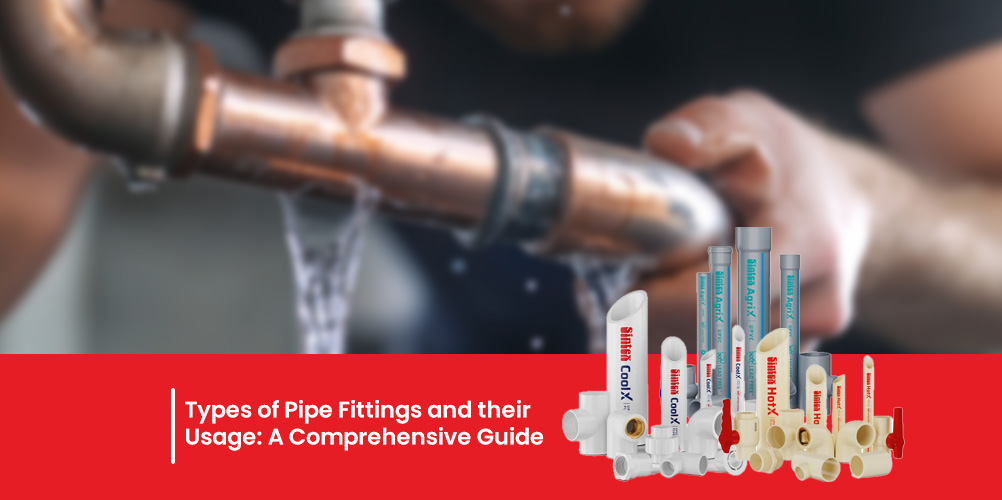
Table of Contents
Pipe fittings are the unsung, quiet heroes of any plumbing system. They keep everything in place, allow water to flow smoothly, and stop leaks that ruin your day. At Sintex, we’ve taken fittings to the next level with high-precision threading and premium-quality joints that keep your system strong and watertight.
Any plumbing system speaks volumes. All connections do their thing from the faucet that fills your glass to the drain that empties your sink. But behind every sleek flow and clean seal is one magic ingredient: the pipe fitting.
On your PVC water piping system at Sintex, your connections are as strong as your strongest joint. That’s why we create fittings to join pipes, safeguard your water, keep it from leaking and last for decades. As a professional plumber, contractor or homeowner, learning about different PVC fittings and how they can benefit you can help you make superior, safer decisions for your home.
Why Pipe Fittings Matter More Than You Think ?
Think of your plumbing as a living network. Without strong joints and connectors, the system can fall apart quite literally. Without rock-solid joints and connectors, the entire system can break down. Fittings control how your PVC pipes branch out, curve, constrict, or seal. Bad fittings leak, contaminate, or restrict flow, particularly at high pressure.
That’s why we at Sintex use premium materials and advanced threading design. Our fittings and connectors of PVC are designed with additional threading, giving good sealing and zero leakage even under load. A small detail that contributes significantly to long-term performance.
Understanding Materials: PVC vs. Metal vs. Plastic
The fittings can be constructed of some of the following: brass, copper, stainless steel, or plastic. But for most contemporary applications, PVC pipe fittings and UPVC fittings are the most common.
PVC and UPVC are used due to the fact that they are simple to install, lightweight, and rust-proof. Moreover, plastic pipes & fittings are significantly cheaper than metal, making them highly suitable for big projects.
What are the Common Types of Pipe Fittings ?
Let’s look at a few fittings and how each keeps your plumbing system working efficiently:
1. Elbows
Elbows assist in changing the direction of the flow, usually by 45° or 90°.
Whether it’s your PVC drain pipe or PVC water pipe, elbows ensure water moves where it’s supposed to, without pressure loss.
2. Tees
These are T-shaped fittings used to split or combine flow. Most suitable to redirect water from a single main line to multiple ends.
3. Couplings
Couplings connect two pipes of the same size. Most convenient when installing or replacing new PVC pipes.
4. Reducers
Reducers connect pipes of different diameters, maintaining smooth flow between large and small sections.
5. Unions
Unions allow easy disconnection of pipes for maintenance. They’re used most often in systems where cleaning or inspection is regular.
6. Adapters
Adapters connect pipes of varying materials, like metal and PVC fittings, to provide system compatibility.
7. End Caps
These close off pipe ends to prevent leaks or contamination. Great for safety and temporary sealing during construction.
8. Nipples
Short threaded connectors link two fittings, mostly used in specialised industrial setups.
9. Cross Fittings
Used where four pipes meet. Cross fittings are functional in irrigation or distribution systems.
10. Bushings
Bushings decrease the pipe opening to accommodate fewer oversized connections, providing ease in system design.
How to Choose the Right Fittings for Your Project ?
PVC connectors or fittings are selected based on three factors: application, pressure, and water temperature.
- For water pipes made of PVC, corrosion-resistant, tight-threaded fittings must be employed.
- For free flow and least jamming, employ PVC drain pipe fittings for drainage applications.
- For hot water installations, use high-temperature-rated fittings at all times.
At Sintex, we simplify this decision by manufacturing a complete range of fittings designed for performance and ease of installation.
How Sintex Makes Leak-Free Connections ?
Here’s where we take fittings seriously. Sintex fittings provide longer threads than most standard fittings, providing a leakage-proof, tight fit between brass and plastic fittings. Our fittings are subjected to severe pressure and torque testing to ensure they can withstand up to 130 Nm torque, so your system is safe even in extreme conditions.
We use antimicrobial technology, UV-stabilised materials, and chlorine-resistant chemicals so our fittings are sanitary and long-lasting for long-term water usage.
What is the Cost: PVC Pipe Price vs. Value
Placing PVC pipe price or plastic pipe price in perspective, remember that worth is not in the cash but in dependability. Inexpensive fittings are cheap initially, but leaks and replacement are more expensive in the long run.
Sintex fittings hit the right note. They are cost-effective, long-lasting, and certified to international quality standards.
The Best Pipes for Plumbing and Drainage
The ideal plumbing system is harmony: the proper pipes and fittings. Sintex provides comprehensive systems of PVC pipes, PVC fittings, and PVC drainpipes that are designed to coexist harmoniously. Our products are corrosion-resistant, UV-resistant, and water-pressure-resistant, with smooth flow and effortless installation.
Final Thoughts
Pipe fittings may appear like little pieces, but they are the backbone of any decent plumbing system. From PVC couplings to reducers and unions, each piece of the puzzle is important to ensuring your water is pure, your walls are not wet, and your system performs at its best.
At Sintex, we bring precision design, quality materials, and rigorous testing together with providing fittings that perform as hard as you do. Because when plumbing is involved, as is life, things that hold strong are important.
Find Sintex PVC fittings and PVC pipes for leak-proof, rust-proof, and long-lasting plumbing solutions.
For water supply systems, you need pipe fittings that handle continuous pressure without leaking. The most commonly used ones are couplings, elbows, tees, and reducers. Couplings join two pipes of the same diameter securely. Elbows redirect flow at 45° or 90° angles, which comes in handy when routing water around walls or corners. Tees split a single supply line into multiple outlets, and reducers manage the transition between different pipe sizes. Among the plumbing pipe fittings types available, PVC fittings are the preferred choice for water supply. Contractors and plumbers prefer them because they resist corrosion, handle sustained pressure, and don't affect water quality. Sintex PVC pipe fittings use longer threading than standard fittings, which creates a tighter seal and zero leakage, even under continuous water pressure.
The most common types of pipes in plumbing are PVC, UPVC, CPVC, and metal pipes like copper and steel. PVC pipes are the most widely used for water supply and drainage. They're lightweight, corrosion-resistant, and straightforward to install. UPVC pipes carry more rigidity and work especially well for cold water supply and drainage systems. CPVC pipes handle higher temperatures, making them a better fit for hot water lines. Metal pipes like copper last long but cost significantly more and corrode over time. For most residential and agricultural plumbing needs, PVC and UPVC are the practical first choice. Sintex offers a full range of PVC pipes and UPVC pipes built to IS:4985 and IS:13592 standards, covering water supply and drainage across project sizes.
Pipes and fittings work together, but serve different purposes. A pipe is the main channel that carries water from one point to another. A pipe fitting is a connector that links pipes, controls flow direction, adjusts size, or seals off a line. So what are pipe fittings and their uses, really? Put simply: pipes carry the water, and fittings guide it. Without the right pipe fittings, a network of pipes cannot branch out, change direction, or connect to fixtures. Among the common types, elbows handle direction changes, tees split or combine flow, couplings join pipes of the same size, reducers manage size transitions, and end caps close off open line ends. Each fitting plays a specific role. Using the wrong one at any junction leads to leaks, pressure loss, or system failure. Sintex designs pipes and fittings as a complete, compatible system so both work together without compromising the connection.
Plumbing systems use several types of pipe joints and fittings, each built for a different function. Elbows are among the most common types of pipe fittings, changing flow direction at either 45° or 90°. Tees split or combine flow from a main line. Couplings connect two pipes of the same diameter, and reducers bridge pipes of different sizes. Unions let you disconnect pipes for maintenance or inspection without cutting them. Adapters connect pipes made of different materials, such as metal to PVC. Cross fittings manage four-way intersections, common in irrigation or distribution setups. Bushings reduce a pipe opening to fit a smaller connection. Each of these plumbing pipe fittings types serves a distinct, non-interchangeable purpose. The key is identifying what your system needs at every junction and pairing the right fitting with a pipe that matches it in pressure rating and material.
PVC and UPVC pipe fittings rank among the most durable options available today. They resist corrosion, UV exposure, and chemical contact, which gives them a long service life even in demanding conditions. Among the types of PVC fittings and uses, pressure-rated fittings built for water supply systems tend to outlast non-pressure variants because manufacturers hold them to stricter quality benchmarks. What sets Sintex apart in this area is the extended threading design on their fittings. Longer threads create a stronger, tighter seal compared to standard pipe connectors. Sintex also tests their fittings for torque resistance up to 130 Nm, and uses UV-stabilised, antimicrobial materials throughout. These pipe connectors are built to hold up over years of daily use, not just a season or two. If durability without frequent replacements is what you're after, Sintex PVC fittings deliver exactly that.
Categories
Year
Related blogs