

Table of Contents
CPVC pipes have become the default choice for hot water plumbing in Indian homes, and they turn up in almost every new bathroom, kitchen and geyser line. But most buyers still have the same handful of doubts before they commit. This CPVC pipe FAQ collection answers the ten questions we hear most often, covering what the material actually is, where it is used, whether it is safe for drinking water, how hot it can go, what sizes exist, how long it lasts and how it gets installed. Everything here is drawn from Indian standards and manufacturer documentation, so you can check any answer yourself.
Key Takeaways
- CPVC stands for Chlorinated Polyvinyl Chloride, a thermoplastic made by chlorinating ordinary PVC.
- Hot and cold both. CPVC pipes handle both, which is why they’re standard for geyser and bathroom lines.
- The Indian standard is IS 15778 for potable hot and cold water pipes.
- Sizes run from half an inch upward, in SDR 11 and SDR 13.5 classes.
- Joints are made with solvent cement, not threading, so installation quality decides how long the system lasts.
1. What Are CPVC Pipes?
Chlorinated Polyvinyl Chloride is the CPVC full form, and it describes exactly how the material is made. Ordinary PVC resin is put through a chlorination process, which raises the chlorine content and changes how the plastic behaves under heat.
That single change is what separates the two materials. Regular PVC softens at fairly modest temperatures, so it is restricted to cold water. The extra chlorine lets CPVC pipes hold their strength and shape at much higher temperatures, which is why they can carry hot water where PVC can’t.
Chlorine content is critical here: chlorination raises the chlorine content of the base PVC resin from roughly 57 percent to somewhere between 62 and 68 percent, which lifts the polymer’s glass transition temperature by 20 to 35°C. That higher softening point is exactly what lets CPVC carry hot water.
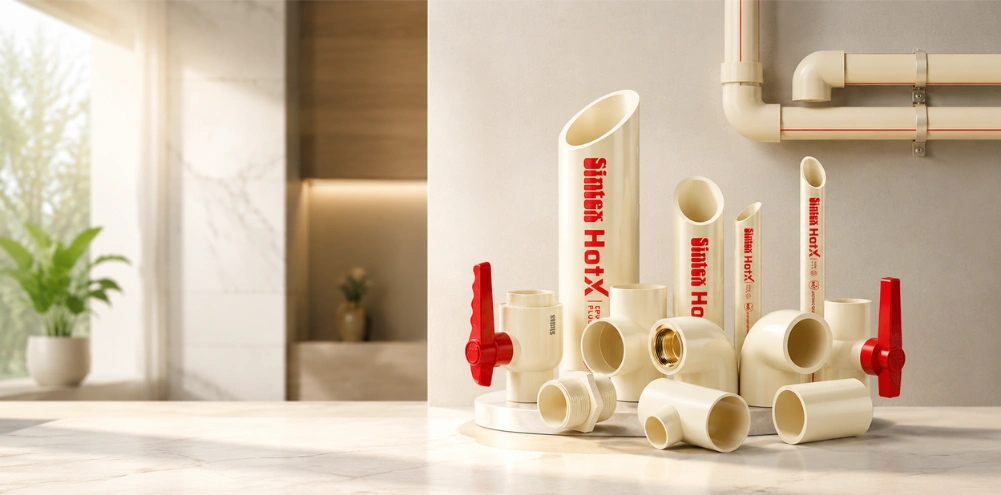
In every other respect it behaves like a good plastic pipe. It doesn’t rust, resists most chemicals found in water supplies, is light to handle and has a smooth bore that doesn’t scale up the way metal does. The Bureau of Indian Standards covers the material under IS 15778, the standard for CPVC pipes for potable hot and cold water distribution supplies. Sintex’s HotX CPVC Plus is one such range built to this standard, designed specifically for hot and cold potable water plumbing in Indian conditions.
2. What Are CPVC Pipes Used For?
You can use CPVC anywhere where hot water travels, and in plenty of places it doesn’t. Typical CPVC pipe application in Indian buildings falls into three groups.
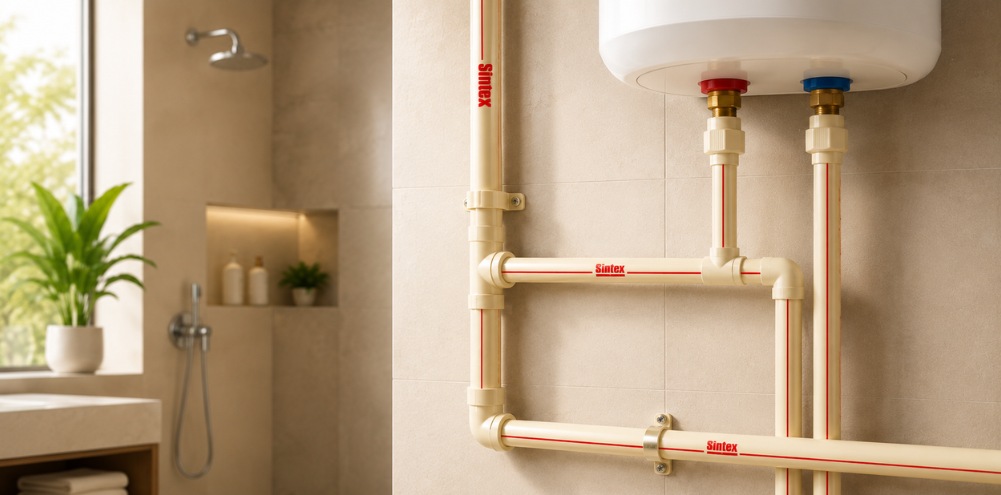
- Residential plumbing: Geyser inlet and outlet lines, bathroom and kitchen supply, and solar water heater connections. This is the biggest use by far, since a home’s hot water line is the one place PVC simply can’t be used.
- Commercial buildings: Hotels, hospitals, schools and offices, where hot and cold water both run through the same system and demand is heavy through the day.
- Industrial use: Water distribution inside plants, including heating and cooling lines and some chemical transfer, where the material’s chemical resistance matters.
You’ll also find CPVC on solar water heating loops, where outlet temperatures can climb, and in boiler and cooling lines inside plants.
Because the same system carries cold water perfectly well, many builders run CPVC pipes for both hot and cold lines rather than mixing two materials in one wall. It simplifies the job and means one set of fittings and one solvent cement on site. Sintex HotX CPVC Plus covers all three groups above, with a matched fittings range across residential, commercial and industrial applications.
3. What Are the Benefits of CPVC Pipes?
Beyond handling heat, a few practical characteristics explain why CPVC pipes took over from metal in Indian plumbing.
- Corrosion resistance: The material doesn’t rust or corrode, so you don’t get the brown water and slow failure that eventually hits GI pipe.
- Smooth internal surface: A smooth bore keeps flow steady and resists the mineral scaling that narrows metal pipes in hard water areas.
- Lighter and easier to handle: Pipes are far lighter than metal, which cuts transport and labour effort on site.
- No threading needed: Joints are solvent-welded rather than cut and threaded, so a run goes up faster, with fewer tools and lower labour cost on site.
- Chlorine resistance: Municipal water carries residual chlorine, which degrades some materials over time, and CPVC is designed to be unaffected by it in potable supplies.
- Antimicrobial additive in the compound: Sintex HotX CPVC Plus carries an antimicrobial additive mixed into the pipe material itself, not applied as a coating. That means the protection doesn’t wear off with water flow. It’s a practical addition for potable lines where hygiene over the long term matters.
Worth remembering that the pipe is only half the system. CPVC pipe fittings, elbows, tees, reducers, couplers and brass transition fittings for taps and mixers have to come from the same compatible range. Mixing a pipe from one system with fittings meant for another is a common cause of joint failure.
Also Read: Benefits of CPVC Pipes for Plumbing
4. Are CPVC Pipes Suitable for Hot and Cold Water?
Yes to both, and this is the main reason CPVC exists. The system carries cold water as well as any plastic pipe, and unlike PVC, it is built to carry CPVC pipes for hot water too.
The numbers need care, though, because two figures circulate and they mean different things. IS 15778 defines the standard’s scope as water service up to and including 82°C, and Amendment 3 (December 2020) replaced the earlier 90°C reference with 82°C, so that’s the standard’s working limit throughout. Manufacturers, including Sintex, cite a peak capability of about 93°C, matching the international convention for CPVC. The 93°C figure is a maximum the material can tolerate, not a temperature to design a system around.
There’s a second point that matters more than the headline number. Pressure and temperature work against each other. The standard notes a recommended maximum safe working stress of 8.6 MPa at 27°C, and states that as temperature rises towards 82°C the strength of the pipe reduces and the working pressure must be modified accordingly. So a pipe carrying near-boiling water safely handles far less pressure than the same pipe on a cold line.
In practice, this is why geyser outlets are the one spot to be careful. Keep the actual CPVC pipe temperature rating in mind against your geyser’s thermostat setting, follow the manufacturer’s pressure derating, and don’t let a solar heater outlet run unchecked into the line.
5. Are CPVC Pipes Safe for Drinking Water?
When you buy pipes certified for the job, they are safe for drinking water. The Indian standard governing them, IS 15778, is written specifically for potable hot and cold water distribution supplies, so drinking-water suitability is built into the specification rather than being an added claim.
For anyone asking whether ‘is CPVC pipe safe for drinking water’ in practice, three checks settle it.
- Look for the ISI mark. BIS certification marking against IS 15778 is the clearest signal the pipe meets the Indian requirement for potable water, and the standard requires the pipe to be marked at intervals of no more than 3 metres with the maker’s name, outside diameter, class and pressure rating, and batch number. Since Amendment 3, that batch number also has to encode the production year, month, day, machine number and shift, which makes a genuine pipe traceable to the run that made it.
- Check for lead-free and potable certifications. The binding Indian requirement is in IS 15778 itself: a 2021 amendment requires that lead, tin and other toxic extractables stay within the limits set in IS 4985, alongside the Government of India’s phase-out of lead stabilisers. You’ll also see international marks on some ranges, such as NSF/ANSI/CAN 61 for what can leach into the water and NSF/ANSI/CAN 372 for lead content in the material. These are American standards rather than Indian requirements, so treat them as an extra assurance on top of the ISI mark, not a substitute for it. Sintex’s HotX CPVC Plus range carries both. The pipe compound also includes an antimicrobial additive throughout the material for hygiene protection that a standard CPVC pipe doesn’t offer.
- Use compatible fittings and the correct solvent cement. A certified pipe joined with the wrong cement or an incompatible fitting undoes the assurance.
Installation matters too. Flush a new line thoroughly before use so any residual solvent cement is cleared out, and give joints their full cure time before the line carries drinking water. The standard backs this up on the material side: Amendment 4 (June 2021) requires that pipes have no detrimental effect on the water, with lead, tin and other toxic extractables held to the limits set in IS 4985.
6. How Long Do CPVC Pipes Last?
Longer than most other plumbing materials, though nobody can promise a single universal number, and any brand quoting an exact lifespan for every situation is overreaching.
What decides the actual life of the pipe is straightforward.
- Operating temperature. A line running constantly at high temperature ages faster than one carrying mostly cold water, because strength reduces as temperature rises.
- Pressure. Sustained high pressure, and repeated water hammer from fast-closing taps and valves, shorten service life.
- Water chemistry and exposure. CPVC handles chlorinated municipal water well, but long unprotected exposure to direct sunlight is hard on any plastic unless the pipe is UV-stabilised.
- Installation quality. Badly made solvent joints and inadequate support are the most common causes of early failure, far more than the pipe itself wearing out.
So the honest view on CPVC pipe life span is that a properly specified, correctly installed system in normal domestic service lasts for decades. The standard itself is built around long-term hydrostatic performance testing, which is a far better guide than any marketing figure on a brochure. Sintex HotX CPVC Plus is tested to these long-term hydrostatic requirements under IS 15778 so, the lifespan claim rests on the standard’s own performance criteria rather than a standalone promise.
7. What Sizes of CPVC Pipes Are Available?
CPVC pipes are sized by CTS, or Copper Tube Size, which is the sizing convention this system follows. You’ll see sizes quoted in inches, and the range available depends on the manufacturer and pressure class.
Sintex, as one example, lists its HotX CPVC Plus range in two classes: SDR 11 pipes from ¾” to 2″ carrying a red stripe, and SDR 13.5 pipes from ¾” to 2”carrying a brown stripe, both in 3 metre lengths, with fittings across the ¾” to 2″ span. Its concealed valves and wall mixer adaptors run in the ½” to 1″ range.
SDR is the ratio of the pipe’s diameter to its wall thickness. A lower SDR means a thicker wall for the same diameter, so SDR 11 pipe is the heavier-duty option. BIS recognises SDR 11 & SDR 13.5 CPVC.
Choosing among CPVC pipe sizes comes down to demand and run length. Branch lines to a single tap or geyser typically use the smaller sizes, while risers and mains feeding several fixtures step up. Longer runs also lose pressure, so a longer line may need a size larger than a short one serving the same fixture.
8. How Are CPVC Pipes Installed?
CPVC is joined by solvent cement welding, not threading. The cement chemically softens both surfaces so they fuse into one piece as they set, which is why a correct joint is as strong as the pipe itself.
The broad sequence looks like this.
- Measure and cut: Cut square with a proper pipe cutter, since an angled cut reduces the bonding surface.
- Deburr and clean: Remove burrs from the cut edge and wipe both the pipe end and the fitting socket clean and dry.
- Apply cement: Apply the correct CPVC solvent cement, not PVC cement, to pipe and fitting.
- Join and hold: Insert with a slight twist, hold briefly so it doesn’t push back out, and wipe off excess.
- Cure before pressure: Let the joint cure for the time the cement manufacturer specifies before testing or using the line.
Two questions come up constantly in CPVC pipe installation questions. Yes, CPVC needs its own solvent cement, since PVC cement is not a substitute. And metal connections at taps, mixers and geysers are made with transition fittings, usually brass, rather than by threading the plastic directly.
Allow for thermal movement too. Hot water lines expand and contract, so proper clipping and support matter, and always follow the manufacturer’s installation guidance for the specific range. Sintex HotX CPVC Plus, for example, comes with a matched solvent cement and a fittings range from the same system, which ensures compatibility.
Also Read: Common Plumbing Mistakes and How to Avoid Them
9. What Is the Difference Between CPVC, PVC and uPVC Pipes?
These three get mixed up constantly at the counter, and this is the single most common entry in any CPVC pipe FAQ. Note that uPVC and PVC are commonly used to mean the same rigid, unplasticised material in Indian plumbing, with uPVC simply making the “unplasticised” part explicit.
The differences come down to one property: how much heat the material tolerates before it softens. That single difference decides where each pipe is allowed to go in a building, which is why the three are not interchangeable even though they look broadly similar on the shelf.
| CPVC | uPVC / PVC (pressure) | PVC drainage | |
| Material | Chlorinated PVC | Unplasticised PVC | Unplasticised PVC |
| Water temperature | Hot and cold, to 82°C scope | Cold lines; rated at 27°C with derating as temperature rises | Not a pressure pipe |
| Typical use | Geysers, bathrooms, kitchens, solar | Cold supply lines, overhead tank lines | Waste, soil and rainwater |
| Indian standard | IS 15778 | IS 4985 | Drainage standards |
| Jointing | CPVC solvent cement | uPVC solvent cement | Solvent cement or rubber ring |
One more distinction worth keeping straight: CPVC and uPVC use different solvent cements, and the two are not interchangeable. Using PVC cement on a CPVC joint is a common site error that shows up later as a weeping joint.
A quick note on the third column: drainage pipes are not pressure pipes at all. They carry waste water under gravity, so they’re made to different standards and shouldn’t be pressed into supply duty.
The practical rule is simple. If hot water touches the line, use CPVC. If it is a cold supply line, uPVC does the job at lower cost. If it is waste or rainwater, you want the drainage range, not a pressure pipe. None of these is a better material in the abstract; they’re built for different jobs, and the CPVC vs PVC pipes question is really a question about temperature.
10. How Do You Choose the Right CPVC Pipes for Your Application?
Once you know the material, picking the right pipe comes down to matching the product to the conditions of the line.
- Application and temperature: Hot line, cold line, or both. This decides the material before anything else.
- Size: Work from fixture demand and run length, then choose from the available CPVC pipe sizes rather than defaulting to whatever’s in the van.
- Pressure class: SDR 11 gives a thicker wall than SDR 13.5 for the same diameter. High-rise risers and mains generally justify the heavier class.
- Standards and certification: Look for the ISI mark against IS 15778, plus potable and lead-free certifications.
- Fittings compatibility: Buy CPVC pipe fittings from the same system as the pipe, and use the matching solvent cement.
- Installation conditions: Concealed, exposed or outdoor. Anything in sunlight should be UV-stabilised, and hot lines need proper support for expansion.
Budget deserves an honest mention as well. CPVC costs more per metre than uPVC, which tempts some buyers into running a cold-water pipe on a hot line to save money. That saving disappears the first time a softened pipe sags or a joint gives way behind a tiled wall, so match the material to the duty rather than to the quote.
If you’re unsure on any of these, ask the supplier for the product’s specification sheet and check the certifications on it rather than relying on what’s printed in the catalogue.
Get these six right and the system does its job quietly for years, which is all anyone wants from plumbing.
Also Read: Home Plumbing Pipes: A Guide to Types and How to Choose the Right One
Conclusion
Work through any CPVC pipe FAQ and the answers come back to the same few facts: it is chlorinated PVC, it is made for hot and cold potable water, it is covered in India by IS 15778, it is sized by CTS in SDR classes, and it is joined with solvent cement. Get the certification, the size and the installation right, and the material handles the rest. Our Sintex HotX CPVC Plus range is built to these standards, with an antimicrobial additive in the pipe compound, NSF certifications for potable water, and matched fittings and solvent cements so the whole system comes from one place.