

Table of Contents
Quick Answer: SMC Panel Tank Maintenance comes down to four routines: inspect the panels, joints and bolts on a fixed schedule, clean the interior at an interval matched to your water quality, keep the external steel supports coated and the fasteners tight and repair small leaks before they spread. Do that and an SMC panel tank can serve for decades. Neglect the steelwork and the foundation, and problems arrive far sooner.
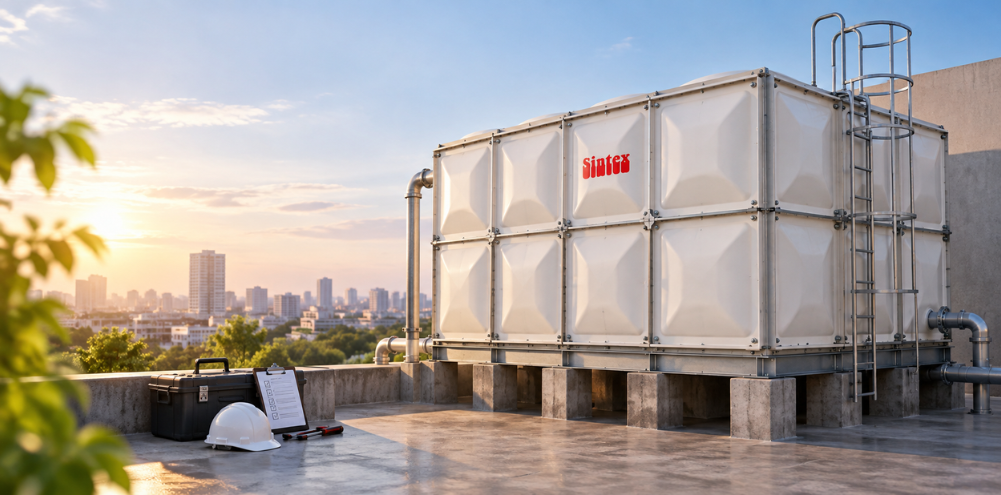
Large panel tanks tend to get forgotten. They sit on a terrace or in a basement; they hold hundreds of thousands of litres, and as long as taps keep running downstairs, nobody looks inside them. That works until it doesn’t. Good SMC Panel Tank Maintenance is what keeps a building’s water supply predictable, and it costs far less than an emergency shutdown with tankers parked outside. This guide covers what maintaining an SMC water tank actually involves for a facility team: how often to inspect, what to look at, how to clean it, what typically goes wrong, what can be repaired, and what decides how long the tank lasts.
Key Takeaways
- Inspect on a schedule, not when something looks wrong. Quarterly walk-arounds plus an annual detailed check suit most buildings.
- Clean the interior on a risk basis: stored water quality, turnover and end use.
- Watch the metalwork. Panels don’t rust, but external steel and bolts do, and that’s where SMC water tank maintenance belongs.
- Most faults are repairable. Gaskets, bolts and single panels swap out without dismantling the tank.
- SMC panel tank lifespan rests as much on the foundation and upkeep as on the panels.
What Does SMC Panel Tank Maintenance Involve?
Maintaining a panel tank is not one job but a small set of recurring ones. Because these tanks are assembled on site from moulded panels, bolts, gaskets and a support structure, maintenance covers the assembly as much as the panels.
Work through it in five areas.
- Panels: Check internal and external surfaces for cracks, scratches deep enough to expose the glass reinforcement, blisters and repair marks. IS 14399, the Indian standard for these tanks, lists exactly these as panel defects.
- Joints, seals and bolts: Every panel joint depends on a gasket held under bolt tension. Sealants must stay non-toxic and chemically resistant to the water stored, and fasteners must stay tight and uncorroded.
- Support structure: Internal stays are stainless steel, GRP or uPVC, but external supports are coated or galvanised mild steel. That coating is consumable and needs renewing.
- Internal cleanliness: Sediment settles, and the tank’s smooth interior needs periodic washing out.
- Fittings and access: Inlet, outlet, overflow, drain, air vent, manhole covers and ladders all need to work and stay sealed.
Knowing how to maintain SMC panel tank assets really means running these five checks on a schedule instead of reacting to complaints.
How Often Should an SMC Panel Tank Be Inspected?
There’s no one universal interval. Frequency depends on how heavily the tank is used, site conditions, the quality of water stored, the manufacturer’s recommendations for your tank, and your own facility maintenance policy. A hospital tank in a coastal city and a lightly used office tank inland don’t warrant the same schedule.
Within those constraints, a workable pattern looks like this.
- Routine visual checks, monthly or quarterly: Walk around the tank and look at the support steel, the base and the surrounding floor for damp patches or staining. This takes minutes and catches slow leaks early.
- A detailed inspection, at least annually: Because the National Building Code requires storage cisterns to be thoroughly cleaned at least once every year, the annual clean is the natural point to inspect the interior properly, since the tank is drained and accessible anyway.
- An unscheduled inspection after any significant event: Seismic activity, building work nearby, a change in water clarity, or any structural repair justifies a look regardless of the calendar.
Shorten the interval where risk is higher: poor or variable raw water, tanks that sit full without turnover, exposed outdoor installations, and tanks serving hospitals, food operations or fire reserves. Regular SMC water tank maintenance is mostly about catching small things while they’re still small.
What Should Be Included in an SMC Panel Tank Inspection?
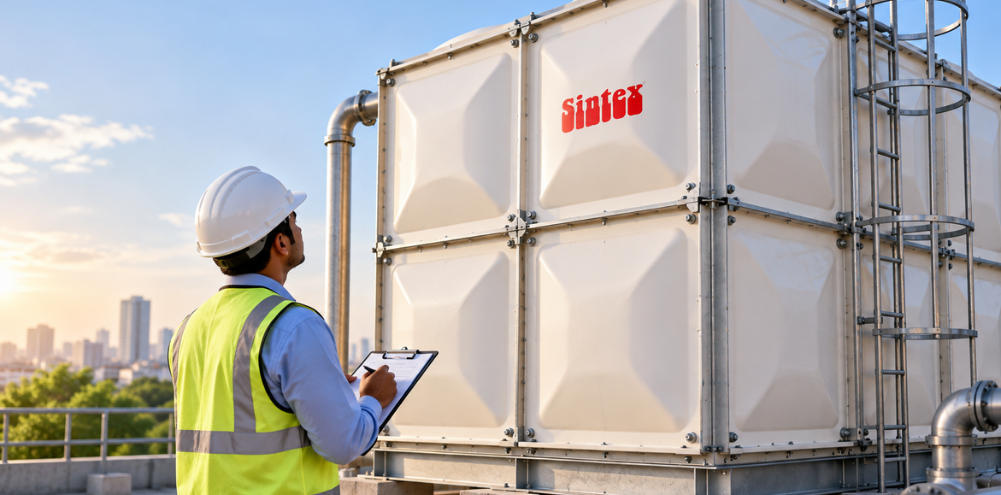
A good inspection is systematic. Work from the outside in, and write down what you find rather than trusting memory. This SMC panel tank maintenance guide breaks the check into five groups.
- Panel condition: Inspect internal and external surfaces for the defects the standard lists: surface pits, poor impregnation of the fibreglass with resin, cuts, cracks and scratches exposing the glass reinforcement, sharp projections or exposed fibres, repair marks, and blisters caused by air pockets.
- Leakage: Look for active drips, damp patches, mineral staining or efflorescence around joints, and pooling under the tank. The standard’s own acceptance test is a tank filled to overflow level showing no visible sign of leakage after 48 hours, which is a fair benchmark for an in-service tank too.
- Joints, seals and gaskets: Check gaskets at panel joints for compression set, displacement or perishing, and confirm sealing material is intact.
- Bolts and fasteners: Fasteners should be at least 10 mm diameter and hot-dip galvanised, with stainless steel used for any internal bolting. Look for loose, missing or rusting bolts and check tension against the manufacturer’s figure.
- Structure and fittings: Check external steel supports for rust and coating breakdown, confirm the base is level and bearing evenly, and test that the air vent still excludes insects, that manhole covers seal and lock, and that ladders are sound.
How Should an SMC Panel Tank Be Cleaned?
Periodic cleaning matters for two reasons. Sediment settles out of stored water onto the tank floor, reducing usable capacity and giving bacteria somewhere to establish. And standing water in a warm tank is a hygiene risk in itself. The National Building Code treats this as a requirement, specifying that storage cisterns be thoroughly cleaned at least once every year to remove settled impurities.
On frequency, we advise internal cleaning of our panel tanks generally once in 18 to 24 months where water quality allows it. Where the Code’s annual requirement applies to your installation, or where poor water quality, slow turnover or a sensitive end use warrants it, clean more often. Set the interval deliberately, document it, and stick to it.
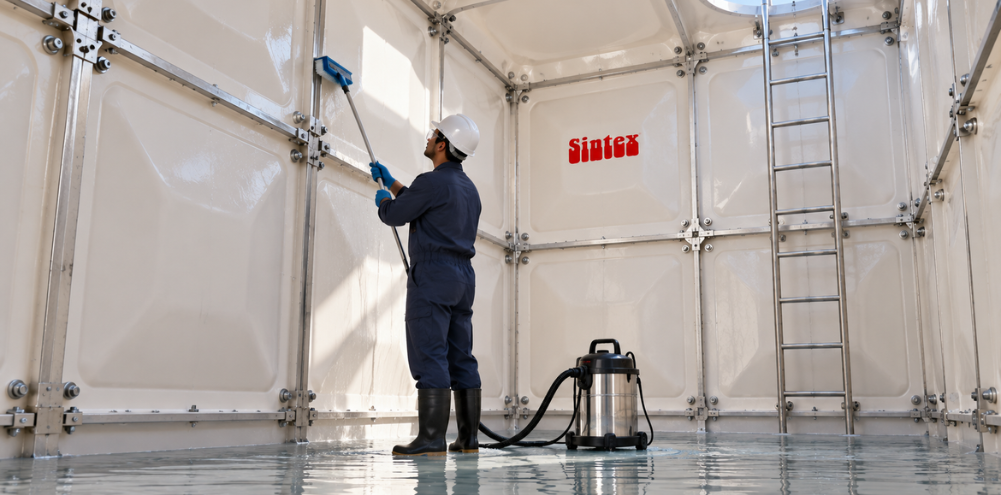
Cleaning itself is specialist work, and tank entry is a confined space activity for trained personnel with the right equipment and supervision. What matters for a facility manager is what to check around it.
- Before cleaning: confirm isolation and alternate supply, check that the drain and wash-out arrangements work, and plan access.
- During cleaning: use the opportunity while the tank is empty. This is the one time the interior, the joints and the internal supports can be examined properly.
- After cleaning: confirm the tank has been disinfected and flushed before being returned to service, check for leaks as it refills, and record what was done.
Sound SMC panel tank cleaning is as much about the inspection it enables as the sediment it removes.
Also, Read: Why is Water Tank Hygiene Important for Health?
Common SMC Panel Tank Maintenance Issues
Panel tanks are low-maintenance rather than no-maintenance, and the problems that appear are fairly predictable. It helps to sort them by whether your own team can handle them.
Usually routine maintenance:
- Joint and gasket leakage: The most common issue by far. Gaskets take a compression set over years, bolts relax, and a joint that was watertight at commissioning starts to weep. It typically shows as staining or damp below a specific seam rather than a visible drip.
- Loose or corroded fasteners: Bolts are galvanised rather than stainless unless they are internal, so once the coating is damaged, rust follows and the bolt can no longer hold gasket compression.
- Sediment accumulation: Silt and scale settle on the tank floor, reducing usable capacity.
- Fitting problems: Damaged air vent mesh, a manhole cover that no longer seals, a dripping inlet or outlet connection.
- Surface coating breakdown on external steel: In humid or coastal air the coating on the exterior support system degrades, which is why it is recommended to repaint the iron items, the vertical posts and tie rods, after a period in service.
Needs specialist assessment:
- Panel damage that exposes the glass reinforcement, or cracking across several panels rather than one.
- Any sign of foundation settlement or uneven bearing, since panel tanks need continuous support under every panel edge and settlement stresses joints never designed to carry it.
- Corrosion of the structural support system or stay bars.
- Leaks that recur after a proper repair, which usually point to a cause other than the gasket itself.
The dividing line is simple enough: components are routine, structure is specialist.
Can an SMC Panel Tank Be Repaired?
It depends on where the damage is and how far it extends, but usually yes. Because an SMC panel tank is bolted together from discrete panels rather than cast in one piece, most damage can be addressed locally rather than by replacing the tank.
Commonly repairable:
- Leaking joints, by replacing the gasket and re-tensioning bolts to the manufacturer’s specification.
- Corroded or missing bolts, replaced with fasteners of the correct specification.
- Fittings such as vents, covers, ladders and inlet or outlet connections.
- Individual damaged panels, which can be swapped out without dismantling the whole tank.
- Coating breakdown on external steelwork, by cleaning back and repainting.
Needs trained assessment first: cracks exposing the glass reinforcement, damage across multiple panels, anything involving the support structure, and any suspicion of foundation movement. These affect how the tank carries load and how it contacts stored water, so they warrant a proper structural assessment rather than a patch.
Two rules apply to any repair. Use the manufacturer’s recommended method and materials, since the standard directs that leaks be stopped in accordance with the manufacturer’s recommendations and the tank retested afterwards. And verify the repair by refilling and checking for leakage before signing it off. This SMC panel tank maintenance guide assumes repairs get tested, not just performed.
How Long Does an SMC Panel Tank Last?
We design our SMC panel tanks for a service life of up to 50 years, covering the tank and its parts. That’s a realistic figure for the composite panels themselves, which don’t rust and are UV stabilised on the outer face, but it deserves two pieces of context.
First, the panels and the assembly age differently. Bolts, gaskets and the external steel structure are consumable items with shorter lives, and they need periodic replacement or recoating within that overall span. A 50-year SMC water tank is one whose fasteners and seals have been maintained throughout, not one left untouched.
Second, a stated design life is not a warranty. Our supply warranty is one year from dispatch, which is normal for the industry and separate from the expected service life. Facility managers should read the two figures as answering different questions: how long the tank should last if looked after, and what the supplier covers commercially.
So the honest answer on SMC panel tank lifespan is that a well-specified, well-installed, well-maintained tank should serve for decades, and the same tank neglected can develop problems in a fraction of that time.
What Factors Affect SMC Panel Tank Lifespan?
Several things decide whether a tank reaches its potential life or falls short.
- Installation quality: This matters more than anything else. Every panel edge must rest on the supporting steel structure, and the base has to stay level and stable. A tank on an uneven or settling foundation carries stress in its joints for its entire life.
- Operating conditions and load: The standard covers tanks storing water not exceeding 50°C at pressures no greater than the static head of the tank’s own depth. Running outside those conditions shortens life.
- Exposure: Outdoor tanks take constant UV and weather. Outer panel faces are UV stabilised, but exposed steelwork weathers faster, particularly in coastal or humid regions.
- Water quality: Our panel tanks suit liquids in the pH 5 to 8 range. Aggressive water, heavy sediment loads or high chlorine dosing all place extra demand on surfaces and seals.
- Structural support condition: Corroded bolts, degraded stay bars and rusting external posts undermine the assembly, however sound the panels are.
- Seal and joint condition: Gaskets are the shortest-lived component in the tank, and their condition largely determines how often you deal with leaks.
- Cleaning practice and inspection frequency: Tanks cleaned and inspected on schedule surface problems early; neglected tanks surface them as failures.
- Speed of corrective action: How quickly a small fault gets fixed matters as much as finding it. Consistent SMC Panel Tank Maintenance is what converts a stated design life into an actual one.
How Facility Managers Can Extend the Service Life of an SMC Panel Tank
Extending service life is mostly about routine, not heroics. A few habits do most of the work.
- Run a planned inspection schedule: Fix quarterly walk-arounds and an annual detailed inspection in the maintenance calendar, with named responsibility rather than “whoever is free”.
- Document every clean and inspection: Record the date, who did it, what was found, and what was rectified. Over years this record shows whether a leak is new or recurring, and it’s invaluable when deciding between repair and replacement.
- Act on small leaks immediately: A weeping joint is a gasket and an hour’s work. Left alone, it corrodes fasteners and can wash out foundation support.
- Keep the metalwork protected: Repaint external steel posts and tie rods on a defined cycle, before rust reaches the section rather than after.
- Maintain bolt tension: Check fasteners at each detailed inspection and replace any that are corroded or missing with correct-specification parts.
- Protect water quality: Keep manhole covers closed and locked, keep vent mesh intact, and clean before sediment becomes a layer.
- Respect the design conditions: Don’t exceed the temperature, pressure or chemistry the tank was specified for.
Understanding how to maintain SMC panel tank assets well is less about technical difficulty than about doing ordinary things on time, and this SMC panel tank maintenance guide is only useful if it turns into a schedule someone owns.
Preventive Maintenance vs Reactive Repair: Why Planning Matters
The difference between planned and reactive work is mostly a difference in cost and disruption.
Preventive maintenance is scheduled, cheap and quiet. An inspection finds a gasket beginning to weep; it’s replaced during planned downtime, and nobody in the building notices. Reactive repair is what happens when the same gasket fails at scale: water on the terrace or in the basement, an emergency drain-down, tankered water while the tank is out of service, and a repair done under time pressure at a premium.
The consequences compound too. A slow leak doesn’t stay a leak. It corrodes fasteners, saturates and undermines the foundation, and can eventually turn a component problem into a structural one. Contamination risk works similarly, since a damaged vent or unsealed cover is an open route into stored water that nobody notices until a water quality complaint arrives.
There’s a compliance dimension as well. The panels used in these tanks are type tested for potability, and the standard requires that potability test to be repeated once every three years even when nothing in the material or process changes. That’s a useful reminder that water safety is treated as a recurring check, not a one-time certificate. Consistent SMC water tank maintenance is simply the building-level version of the same idea.
SMC Panel Tank Maintenance Checklist for Facility Managers
Use this as a working document. Adjust the intervals to suit your building, your water quality and your manufacturer’s guidance, but keep the six groupings, because each one fails in a different way and on a different timescale. Used at the annual detailed visit, it doubles as a full SMC panel tank inspection checklist.
| Group | Check | Frequency |
| Routine visual checks | External walls, support steel, base and surrounding floor for damp or staining | Monthly / quarterly |
| Overflow discharging when it shouldn’t; vent mesh intact; manhole closed and locked | Monthly / quarterly | |
| Periodic inspection | Panel surfaces inside and out: pits, cracks or scratches exposing reinforcement, blisters, repair marks | Annually |
| Internal supports and stay bars for corrosion and secure fixing | Annually | |
| Access covers, ladders, inlet, outlet and overflow fittings | Annually | |
| Cleaning | Full internal clean, disinfection and flush before return to service | At least annually; per manufacturer guidance |
| Interior inspection while the tank is drained | At each clean | |
| Joints and seals | Gaskets for compression set, displacement or perishing | Annually |
| Bolt tension and condition; replace to correct specification | Annually | |
| Structural components | Base level and continuous bearing under every panel edge | Annually |
| External steel posts and tie rods; repaint before rust reaches the section | Every few years | |
| Documentation | Log date, personnel, findings, actions and parts replaced | Every visit |
| Retain commissioning, leak test and repair records for the tank’s life | Ongoing |
Two practical notes. Keep a single maintenance file per tank holding every inspection record, cleaning certificate and repair note, since patterns only become visible across years. The same applies to internal entry, which is confined space work for trained personnel with proper equipment and supervision.
When Should an SMC Panel Tank Be Repaired or Replaced?
Repair is the default for most faults. Replacement becomes the sensible answer when the pattern of faults changes rather than when any single fault appears.
- Repair when: leaks are isolated to specific joints, gaskets or bolts are the cause, individual panels are damaged but the rest are sound, or the external steel needs recoating. All of these are component-level problems with component-level fixes.
- Consider replacement when several of these are true at once: leaks recur at multiple joints after proper repair, panels show widespread cracking or exposed reinforcement rather than isolated damage, the support structure is significantly corroded, the foundation has settled unevenly, or the tank no longer meets your capacity or water quality needs.
The deciding question is usually whether repairs are still isolated events or have become a running cost. A tank needing occasional attention is normal. A tank needing repeated attention at different points is telling you the assembly as a whole is near the end of its useful SMC panel tank lifespan. A documented maintenance history is what makes that judgement evidence-based instead of a guess.
Maintaining Sintex SMC Panel Tanks
For our SMC panel tanks, the maintenance essentials come from the product documentation rather than general practice.
- Cleaning: Clean the interior generally once every 18 to 24 months, depending on stored water quality.
- External steel: Repaint the iron items, the vertical posts and tie rods, after a period in service. Outer panel faces are UV stabilised, so no colour fading or cracking is expected there.
- Joints: Panels are bolted with a food-grade PVC gasket sandwiched between them, so gasket condition and bolt tension are what to check at joints.
- Panel replacement: Replace individual panels without disturbing the rest of the structure.
- Service life: We design these tanks for up to 50 years of service, covering the tank and its parts, against a supply warranty of one year from dispatch.
Worth knowing on scope: the tank and accessories are in our scope, while the RCC base foundation and MS grillage sit with the client, though we provide drawings and tank weight for the structural design. Since foundation quality drives long-term SMC Panel Tank Maintenance outcomes, confirm that boundary at handover. For anything specific to your installation, follow the documentation supplied with your tank, or see our SMC panel tank page.
Conclusion
A panel tank rewards routine. The composite panels are the durable part, and left alone they neither rust nor rot, but the bolts, gaskets, coatings and foundation around them all age and need attention. That’s why SMC panel tank lifespan comes down to installation quality and upkeep at least as much as to the tank itself. Set an inspection schedule, clean on an interval that suits your water, fix small leaks while they’re small, and keep records. Done consistently, SMC water tank maintenance is a modest line in the budget that protects a building’s entire water supply.
We advise internal cleaning of our panel tanks generally once in 18 to 24 months, depending on stored water quality. Note that the National Building Code requires storage cisterns to be cleaned at least once a year, and tanks with slow turnover, poorer raw water or potable duty in sensitive buildings justify that shorter interval.
Damp patches or mineral staining below a specific joint, rust spots on external steel, slack or missing bolts, and a change in water clarity or taste downstream. Sediment reducing usable capacity is another early sign, often noticed as the tank runs dry sooner than it used to.
Yes, and they usually are. Most minor leaks come from a gasket that has taken a compression set or a bolt that has lost tension, both of which are replaceable in place. The standard directs that leaks be stopped per the manufacturer's recommendation and the tank retested afterwards.
It does. Our panel tanks suit liquids in the pH 5 to 8 range, and water outside that band places extra demand on surfaces and seals. Heavy sediment loads and aggressive chlorine dosing also shorten gasket life, even though the panels themselves are unaffected.
Yes. Gaskets are a serviceable component, and replacing one is routine work rather than a major repair. Sealing material must be non-toxic and chemically resistant to the water stored, so use the manufacturer's specified gasket rather than a general-purpose substitute.
Yes. Much of what maintenance addresses is invisible from outside: sediment on the floor, bolts losing tension, coating breakdown starting on external steel, and vent or cover damage that admits contamination. Waiting for a visible leak means acting after the damage rather than before.
Keep the date of every inspection and clean, who carried it out, what was found, what was rectified, and any parts replaced. Retain commissioning and leak test records too. This history is what distinguishes a one-off fault from a recurring pattern when deciding between repair and replacement.
Drain through the wash-out valve at the base rather than the normal outlet, so settled solids leave with the water. Improving turnover helps, since water sitting still allows solids to settle, and upstream filtration reduces what reaches the tank in the first place.
Isolated faults, a single leaking joint, a damaged panel or corroded bolts, point to repair. Replacement is worth considering when leaks recur at several joints after proper repair, panel damage is widespread, the support structure is badly corroded, or the foundation has settled unevenly.
Follow the documentation supplied with the tank. Our guidance is internal cleaning generally once in 18 to 24 months and painting the iron vertical posts and tie rods after a period in service, with individual panels replaceable without dismantling the structure.