
PVC vs. CPVC Pipes: Which One Is Best for Your Plumbing Needs?
Share
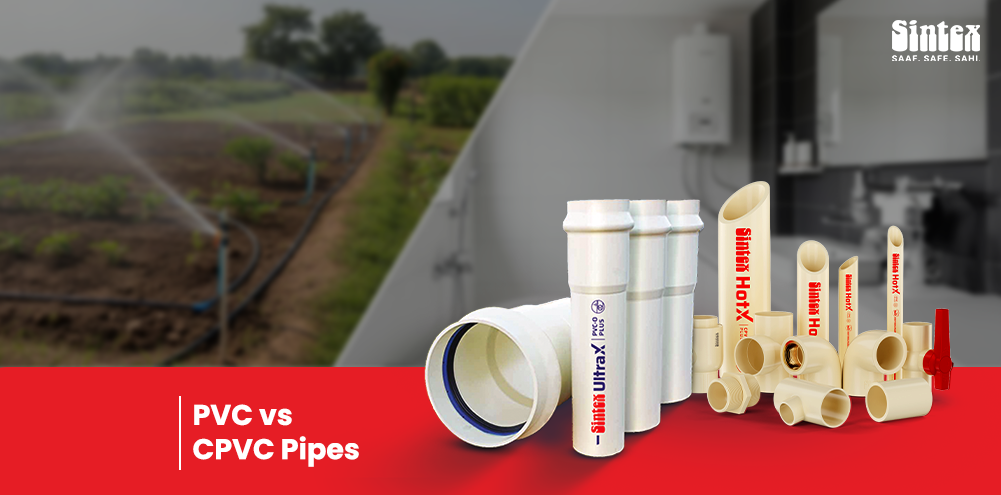
Table of Contents
Walk into a hardware shop and PVC and CPVC look near enough the same. Similar feel, similar fittings, stacked on the same rack. Cost is the first place they split, so plenty of buyers grab the cheaper one or just copy whatever the last plumber fitted. That is how a cold-water pipe ends up on a geyser line and fails inside two years. The CPVC vs PVC decision is mostly a temperature decision, with cost and chemistry sitting on top.
This guide covers what each pipe is, the IS standards behind them, how they compare on heat and pressure, and which one belongs on which line. For hot water runs, Sintex CPVC Plus is rated for the temperature. For cold supply and drainage, the broader Sintex pipes range handles it.
Key Takeaways
- The CPVC vs PVC decision is essentially a temperature decision: CPVC handles water up to 93°C, while PVC softens and loses its pressure rating above 60°C.
- Most homes use both: PVC on cold supply, drainage, and below-ground runs; CPVC wherever hot water flows.
- Never solvent-weld the two materials together as the cements are not interchangeable and the joint will eventually fail. Use a threaded transition fitting where they meet.
- Installed correctly and kept within their ratings, both pipes are good for 50 years or more; failures almost always come down to the wrong pipe on the wrong duty, or a rushed joint.
What Is PVC Pipe?
PVC is polyvinyl chloride. The grade you actually meet on Indian sites is uPVC, the unplasticised type, covered by IS 4985 for pressure pipes and IS 13592 for soil and waste. Stiff, barely any weight to it, and cheap to buy. Heat is the ceiling. Around 60°C its pressure rating starts dropping off, so PVC sticks to the cold side: supply lines, drainage, the irrigation feeding a field. You order it by pressure class, usually 4, 6, or 10 kgf/cm².
What is CPVC pipe?
CPVC is chlorinated polyvinyl chloride. An extra chlorination step takes the chlorine content from about 57% up to roughly 67%. That one change is the reason it copes with water near 93°C. The relevant standard here is IS 15778, and it is sized to CTS, copper tube size, mostly SDR 11 from half inch up. Colour gives it away on site: a pale cream, not the white of PVC. Anywhere hot water flows, CPVC is the pipe. Geyser connections, potable hot-and-cold runs, the warmer industrial fluids that PVC could never survive.
What Are the Differences Between CPVC and PVC?
Chemically, the two are close relatives. On the job they part ways the moment heat or pressure climbs. The table sets out the points that decide most plumbing work.
| Feature | PVC (uPVC) | CPVC |
| Top working temperature | ~60°C before it softens | ~93°C |
| Made to (IS code) | IS 4985 / IS 13592 | IS 15778 |
| Colour | White or grey | Pale cream |
| Chemical resistance | Good with acids, alkalis, and salts at ambient temperature | Holds that resistance even at higher temperatures |
| Typical applications | Cold supply, drainage, SWR, irrigation | Hot and cold potable supply, geyser lines, industrial fluids |
| Joining method | Solvent weld with PVC cement, or rubber-ring and threaded joints | Solvent weld with CPVC-grade cement only |
The cement is where jobs fail. CPVC needs CPVC-grade solvent cement, applied to a deburred, cleaned, dry surface, then left to cure before the line is pressure tested. PVC cement on a CPVC joint never reaches full strength. It may hold at first and weep weeks later.
What Are Common Uses of CPVC Pipe and PVC pipes?
Sort by temperature and the uses fall out on their own. PVC moves cold water and waste. Think borewell and overhead-tank supply, the SWR drainage stack, the downpipes carrying rain off the roof, irrigation out in the field. CPVC takes anything warm. Geyser outlets, the hot line to a shower mixer, the hot-and-cold pair behind a kitchen sink, solar water heater connections. A typical Indian home uses both, PVC below ground and on drainage, CPVC on the heated supply.
How Do You Choose Between CPVC and PVC?
Temperature first. Any line carrying hot water is CPVC. Cold supply or drainage stays on PVC, which is cheaper and fully capable. After that, look at the fluid, since anything corrosive or above 60°C pushes you to CPVC. Match the pipe’s pressure class to the working pressure with some margin in hand. For drinking water, choose a pipe carrying an IS or NSF certification rather than a general-purpose grade. And follow the local plumbing code and the building’s approved drawings, because those often settle the choice regardless. Once all of that is fixed, price makes the last call. The site rule barely changes: PVC for cold and waste, CPVC for hot, no direct solvent joint between the two.
Advantages of PVC and CPVC Pipes
Both materials pushed out metal for the same reasons. Rust is not a problem with either. Nothing corrodes, nothing scales up inside, so the bore stays clear and the flow does not drop off over the years. Pick up a length and it weighs next to nothing against GI or copper, which saves on both labour and freight. The inside is smooth, so friction loss is small and pumps are not fighting long runs. And the joints are solvent welded, which means no blowtorch on site, no threading machine, no standing around waiting on metal to cool.
Each has its own strength. PVC is the low-cost option and lasts decades on cold lines. CPVC adds the heat rating, better fire performance, and stable strength at temperatures where PVC would already be softening. Installed to standard and within rating, both pipes are good for 50 years or more.
Common Applications of PVC & CPVC Pipes
In homes, PVC handles the drainage stack, the vent lines, and the cold feed from the overhead tank to taps and flush tanks, while CPVC carries hot water from the geyser to bath and kitchen. Scale it up to a commercial building and the logic holds. CPVC risers push hot water up through the floors. PVC takes the SWR drainage and the storm lines. Industry is where the gap really tells. CPVC handles hot process water and dilute acids that would have PVC sagging or steel pitting, and PVC gets the easier duties: cooling water, effluent, the cold transfer lines that never see much heat.
Final Words
The PVC vs CPVC choice comes down to matching the pipe to the heat in the line. Cold water and drainage suit PVC. Hot water needs CPVC. Get that one call right and the rest of the layout tends to follow. Neither material lets you down on its own. They last for decades and cost reasonable money. What they ask in return is basic: size it right, make the joint properly, keep it inside the rated pressure and temperature. When a line does fail, it is almost always the wrong pipe on the wrong duty, or a joint someone rushed. This doesn’t necessarily mean there’s an issue with the plastic.
Also, Read: What is PVC Pipes and Fittings?
Explore the Sintex Range
With the choice clear, here is where our range fits. Sintex makes both grades under its NXT Advantage system. That brings in UV protection, an anti-microbial layer, thermal insulation, and brass-insert fittings right across the lineup. The pipes are lead-free and food-grade certified, the outer wall is UV-stabilised for open runs, and everything mates with standard plumbing, no special adaptors needed.
| Pipe System | Type | Key Feature |
|---|---|---|
| HotX CPVC Plus | CPVC | Antimicrobial, brass fittings, rated to about 93°C |
| CoolX UPVC Plus | uPVC | Long life, low cost, safe for potable cold water |
| AgriX UPVC Plus | uPVC | Built for irrigation and rural water transport |
The same system runs past pipes, into Sintex water tanks for storage and, so a layout can move from source to drain on matched components. The full pipes range is worth a look before sizes are finalised.
At the same temperature and pressure the two are close. Heat is the separator. Once you cross about 60°C, PVC begins giving up its pressure rating, while CPVC holds on to roughly 93°C. So on a hot line, CPVC wins on strength every time. Keep the water cold and at room temperature, and PVC does the job perfectly well.
They can share a system, PVC on cold and drainage, CPVC on hot. What you cannot do is solvent-weld one to the other. The cements are not the same, and a glued PVC-to-CPVC joint tends to fail. Where the two materials meet, switch to a threaded or flanged transition fitting and let that take the load.
Kept within its temperature and pressure limits, CPVC carries a service life of 50 years and up. Two things eat into that: long sun exposure with no UV protection, and running it flat out at the very top of its heat band day after day. That is why you mostly see it indoors, boxed into a wall, or lagged where it has to run outside.
It is, as long as the pipe is meant for potable use. Check for an IS 4985 stamp, or an NSF mark, either of which tells you it is drinking-water-grade uPVC. General-purpose or recycled PVC has no place on a potable line. Hot drinking water needs CPVC, since PVC cannot take the temperature.
Not really. A wheel cutter or a fine-tooth saw will cut it, a deburring tool cleans the edge, and CPVC-grade cement does the joint. No soldering. No threading. No flame anywhere near it. The part people get wrong is the joint itself: it has to be clean and dry, properly deburred, and given its full cure time before anyone pressure-tests the line.
Yes. The chlorination and higher temperature rating make CPVC cost more per metre than uPVC. On a hot line the extra is justified, because PVC would fail at the temperature, and a re-do costs more than the original price gap.
No. PVC cement does not bond CPVC to full strength, and CPVC cement is formulated only for CPVC. A glued joint between the two can leak or pull apart under pressure. Join them with a threaded transition fitting instead.
No single pipe covers a whole house. The standard approach uses uPVC for drainage and cold supply and CPVC for hot water. That split keeps each line within its rating and is the usual reason a plumbing layout runs for years without early repairs.
Categories
Year
Related blogs