
Table of Contents
| Quick Answer: A drip irrigation pipe delivers water in small, controlled amounts close to the plants. A regular agriculture pipe carries water from the source, such as a borewell, tank, canal or pump, to the field. They do different jobs, and most drip systems use both: agriculture pipe as the mainline and drip lines at the crop. |
A good irrigation system does more than move water from one place to another. It needs to deliver the right amount of water where the crop needs it, without making the farmer spend more time, water or money than necessary.
This is where the choice between a drip irrigation pipe and a regular agriculture pipe becomes important. Drip pipes release water through outlets placed along the line, usually close to the crop. Regular agricultural pipes are generally used to move water between the source and different sections of the field.
Before deciding, look at the water source, available pressure, crop spacing, field size and the amount of maintenance the system will need. There isn’t one pipe that will suit every farm.
Key Takeaways
- Drip irrigation pipe is used when water needs to be released close to the plants in a controlled manner.
- Agricultural irrigation pipe is useful for carrying water from a borewell, tank, canal or pump to another part of the farm.
- Drip can help manage water application more closely when the system is properly planned and maintained.
- Regular agricultural pipes are useful for water transfer and conventional irrigation setups.
- Material, pressure, sunlight exposure, soil conditions, fittings and upkeep can all affect how the pipe performs over time.
- On most farms the two work together: agriculture pipe as the mainline and submain, and drip pipe at the crop.
What Are Drip Irrigation Pipes?
A drip irrigation pipe is part of a system that delivers water slowly and in a controlled manner close to the plants. Instead of releasing water across a large area, the system uses outlets or emitters placed along the pipe to direct water towards the crop root zone.
This makes drip irrigation particularly useful where crops are planted in rows or at defined spacing. Vegetables, fruit crops, orchards and several other crops can benefit from this type of arrangement, provided the system is designed according to their irrigation requirements.
The main idea is simple. Water travels through the irrigation line and is released at selected points rather than being distributed everywhere at once.
This means the pipe layout has to match the field. Spacing between plants, row length, available water pressure and required irrigation frequency all matter when setting up irrigation pipes for agriculture.
A drip system also needs more than just the pipe. Filtration, suitable fittings, pressure control and regular emitter checks matter because dirt or suspended particles can affect water flow.For help choosing connectors and joints, see our guide to types of pipe fittings.
Types of Drip Irrigation Pipes
Drip lines are usually made from flexible polyethylene (LLDPE or LDPE), while the mainline that feeds them is typically rigid UPVC or HDPE pipe. The drip line itself comes in three common forms:
- Inline emitter pipe: Emitters are built into the pipe wall at fixed spacing. Suited to row crops with uniform plant spacing.
- Online emitter pipe: Emitters are fitted onto a plain pipe at the position of each plant. Suited to orchards and widely spaced crops.
- Drip tape: Thin-walled flat tape with built-in emitters, generally used for seasonal row crops.
The mainline, submain and fittings that carry water to these drip lines are where agriculture pipe is used.
What Are Regular Agri Pipes?
A regular agriculture pipe is generally used to transport water from the source to another location on the farm. The source could be a borewell, canal, tank, pump or another water supply point.
These pipes are useful for moving larger volumes of water through mainlines and distribution lines. They can also form part of conventional irrigation systems where water is released or distributed differently across the field.
A farm irrigation pipe may therefore be used before the water reaches the actual irrigation point. For example, a pipe can carry water from a borewell to a storage tank and then from the tank to different areas of the farm.
The required pipe depends on the flow, pressure, distance and layout. A pipe used as a mainline may have different requirements from one used for a shorter distribution run.
Regular agricultural pipes can also be used in irrigation systems that include drip components. The important point is that different parts of the network can have different functions, so the complete system needs to be planned rather than choosing every pipe in isolation.
In India, agriculture pipes are commonly UPVC pipes made to IS 4985 or HDPE pipes made to IS 4984.

Drip Irrigation Pipes vs Regular Agri Pipes: Key Differences
The biggest difference is what each pipe is expected to do. A drip irrigation pipe is built into a controlled delivery system, while an agricultural irrigation pipe is commonly used to move water between the source and the irrigation area.
| Factor | Drip Irrigation Pipe | Regular Agri Pipe |
| Water delivery | Controlled delivery near plants | Mainly transports and distributes water |
| Water efficiency | Can support targeted irrigation | Depends on the irrigation method used |
| Installation | Requires planned rows, outlets and fittings | Generally simpler for transport lines |
| Crop suitability | Useful for crops with defined spacing and regular irrigation needs | Suitable for broader farm water movement |
| Pressure | Works at low pressure at the emitter, usually managed with regulators or control valves | Rated for higher working pressure, chosen by pump head and pipe class |
| Maintenance | Filters, outlets and emitters need checking | Mainly involves joints, leaks and pipe condition |
| Durability | Flexible polyethylene lines are usually laid on the surface, so sunlight exposure and handling matter | Rigid UPVC or HDPE lines are often buried, so soil conditions and joint quality matter |
| Operating requirements | Requires system design and filtration | Pump, pipe size and joints suited to the flow and distance |
| Typical material | LLDPE or LDPE (flexible) | UPVC or HDPE |
| Role in the system | Laterals running along the crop | Mainline and submain from the source |
The two should not necessarily be treated as competing products. On many farms, they can serve different roles within the same irrigation network.
Water Efficiency: Which Pipe System Uses Water Better?
Drip pipes put water right where the plant needs it, at the base of the crop, instead of soaking the whole field.
That is a real advantage when crops sit in neat rows with fairly predictable water needs. Instead of drenching the ground around each plant, the water goes straight to the roots.
However, laying drip pipes alone does not make a system efficient. A bad layout, clogged emitters, the wrong pressure, or a few leaks here and there can quietly undo most of the benefit.
Regular irrigation pipes for agriculture are different because their main job is usually to transport water. How efficiently the water is used ultimately depends on what happens after it reaches the field.
So, if the farm needs targeted root-zone irrigation, drip has an advantage in terms of control. If the immediate requirement is to move water from one part of the farm to another, a regular agricultural pipe may be a better choice.
In flood or furrow irrigation, a large share of the water can be lost to evaporation, run-off and deep percolation below the root zone. Drip reduces these losses by applying water only at the root zone, which is why it is widely promoted in water-scarce regions.
Which Is Better for Different Crops?
The crop itself is one of the first things to consider when choosing an agricultural irrigation pipe.
Vegetables and row crops
Vegetables planted in regular rows can work well with drip irrigation because the outlets can be positioned along the crop rows. This allows water delivery to follow the planting pattern.
Fruit crops and orchards
For orchards, the spacing between trees becomes important. A drip arrangement can be designed around the position of individual plants, provided you understand the required flow and irrigation frequency.
Larger or mixed farm areas
If the main requirement is to transport water across a large farm, regular farm irrigation pipe can be useful as a mainline or distribution line. It can carry water from the source to different sections before the water is distributed through the chosen irrigation method.
The decision should therefore start with the crop layout and water requirement rather than the pipe name alone.
Quick Pick: Which Pipe for Which Situation?
Use this as a starting point, then check pressure, distance and layout for your own farm.
- Orchard or widely spaced fruit trees: drip line with online emitters, fed by a UPVC or HDPE mainline.
- Vegetables or row crops at fixed spacing: inline-emitter drip line or drip tape, fed by a UPVC or HDPE mainline.
- Borewell, canal or tank to field: agriculture pipe (UPVC or HDPE), sized for the flow and the distance.
- Large farm with several plots: agriculture pipe as the mainline and submains, with drip lines or another irrigation method at each plot.
- Uneven ground or long runs: HDPE, because it flexes; UPVC where the run is straighter and the pressure is steady.
Drip Irrigation Pipes: Benefits and Limitations
A drip irrigation system has some clear advantages when the farm needs controlled water delivery.
Benefits include:
- Water can be directed close to the crop root zone.
- Delivery can be planned around crop spacing.
- It suits regular irrigation schedules.
- Water application can be controlled more precisely than broad field distribution.
But there are also practical considerations.
Drip systems need filtration because suspended particles can block emitters. The outlets also need to be checked periodically. Leaks, clogging and pressure problems can affect how evenly water reaches the plants.
The pipe material and installation conditions matter too. Exposure to sunlight, operating pressure, handling and storage can influence the system’s service life.
For farmers considering irrigation pipes for agriculture, the cost of the complete setup should therefore include fittings, filtration and maintenance, not just the pipe itself.
Regular Agri Pipes: Benefits and Limitations
A regular farm irrigation pipe is useful when water needs to be transported over a distance.
It can connect a borewell, pump, tank or canal to the field. Depending on the system, it may also be used for distribution across different sections of the farm.
One advantage is that the pipe does not require every section of the field to have individual outlets. This makes it suitable for straightforward water-transfer arrangements.
The limitation is that a regular pipe by itself does not provide the same level of targeted root-zone delivery as a properly designed drip system. If the crop needs frequent, controlled watering at specific points, you may need additional irrigation components.
Which Is Easier to Install and Maintain?
A conventional agriculture pipe used for water transport can be relatively straightforward to lay, especially when the route is simple and the number of branches is limited.
Drip systems require more planning. The mainline, sub-mainlines, laterals, filters, pressure controls, connectors and emitters all need to work together.
Maintenance is also different. With drip irrigation, checking filters and emitters becomes important because clogging can affect water distribution. Regular agricultural pipelines generally require attention to joints, leaks, pressure and physical damage.
Water quality matters for both. Soil, sand and other particles entering the system can create problems, so the maintenance routine should match the quality of the available water.
Which Is More Durable for Agricultural Use?
There is no universal answer because pipe life depends on more than the material alone.
For any agriculture pipe, consider the operating pressure, sunlight exposure, soil conditions, temperature, installation method and how the pipe is handled during farm work.
PVC and HDPE both show up in agricultural setups, but which one fits depends entirely on the job at hand. Agriculture PVC pipe options tend to be the go-to for water transport and irrigation, while HDPE agriculture pipe earns its place where flexibility and resistance to tricky site conditions matter more.
Neither material is better across the board. The right choice depends on the application’s pressure, layout and installation needs.
Drip Irrigation vs Regular Agri Pipes: Which Is More Cost-Effective?
What costs less upfront doesn’t always cost less over the years.
Drip systems often need extra components, filters, emitters, pressure controls and fittings, which pushes up the initial spend. But when controlled irrigation actually matters for the crop, that added control over water application can be worth it.
A regular agriculture pipe keeps things simpler when the main need is to move water from the source to the field. Even so, the true cost comes down to how well that water gets distributed once it reaches the field.
Farmers should compare:
- Initial pipe and fitting costs
- Pumping and water requirements
- Installation labour
- Filtration and maintenance
- Replacement needs
- Farm size and layout
- Crop requirements
The better choice is the one that makes sense for the complete irrigation setup, not simply the lowest price per metre.

How to Choose the Right Agricultural Pipe for Your Farm
Before you buy an agricultural irrigation pipe, it helps to work through a few things first.
- Identify the crop. Not every crop drinks the same way. One planted in tight rows needs steady, consistent water. In contrast, another spread across open ground might only need occasional watering, so the farm irrigation pipe setup should follow the crop, not the other way round.
- Measure the farm. How far is your water source from the field? That distance decides pipe length, how much pressure you’ll lose along the way, and whether you’ll need junctions or booster points to keep flow steady.
- Check the water source. A borewell doesn’t behave like a canal, and a canal doesn’t behave like a tank. Pressure, flow rate and even water quality can shift depending on the source, and your pipe has to handle whichever one you’re working with.
- Know the pressure. Every pipe is rated to handle a certain pressure ceiling. Go past it, and you’re looking at bursts or leaks down the line, so match the pipe to what your system will actually push through it.
- Choose the irrigation method. Drip, sprinkler, and surface irrigation move water differently. Each one requires a different pipe diameter, layout, and set of fittings, so the method comes first; the pipe follows.
- Consider soil and installation. A pipe buried underground deals with constant soil pressure and moisture. One left exposed on the surface takes a beating from sun and weather instead. Where it sits changes what it needs to survive.
- Choose the material. PVC and HDPE don’t respond the same way to pressure, heat, or bending. Get the material wrong, and problems tend to surface only after the system’s already in the ground.UPVC suits rigid, pressure-based water transport; HDPE suits situations that need flexibility. Whatever you pick, check that the pipe’s specification matches the job.
- Plan maintenance. How easy is it to clean, filter, or check joints once the system’s running? Thinking this through early saves you from clogged emitters or pipe damage that could’ve been avoided.
- Set a realistic budget. The pipe is just one line item. Fittings, installation, and the maintenance that follows all add up, so budget for the whole system, not just what you’re buying today.
Why Choose Sintex Agricultural Pipes?
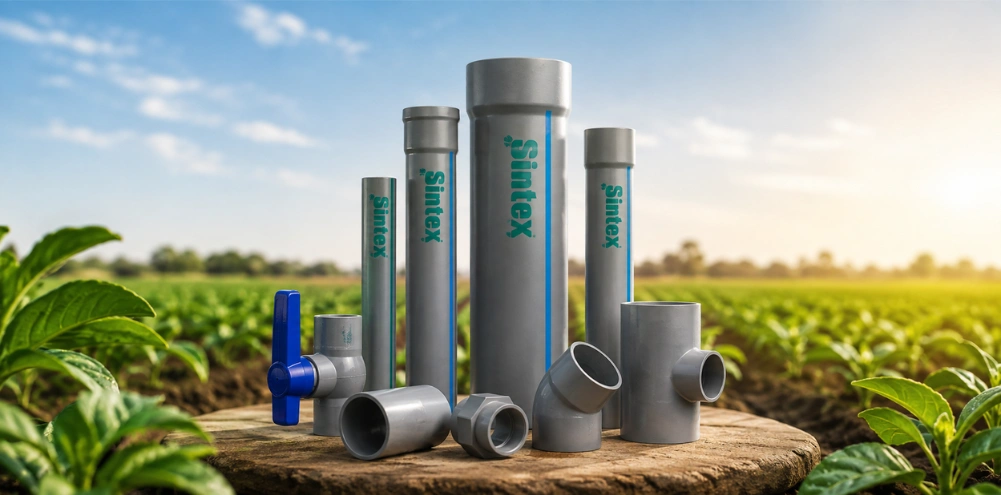
Sintex AgriX UPVC Plus is designed for agricultural water supply, including borewells, canals and field-level water transport. It is lead-free and UV stable for agricultural use.
You can explore Sintex AgriX UPVC Plus pipes and fittings when planning an agricultural water supply system.
For projects that need HDPE, Sintex also offers the Sintex HDPE InfraFlex range for high-pressure water transport and irrigation applications.
The key is to match the product to the job. A pipe used for a borewell connection or main water line has different requirements from a pipe carrying water along individual crop rows.
Both ranges suit the mainline and water-transport side of an irrigation system. The drip lines that run along the crop are a separate component, chosen to suit the crop and emitter spacing.
Conclusion: Which Should Farmers Choose?
A drip irrigation pipe makes more sense when the farm needs controlled water delivery close to crops, particularly where plant spacing and irrigation schedules can be planned. A regular agricultural irrigation pipe is more suitable when the main job is transporting water from a borewell, canal, tank or pump to another part of the farm.
The choice should come down to crop type, farm layout, water availability, pressure and the irrigation method you plan to use.
For agricultural water transport, Sintex’s AgriX UPVC Plus range provides an option designed for applications such as borewells, canals and field water supply.
Neither is better for every farm. A drip irrigation pipe setup suits targeted watering near the crop root zone, while an agriculture pipe is useful for transporting and distributing water. Your crop, field layout, water source and irrigation method should guide the choice.
Drip pipes deliver controlled quantities of water near plants through outlets or emitters. Regular agriculture pipe is mainly used to move water from the source to different parts of the farm. Both can be part of the same irrigation system.
A properly designed drip system can help control where and how water is applied. A drip irrigation pipe is therefore useful when targeted irrigation is required. Actual water use still depends on crop needs, system design, pressure, maintenance and how the farm is managed
Not always. A drip irrigation pipe makes sense when plants are spaced in rows or at fixed points, such as many vegetables and orchard crops. Other crops may have different irrigation needs. Look at the plant spacing, watering pattern and field layout before deciding which system to use.
That depends on the pipe, where it is installed and how it is looked after. Regular exposure to sunlight, high pressure, rough handling or poor installation can affect its condition. Water quality matters too. Checking the line for leaks or damage and keeping filters and outlets clean can help avoid problems. Flexible drip lines laid on the surface generally need replacing sooner than buried rigid pipe, because sunlight and handling wear them faster.
The size of a farm irrigation pipe depends on how much water the system has to carry. The length of the line, available pressure, farm area and irrigation layout also come into play. Don't choose a bigger pipe just because it can carry more water. It needs to suit the farm's actual requirements.
A regular agriculture pipe can be used in parts of a drip irrigation setup, depending on what the pipe is required to do. It may carry water from the source to the mainline, while separate drip irrigation pipe lines take water towards the plants. Check the pressure rating, fittings and compatibility before putting the system together.
That really depends on the farm. Drip irrigation pipe tends to have higher upfront costs: filters, fittings and emitters, all of which add to the initial cost. A regular agricultural pipe setup is often simpler when moving water is the main goal. So when weighing the two, look beyond just installation cost and factor in water use, labour, upkeep, and replacement down the line.