
Difference between Roto Moulded and Blow Moulded Tanks
Share
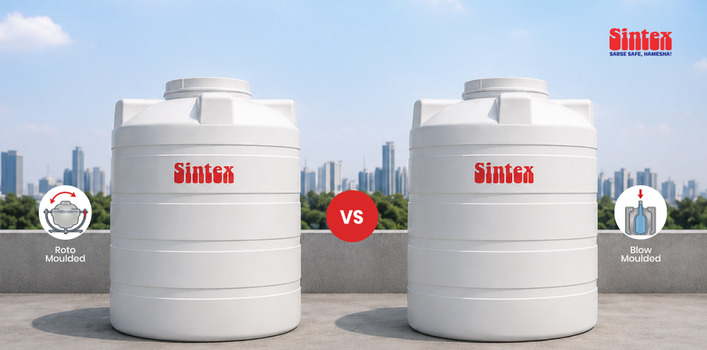
Table of Contents
When people go looking for water tanks on the market, most go by price and size, pick something off the shelf, and call it done. For a small domestic tank, that usually works out fine. For anything above 2,000 litres, or for situations where insulation or long-term durability actually matter, going in without this information tends to cost more in the end.
Key Takeaways
- Roto and blow moulding are manufacturing methods, not quality indicators. Both produce tanks built to do a job well.
- Roto moulded tanks go up to 25,000 litres; blow moulded tanks cap at around 2,000 litres. Capacity is what drives the choice.
- Multi-layer features like PUF insulation, anti-rodent protection, and active silver antibacterial technology are only available in roto moulded tanks.
- Regardless of the process, all Sintex tanks use 100% virgin, food-grade plastic. That is the quality standard that actually matters.
How a Roto Moulded Water Tank Gets Made
The process starts with powdered LLDPE (Linear Low-Density Polyethylene) loaded into a sealed mould. That mould rotates on two axes simultaneously while heat is applied from the outside. As it spins, the powder melts and coats the inner walls of the mould in a uniform layer. Once the cycle completes and the mould cools, it opens to reveal a fully formed tank with no joints anywhere on the body.
That seamless construction is the defining characteristic of roto moulding. The entire shell is one continuous piece with consistent wall thickness, which is what allows roto tanks to be made at much larger sizes without structural compromise.
The process is slow by industrial standards. Cycle times are long, and tooling costs are high. The payoff is the ability to produce tanks up to 25,000 litres, and the flexibility to build multiple functional layers into the tank during the rotation cycle itself.
How a Blow Moulded Water Tank Gets Made
Blow moulding starts with HM-HDPE (High Molecular Weight High-Density Polyethylene) pellets that get melted and pushed through an extruder to form a hollow tube. That tube gets clamped inside a mould, and compressed air is blown in. The plastic expands to fill the mould cavity, cools, and the finished tank is ejected.
The cycle is much faster than roto moulding. Per-unit production costs are lower, and the process suits high-volume manufacturing of consistent smaller shapes. The tank is formed from two mould halves, which means it has a seam running around the body. It also has a practical size ceiling. Blow moulded tanks go up to around 2,000 litres, and producing much larger volumes in a single unit is not something the process handles well.
Roto Moulded vs Blow Moulded Water Tank: Where They Differ
| Attribute | Roto Moulded Tank | Blow Moulded Tank |
| Capacity range | Up to 25,000 litres | Up to 2,000 litres |
| Construction | Seamless, single-piece shell | Seamed, two-mould halves |
| Wall thickness | Uniform throughout | Consistent at standard sizes |
| Multi-layer options | Yes (up to 4 layers) | Standard 2-layer construction |
| Cycle time | Longer | Shorter |
| Tooling cost | Higher | Lower |
| Installation | Heavier, requires planning | Lighter, easier to handle |
| Premium features | PUF insulation, ARPS, Active Silver | UV protection |
| Best suited for | Large capacity, commercial, hot climates | Household, standard residential use |
| Raw material | 100% virgin food-grade LLDPE | 100% virgin food-grade HM-HDPE |
Capacity
This is the most straightforward difference. Roto moulded tanks cover a range from a few hundred litres up to 25,000 litres in a single unit. Societies, apartment buildings, factories, and agricultural operations that need bulk storage depend on this range.
Blow moulded tanks cap out at around 2,000 litres. For a family of three or four in a standard flat, that is perfectly adequate. For anything larger, blow moulding cannot deliver.
Build Structure
A roto mould water tank has no seam, full stop. One continuous shell, uniform wall thickness throughout. Under physical stress during transport, under the pressure of a full load at large volumes, across years of outdoor exposure, there is no join point to fail.
A blow moulded tank has a seam where the two mould halves meet. In a quality product, this seam is tested and controlled, and in normal household use at standard capacities it does not become a problem. The structural situation is simply different from a seamless product, and that difference matters more as size and stress conditions increase.
Weight and Installation
Blow moulded tanks are lighter. HM-HDPE is denser than LLDPE as a material, but blow moulded tanks use thinner walls and less raw material overall, which results in a lighter finished product. Getting a 500-litre or 1,000-litre blow-moulded tank onto a terrace or up a staircase without a crane or a team of people is genuinely easier.
Roto moulded tanks are heavier. A 2,000-litre roto tank going onto a mounting frame on a terrace is a planned installation, not a one-afternoon job. Mechanical support and structural preparation are part of the process.
Features and Layers
Blow moulded tanks cover the core requirements well. A UV-protective outer layer, food-grade inner surface, and Germblock antimicrobial protection are standard. For a household that needs reliable drinking water storage at a fair price, a blow moulding water tank does the job without fuss.
Roto moulded tanks go further, and the manufacturing process is what makes that possible. Different materials can be introduced at different points in the rotation cycle, which allows for genuine multi-layer construction. A 4-layer Sintex roto tank has a UV-protective outer layer, a dark sunlight-blocking middle layer that prevents algae growth, a Polyurethane Foam layer for thermal insulation, and a food-grade inner surface with Germblock technology.
The PUF insulation layer makes a noticeable difference in summer. Water stored in an uninsulated tank on an exposed rooftop can get uncomfortably warm during peak heat months. The insulated roto tank keeps temperature changes minimal. For households in hot climates and for commercial kitchens with temperature-sensitive requirements, this layer is genuinely useful rather than a marketing feature.
Active Silver antibacterial technology and ARPS (Anti-Rodent Protection System) are also available on Sintex roto moulded variants. Neither of these is available in the blow moulded range.
Price
Blow moulded tanks are cheaper. Faster production, simpler tooling, less raw material per unit, all of it reduces the per-unit cost. For buyers who want a clean, hygienic, food-safe tank in a standard size without paying extra for features they do not need, the blow moulded product is honest value.
Roto moulded tanks cost more, and the reasons are visible: longer manufacturing cycles, heavier raw material use, multi-layer construction, premium feature availability. Buyers specifying tanks for long-duration projects, large-capacity needs, or insulation requirements will find that the cost is accounted for.
On Raw Material Requirements
Both manufacturing processes at Sintex use 100% virgin, food-grade plastic. LLDPE in roto moulding and HM-HDPE in blow moulding are both types of polyethylene. One is not inherently better quality than the other. Each is the correct grade for its respective process.
The virgin specification matters because recycled plastic varies in quality depending on its source and processing. It can carry residues from prior use. For a product storing drinking water, that variability is not acceptable. Virgin plastic is consistent, food-certified, and traceable. All Sintex tanks meet that standard regardless of moulding type.
Also, Read: What Makes a Tank for Healthy Storage?
So Which One Do You Need?
For a household needing a 500-litre to 2,000-litre tank, a blow moulded water tank covers the requirement cleanly. Lighter, easier to install, lower price, solid on the hygiene fundamentals.
Above 2,000 litres, a roto moulded water tank is the only option. There is no blow moulded equivalent at those volumes.
For buyers in hot climates where summer water temperatures are a real concern, or for commercial kitchens and food-service setups that need temperature-controlled storage, a 4-layer roto tank with PUF insulation is the right product.
For housing societies, large commercial buildings, or any project where capacity runs into the thousands of litres, the roto range is where to look.
Also, Read: How to Choose the Right Tank Capacity?
Both the roto moulded and blow moulded water tank are quality products built to do different jobs. Figure out which job you have, and the right choice follows from that.
To find the Sintex tank that fits your requirement, visit the Sintex website or speak to your nearest authorised dealer.
A roto moulded tank is made by rotating a mould on two axes while applying heat to powdered plastic inside. The plastic melts and coats the mould walls evenly, forming a seamless, single-piece shell. This process allows for large-capacity tanks, uniform wall thickness, and multi-layer construction that includes insulation and advanced protective features.
A blow moulded tank is made by blowing compressed air into a heated plastic tube clamped inside a mould. The plastic expands to take the mould's shape and cools into a finished tank. The process is faster and more cost-efficient, making it well-suited for producing consistent, high-quality tanks in standard household capacities up to 2,000 litres.
No. They are two separate manufacturing processes that use different raw materials, equipment, and production cycles. Roto moulding rotates a mould to coat walls with melted powder. Blow moulding inflates a plastic tube inside a fixed mould. Both produce quality tanks. The difference lies in size range, available features, and production cost, not in material safety or hygiene.
The main differences are capacity, structure, and features. Roto moulded tanks are seamless, go up to 25,000 litres, and support multi-layer builds including PUF insulation. Blow moulded tanks have a seam, cap at 2,000 litres, and suit standard household use. Both use virgin food-grade plastic and meet quality standards for safe drinking water storage.
Extrusion blow moulding is the most common method for water tanks. A hollow plastic tube is extruded, clamped in a mould, and inflated with compressed air. Injection blow moulding and stretch blow moulding are used for other applications like bottles and containers but are not standard for large water storage tanks due to size and structural constraints.
Categories
Year
Related blogs