Table of Contents
Quick Answer: A domestic biogas plant turns kitchen waste into cooking gas and leaves a slurry you can use as manure. It suits households that generate a few kilos of usable organic waste every day, have a couple of square metres of accessible outdoor space, and are willing to feed the plant daily. Below that threshold of waste, space or commitment, it won’t repay the effort.
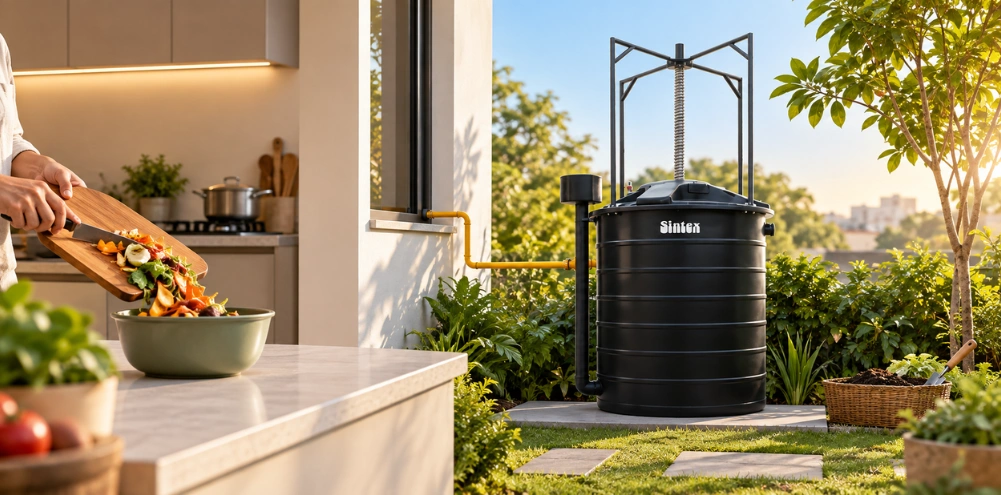
Every Indian kitchen throws out vegetable peel, leftovers and spoiled food, and most of it goes into a bin. Using a biogas plant for home captures that waste instead and converts it into gas you can cook with.
The catch is that a biogas plant is not an appliance you install and forget. It’s closer to a small living system that needs feeding every day and behaves differently in winter. This guide walks through whether your household actually fits one, how to size it, what installation involves, and what output you can realistically expect.
Key Takeaways
- A small biogas plant for home use needs a steady daily supply of kitchen waste, not an occasional one.
- Size the plant to the waste you actually produce, not to the number of people in the house.
- Even the smallest units need roughly half a square metre, with room around them for feeding and slurry removal.
- Gas output falls in cold weather, because digestion works best between 35 and 40°C.
- Biogas needs its own stove. An LPG burner won’t run on it.
Is a Domestic Biogas Plant Suitable for Your Home?
A domestic biogas plant suits a household producing at least two to three kilos of usable organic waste a day, with accessible outdoor space and someone willing to feed it daily. Households below that mark are better served by composting.
The daily commitment is the part people underestimate. A domestic biogas plant relies on a consistent supply of suitable organic waste to maintain stable digestion and gas production. If you don’t take care of it, it yields poor results.
A domestic biogas plant is suitable if you:
- ☐ Generate 2 kg or more of kitchen waste daily, consistently
- ☐ Have outdoor space at ground level or on a stable terrace
- ☐ Cook at home most days, so the gas gets used
- ☐ Can feed the plant and check it as a daily routine
- ☐ Have water available for mixing feed, since every load needs it
- ☐ Have somewhere to put the slurry, such as a garden or planters
Reconsider a domestic biogas plant if you:
- ☐ Travel often or leave the house empty for long stretches
- ☐ Produce mostly packaged food waste with little fresh organic matter
- ☐ Have no outdoor access, only a balcony with no drainage
- ☐ Want a fit-and-forget system with no daily involvement
- ☐ Have no use for the slurry and no way to dispose of it
How Does a Home Biogas Plant Work?
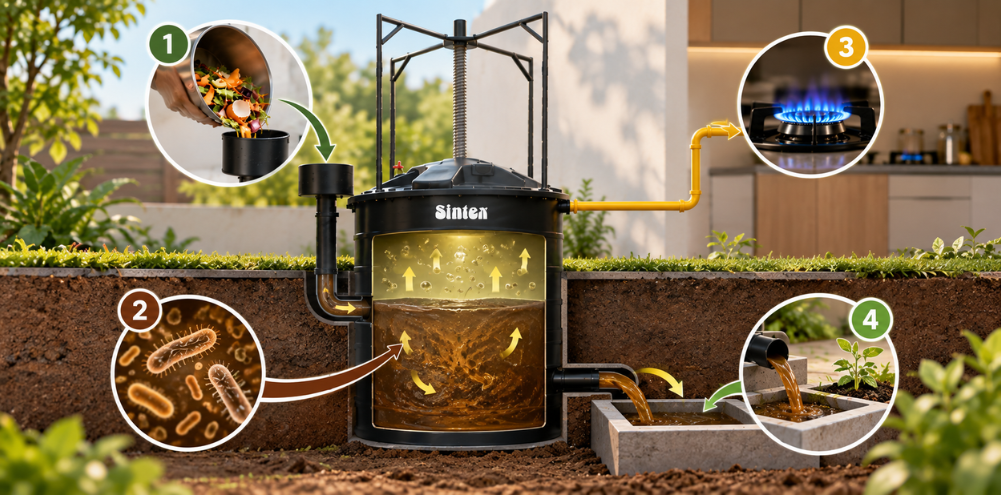
A biogas plant for domestic use works by anaerobic digestion, the biological breakdown of organic matter without oxygen. Bacteria inside a sealed digester consume the waste and release gas, which collects above the slurry and is piped to a stove.
The process runs in four steps:
- Feeding. Kitchen waste is mixed with water and poured into the inlet. The Ministry of New and Renewable Energy (MNRE) recommends a 1:1 mix of feedstock and water, with total solids around 8 to 10 per cent for the microorganisms to work well.
- Digestion. Inside the sealed digester, bacteria break the material down over several weeks. MNRE puts hydraulic retention time at about 30 days in tropical regions and 40 in subtropical ones.
- Gas collection. The gas gathers in a holder above the digester. It’s roughly 55 to 60 per cent methane and 35 to 40 per cent carbon dioxide, with a calorific value of 4,500 to 5,000 kcal per cubic metre.
- Digestate output. What’s left flows out of the slurry outlet as a nutrient-rich liquid.
The digestion process does not require continuous electricity, allowing the plant to continue functioning during power outages, provided its operating requirements are maintained.
Also, Read: What Is a Biogas Plant and How Does It Work?
What Can You Put Into a Domestic Biogas Plant?
A biogas plant for home kitchen waste takes any biodegradable organic material. Any organic waste has the potential to produce biogas, including fruit and vegetable waste, manure and food processing waste. What it can’t take is anything that doesn’t rot.
Suitable Feedstock For Domestic Biogas Plant
The Sintex biogas range is designed to treat vegetable waste, food waste, kitchen waste and other organic waste. In practice, that covers:
- Vegetable and fruit peel, cores and trimmings
- Cooked leftovers, including rice, dal and curry
- Spoiled or expired food
- Tea leaves, coffee grounds and eggshells
- Garden clippings in small quantities
Waste to Keep Out of Domestic Biogas Plant
Anything that won’t digest either sits in the tank or blocks it. Keep out:
- Plastic of any kind, including bags and packaging
- Metal, glass and ceramic
- Cleaning chemicals, bleach, phenyl and disinfectants
- Sanitary waste, nappies and wet wipes
- Large bones, coconut shells and other hard material
Chemicals can affect digestion because it depends on live bacteria. MNRE recommends a pH range of 6.5 to 7.5, while excess disinfectant can disrupt this balance.
How to Choose the Right Biogas Plant Size for Your Home
Home biogas plant size depends on the waste you produce daily, not on family headcount. A plant sized above your waste supply sits half-fed and underperforms, which is the most common sizing mistake.
MNRE defines capacity plainly: a 1 m³ plant produces 1,000 litres, or one cubic metre, of biogas in a day. So to choose the correct size, focus on the following aspects:
Estimate Daily Kitchen Waste
Before choosing a capacity, weigh what you actually throw out. Keep a separate bin for organic waste for a fortnight and weigh it daily. Ignore packaging and non-digestible items. Take the lower end of the range rather than the best day, because the plant needs feeding on ordinary days too.
Consider Your Expected Gas Requirement
Match the plant to both your waste supply and your cooking. Sintex publishes daily feed requirements and average cooking time for each capacity in its range:
| Gas capacity | Kitchen waste per day | Average cooking time | Footprint |
| 0.2 m³ | 2 to 2.5 kg plus 3 to 4 litres water | About 20 minutes | 0.54 m² |
| 0.5 m³ | 5 to 6 kg plus 7 to 8 litres water | About 1 hour | 2.89 m² |
| 1 m³ | 10 to 12 kg plus 12 to 15 litres of water | 1.5 to 2 hours | 2.89 m² |
Cooking times are calculated on a 15 CFt burner. Consider them as a supplement to your cylinder, as it is not a replacement.
Also, Read: Biogas Digesters Explained: Types & How to Choose One
Space and Site Requirements for a Home Biogas Plant
Domestic biogas plant installation needs more space than the tank footprint alone. The published figures start at 0.54 m² for a 0.2 m³ unit and 2.89 m² at 0.5 m³, but you need a working room around that for feeding and slurry removal.
Check these before committing to a spot:
- A firm, level base. A full digester is heavy, and the surface must carry it without settling.
- Access to the inlet. You’ll be walking to it daily with a bucket, so keep it near the kitchen.
- A slurry outlet with somewhere to drain. Plan where the digestate goes before installation, not after.
- Open air. Site it outdoors with free ventilation, not in an enclosed room.
- A short gas run to the stove. Long pipe runs collect condensate and drop pressure.
- All-round maintenance access. You need to reach joints, valves and the outlet without dismantling anything.
Sintex notes its plants can be installed above ground or underground and are relatively easy to relocate, which helps if the first position turns out to be wrong.
What Does Domestic Biogas Plant Installation Involve?
Biogas plant installation for a prefabricated home unit should be done by the supplier. MNRE states that even masonry plants cannot be built by an ordinary mason, since the work needs enough skill to finish without cracks. A crack in the digester lets gas escape.
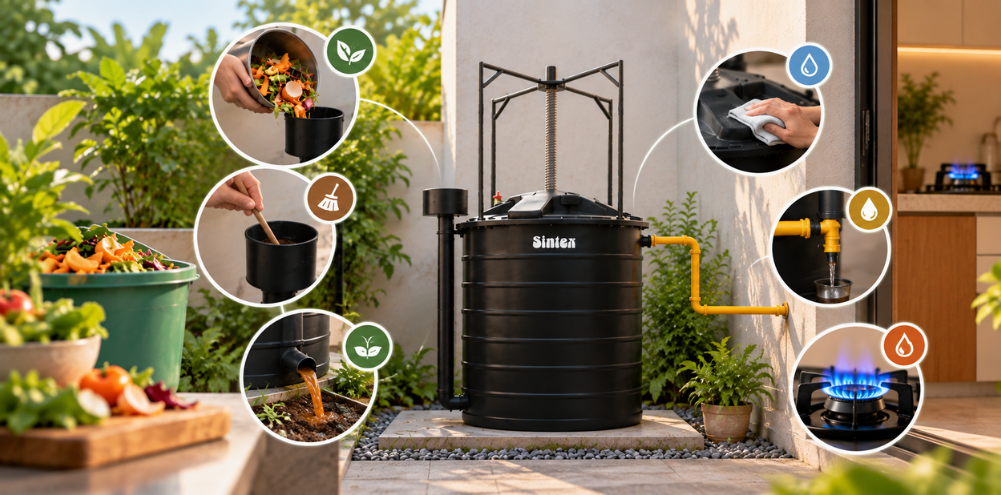
A typical installation runs like this:
- Site assessment. The supplier checks space, base, access and where the slurry will go.
- Base preparation. The ground is levelled and, where needed, a platform is laid.
- Positioning. The digester and gas holder are placed and aligned.
- Inlet and outlet. The feeding point and slurry outlet are fitted at working height.
- Gas line. The line is run to the stove and pressure tested for leaks.
- Charging and commissioning. The plant is filled with starter slurry and left to establish before gas is drawn.
MNRE says small plants of 1 to 25 m³ can be constructed and made functional within one to two months. Prefabricated units install faster, but the biological start-up still takes weeks.
Also, Read: How to Set Up a Biogas Plant: A Technical Guide
What Can You Expect From a Home Biogas Plant?
Output from a domestic biogas plant varies with feedstock, temperature and consistency of feeding, so treat any single figure as a best case. Sintex’s own basis of calculation is that 10 kg of food waste generates about 1 m³ of biogas.
For context, MNRE puts one cubic metre of biogas at 0.42 kg of LPG. Sintex’s figure is 0.434 kg, so both estimates indicate a broadly similar LPG-equivalent energy value.
What changes the number in practice:
- Temperature is the biggest single factor
- Feedstock quality because energy-dense food waste yields more than fibrous material
- Consistency, as irregular feeding destabilises the bacterial population
- Plant capacity, which caps output regardless of how much you feed
Using Biogas for Cooking
Biogas burns cleanly on a domestic stove, and MNRE notes it’s safer than LPG in one respect: biogas is lighter than air, so it disperses upward rather than pooling.
One thing catches most first-time buyers out. You can’t use biogas in an LPG stove. MNRE states that biogas needs a stove designed for it, because the burner holes are larger. Budget for the stove alongside the plant.
What Happens to the Digestate?
The slurry produced after anaerobic digestion is nutrient-rich and can be used as organic manure.
However, its suitability for different applications depends on the feedstock and digestion conditions. Follow appropriate handling and application practices, particularly when using it for growing edible crops.
Maintenance and Day-to-Day Operation of Domestic Biogas Plant
Home biogas plant maintenance is light but constant. There’s no filter to change and no motor to service. But there is a daily routine, and skipping it is what kills output.
The routine:
- Feed daily, mixing waste with water at roughly 1:1
- Screen what goes in, keeping plastic, metal, glass and chemicals out
- Check the inlet for blockage, which can be cleared with a bamboo stick worked up and down
- Check the outlet so slurry keeps flowing and the digester doesn’t back up
- Test for leaks with soap solution over the dome; bubbles mean a crack
- Drain condensate from the gas line, which collects water over time
If you’re away, the plant survives the gap. A running plant can be left 30 to 40 days without feeding provided the gate valve is closed properly.
Seasonal Performance
Digestion is temperature-dependent, and output drops in winter. MNRE gives the optimum as 35 to 40°C, with 35 to 38°C for stable operation.
For cold regions, there are two fixes: add hot water to the input slurry, or insulate the digester with a hot water jacket. Feeding in the afternoon, when the slurry is warmest, also helps.
Odour and Operational Issues
A properly sealed plant shouldn’t smell, because the digester is closed. Persistent odour usually means a leak, an overflowing outlet or waste sitting in an open inlet.
The troubleshooting list deals with the following common symptoms:
- Long flames: Adjust the air shutter on the stove.
- Reddish, unsteady flames: Water has collected in the pipeline, so drain it.
- Slow gas generation: Low temperature or low pH. Feed in the afternoon and correct the pH
- First gas won’t burn: Too much air or CO₂ in the initial collection. Vent it three or four times.
- Digester overflowing: The outlet is choked and needs clearing.
Costs, Savings and Practical Value of Domestic Biogas Plant
The purchase price is only part of the cost of a biogas plant for home use. Budget also for the base, installation, a biogas stove and the gas line, and account for the daily labour of feeding.
On the return side, Sintex’s brochure works from a commercial LPG replacement value of ₹80 per kg, putting the value of 10 kg of food waste at roughly ₹34.72 a day. That figure moves with LPG prices, so treat it as an illustration, not a guarantee.
Value that doesn’t show up in a payback calculation:
- Organic waste diverted from the bin every day
- Slurry replacing bought fertiliser for a garden
- Cooking gas that keeps working during a cylinder shortage
Government Subsidy or Support
Government financial assistance for domestic biogas plants is available under MNRE’s biogas programme, subject to eligibility and applicable scheme guidelines.
The programme specifies land, feedstock and water availability requirements. Additionally, certain financial benefits are restricted to on-site constructed models and may not apply to prefabricated plants.
Since scheme guidelines and funding periods can change, check the latest eligibility requirements with MNRE or the relevant state implementing agency before purchasing a plant.
Also, Read: Biogas vs LPG for Commercial Kitchens
Benefits and Limitations of a Domestic Biogas Plant
A biogas plant for domestic use is a genuine waste solution with real constraints. Here’s the balance.
| Parameter | Benefit | Limitation |
| Waste | Diverts daily kitchen waste from landfill | Only biodegradable waste qualifies |
| Fuel | Produces usable cooking gas with no electricity | Supplements rather than replaces a cylinder |
| Byproduct | Slurry works as fertiliser, no treatment needed | Produced daily, and needs somewhere to go |
| Operation | Simple routine, no moving parts | Must be fed daily to stay stable |
| Output | Consistent when conditions are right | Falls in cold weather |
| Space | Compact units start under 1 m² | Needs outdoor access and working room |
| Equipment | Long service with basic care | Requires a dedicated biogas stove |
What to Check Before Buying a Home Biogas Plant
Work through the following points before you commit to buying a home biogas plant. Each point is something that’s difficult to fix afterwards.
- ☐ Measured daily waste: Weighed over a fortnight, not estimated
- ☐ Capacity matched to that figure: Sized to your real supply, at the lower end
- ☐ Space confirmed on site: Footprint and working room
- ☐ Expected gas use: Checked against published cooking times for the capacity
- ☐ A biogas stove: Confirmed as included or budgeted separately
- ☐ Installation support: Who prepares the base, positions the unit and commissions it
- ☐ Service availability locally: Who attends if the plant stops producing
- ☐ Warranty terms: What’s covered and for how long
- ☐ Slurry plan: Where the daily digestate goes
- ☐ Written specifications: Capacity, feed requirement, footprint and materials on paper
Sintex Biogas Solutions for Home Applications
Sintex biogas plants are floating-type digesters made to convert vegetable, food and kitchen waste into usable fuel at the point where the waste is produced.
The published range runs from 0.2 m³ to 20 m³, and the smallest models sit at household scale:
- FTGB-20-01: 0.2 m³ capacity, taking 2 to 2.5 kg of kitchen waste daily in 0.54 m²
- FTGB-50-01: 0.5 m³ capacity, taking 5 to 6 kg daily in 2.89 m²
- FTGB-100-01: 1 m³ capacity, taking 10 to 12 kg daily in 2.89 m²
Sintex lists quick installation, a small footprint, easy relocation and simple maintenance as the range’s features. The plants can go above ground or underground. They treat food and vegetable waste, and the manure they produce suits small-scale agriculture.
Match the model to your measured daily waste, not to your household size. Also, confirm the current specification with Sintex before ordering.
Conclusion: Should You Consider a Biogas Plant for Your Home?
A biogas plant for home use makes sense in a specific set of conditions: consistent daily organic waste, outdoor space you can reach easily, cooking you’ll actually use the gas for, and someone prepared to run the daily routine.
When these requirements are met, a domestic biogas plant can help households convert organic kitchen waste into useful cooking fuel and nutrient-rich slurry for appropriate applications.
A home biogas plant needs 2 to 12 kg of kitchen waste a day depending on its capacity. Sintex's smallest 0.2 m³ model takes 2 to 2.5 kg with 3 to 4 litres of water, and a 1 m³ plant takes 10 to 12 kg. Below roughly 2 kg daily, a home plant stays underfed and isn't worth installing.
A household biogas plant produces roughly 1 m³ of biogas from 10 kg of food waste, which is Sintex's published basis of calculation. That equals about 0.434 kg of LPG. Actual output falls below this in cold weather or with irregular feeding.
A domestic biogas plant takes days to weeks to begin producing usable gas. Digestion times run from 5 to 90 days depending on feedstock and digester type, most commonly 10 to 30 days. Expect the first gas collected not to burn, since it contains air and carbon dioxide, and vent it before use.
Biogas from a home plant can be used for daily cooking, but only on a stove made for biogas. Biogas cannot be used in LPG stoves, because biogas burners have larger holes. A 0.5 m³ plant gives roughly an hour of cooking a day, so it supplements a cylinder rather than replacing one.
A domestic biogas plant should not produce odour, because anaerobic digestion inside a sealed vessel is odourless in itself. Smell indicates a specific fault: a leaking joint, a backed-up outlet, or waste left in an open inlet. Check joints with soap solution, since bubbles show where gas is escaping.
A home biogas plant works year-round but produces less gas in winter. The optimum digestion temperature is 35 to 40°C, and generation slows below that range. For cold regions, it is suggested to add hot water to the input slurry or fit a hot water jacket around the digester.
A domestic biogas plant's lifespan depends on construction material and maintenance, and manufacturers state it differently. Generally, prefabricated biogas plants are covered for over 10 years. It is best to confirm with the manufacturer before purchasing.
The slurry left after biogas production is a usable fertiliser. The digestate can be used as organic manure, subject to appropriate handling and application practices. Expect roughly a litre a day from a small home plant, and store it in a closed container with a tap. Otherwise, it may attract mosquitoes.
The two smallest models in the Sintex range suit a household. FTGB-20-01 at 0.2 m³ takes 2 to 2.5 kg of kitchen waste daily and occupies 0.54 m². FTGB-50-01 at 0.5 m³ takes 5 to 6 kg, occupies 2.89 m² and gives about an hour of cooking a day.
Check your measured daily kitchen waste first, weighed over a fortnight, then match it to the published feed requirement for each capacity. Confirm your available space against the footprint, check whether a biogas stove is included, and agree who handles installation and commissioning.