

Table of Contents
Two CPVC pipes can look identical on a shelf and carry the same outside diameter, yet be rated for very different pressures. The difference is stamped on the pipe as an SDR number.
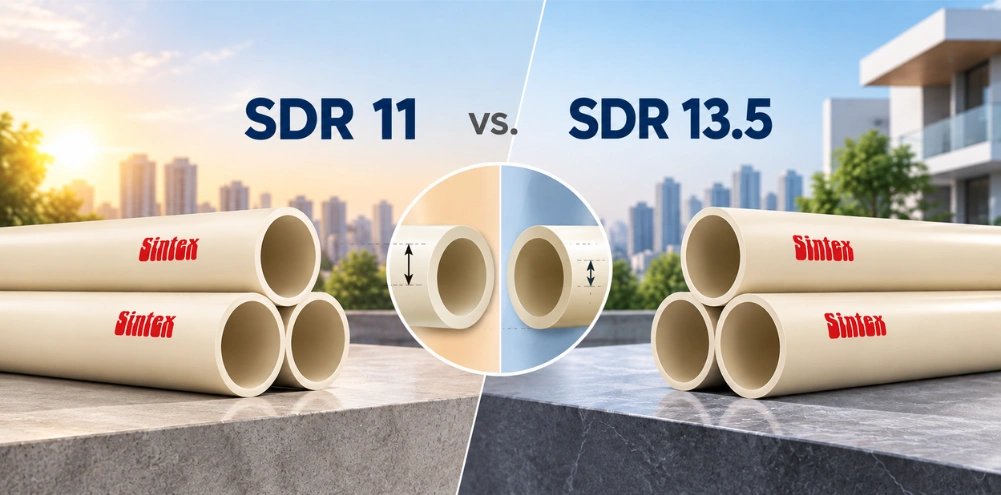
SDR stands for Standard Dimension Ratio, and it’s the classification that links a pipe’s outside diameter to its wall thickness. The SDR 11 vs SDR 13.5 pipe question comes up constantly in plumbing specifications because those two are the classes Indian CPVC is sold in. Getting it wrong means either paying for wall you don’t need or installing a pipe that can’t hold your riser pressure.
Key Takeaways
- SDR is a ratio, not a thickness. It’s outside diameter divided by wall thickness, so it holds across every size in a range.
- Lower SDR means a thicker wall. SDR 11 is thicker than SDR 13.5 at the same outside diameter.
- A thicker wall means higher pressure capability within the same material and standard.
- The same SDR means different things in different materials, because pressure also depends on the material’s own strength rating.
- Temperature changes everything. The SDR pipe rating stays fixed while the allowable working pressure falls as the water gets hotter.
What is SDR in Pipes?
The Standard Dimension Ratio is a pipe’s outside diameter divided by its wall thickness. It’s a plain ratio with no units attached.
SDR = Outside diameter ÷ Wall thickness
India’s CPVC standard is more specific about which numbers go into it. IS 15778 states that for CPVC pipes, SDR is calculated by dividing the average outer diameter in mm by the minimum wall thickness in mm.
Using a ratio rather than a fixed thickness has two practical benefits:
- The rating stays constant across sizes. A pipe with a given material strength and dimension ratio holds the same pressure class whether it’s 4 inches or 60 inches.
- Specification gets simpler. Upsizing a line doesn’t change its pressure capacity, so you don’t redesign the system every time a diameter changes.
That’s the whole reason SDR pipe classification exists rather than a table of thicknesses.
What is an SDR 11 Pipe?
An SDR 11 pipe has a wall thickness equal to one-eleventh of its outside diameter. It’s the thicker-walled of the two classes covered here. Under IS 15778, SDR 11 is designated Class 1 in the CPVC range. The standard’s dimension chart gives these minimum wall thicknesses:
| Nominal size | Minimum wall thickness |
| 15 mm | 1.7 mm |
| 20 mm | 2.0 mm |
| 25 mm | 2.6 mm |
| 32 mm | 3.2 mm |
| 40 mm | 3.8 mm |
| 50 mm | 4.9 mm |
A thicker wall carries more pressure. IS 15778 sets a working pressure for each CPVC class at two temperatures, and Class 1 is rated at 2.76 MPa at 27°C and 0.68 MPa at 82°C. Both figures are for the same pipe. An SDR 11 pipe pressure rating is only meaningful with a temperature attached, so a rating quoted without one tells you nothing.
What is an SDR 13.5 Pipe?
An SDR 13.5 pipe has a wall thickness equal to one-thirteen-and-a-half of its outside diameter, making it thinner-walled than SDR 11 at the same diameter. IS 15778 designates it Class 2. Its minimum wall thicknesses run:
| Nominal size | Minimum wall thickness |
| 15 mm | 1.4 mm |
| 20 mm | 1.7 mm |
| 25 mm | 2.1 mm |
| 32 mm | 2.6 mm |
| 40 mm | 3.1 mm |
| 50 mm | 4.0 mm |
A thinner wall is a design choice. An SDR 13.5 CPVC pipe carries less material, costs less, and leaves a slightly larger bore for the same outside diameter. However, it can’t match SDR 11 on pressure. IS 15778 rates Class 2 at 2.18 MPa at 27°C and 0.55 MPa at 82°C, about a fifth below Class 1 at both temperatures. That SDR 13.5 pipe pressure rating still covers standard domestic hot and cold water distribution.
SDR 11 vs. SDR 13.5: Key Differences
SDR 11 and SDR 13.5 differ in one thing: wall thickness relative to outside diameter. An SDR 11 wall is one-eleventh of the OD, an SDR 13.5 wall one-thirteen-and-a-half. At 50 mm nominal CPVC, that’s 4.9 mm against 4.0 mm, giving SDR 11 higher pressure capability and SDR 13.5 more flow area.
Every other difference traces back to that ratio, as the table shows. CPVC figures are from IS 15778.
| Parameter | SDR 11 | SDR 13.5 |
| Class under IS 15778 | Class 1 | Class 2 |
| Wall as a share of OD | 1/11 | 1/13.5 |
| Wall at 50 mm nominal | 4.9 mm minimum | 4.0 mm minimum |
| Working pressure at 27°C | 2.76 MPa | 2.18 MPa |
| Working pressure at 82°C | 0.68 MPa | 0.55 MPa |
| Relative flow area | Smaller bore at the same OD | Larger bore at the same OD |
| Material availability | CPVC, HDPE | CPVC |
| Typical selection | Risers, multi-storey distribution, higher line pressure | Standard domestic hot and cold water lines |
| Verdict | Choose when pressure or temperature margin is the constraint | Choose when the duty is moderate and cost or flow matters more |
The SDR 11 vs SDR 13.5 pipe decision is a margin question, not a quality question. Both classes are made to the same standard from the same compound.

How Does SDR Affect Pipe Wall Thickness?
The relationship between SDR and pipe wall thickness is direct, and you can calculate it yourself. Wall thickness equals outside diameter divided by SDR.
Take the 50 mm nominal CPVC size, which IS 15778 gives a mean outside diameter of 54.0 mm.
- SDR 11: 54.0 ÷ 11 = 4.9 mm
- SDR 13.5: 54.0 ÷ 13.5 = 4.0 mm
Both match the standard’s published minimums exactly, which is a useful way to sanity-check any SDR pipe wall thickness figure a supplier quotes you.
One exception is worth knowing. In the IS 15778 chart, the 15 mm row carries an asterisk marking dimensions that are not a function of SDR. The numbers show why: 15.9 ÷ 1.7 gives about 9.4, not 11. At the smallest size, the wall is set by a practical minimum rather than by the ratio, so an SDR 11 pipe in 15 mm is thicker than the ratio alone would require.
How Does SDR Affect Pipe Pressure Rating?
The mechanism of impact of SDR on pipe pressure rating is: A thicker wall spreads internal pressure over more material, so hoop stress in the wall drops and the pipe holds more pressure.
The relationship is set out in a standard formula:
P = 2σ ÷ (SDR − 1)
where P is the allowable pressure and σ is the material’s design stress. The SDR minus one term appears because the calculation works from the pipe’s mean diameter, which is the outside diameter less one wall thickness.
Points to Note:
- A lower SDR gives a smaller denominator, which gives a higher allowable pressure.
- The formula also shows that SDR alone can’t give you a pressure number. The design stress term is a property of the material, not the geometry. Change the compound and the same SDR yields a different pressure.
SDR 11 Pressure Rating
IS 15778 rates Class 1 CPVC at 2.76 MPa at 27°C and 0.68 MPa at 82°C. Those are the governing figures for CPVC pipe made to the Indian standard.
The number is specific to CPVC. Before applying any SDR 11 pipe pressure rating, check the material, the size, the operating temperature and the product standard the figure is quoted against.
SDR 13.5 Pressure Rating
The same standard rates Class 2 CPVC at 2.18 MPa at 27°C and 0.55 MPa at 82°C.
The pattern holds at both temperatures: the thinner wall carries about a fifth less pressure. For materials outside IS 15778, take the SDR 13.5 pipe pressure rating from the manufacturer’s published table rather than from the SDR alone.
How Does Temperature Affect SDR Pipe Performance?
Heat softens thermoplastic, which lowers the design stress the material can carry. The SDR classification doesn’t change, but the pressure you are allowed to run through the pipe does.
IS 15778 handles this by rating every pressure class at two temperatures. Between 27°C and 82°C, both Class 1 and Class 2 lose about three-quarters of their working pressure.
Two things follow from that:
- The standard covers water from +1°C to +82°C, and nothing above it.
- Between those two temperatures, the standard gives a graph to read off rather than a number to multiply by.
This is why the SDR 13.5 CPVC pipe versus SDR 11 choice bites hardest on hot-water lines. A geyser line at 60°C has already given up most of its headroom.
How Pipe Material Changes SDR Performance
Material changes SDR performance through one term in the pressure formula. SDR fixes the geometry, but the design stress σ is a property of the compound, so swapping CPVC for HDPE changes the pressure while the ratio stays identical. Each material’s standard also defines its own set of SDR values, so a class offered in one material may not exist in another. CPVC has SDR 13.5, and HDPE does not.
SDR in CPVC Pipes
CPVC is where SDR 11 vs SDR 13.5 is a live choice, because IS 15778 defines both. Class 1 is SDR 11 and Class 2 is SDR 13.5, covering nominal sizes from 15 mm to 50 mm. Above that, the standard moves to Class 3 at SDR 17 for 65 mm and larger.
Also Read: What Are CPVC Pipes? Types, Uses & Advantages Explained
SDR in HDPE Pipes
HDPE uses SDR across a much wider range than CPVC. IS 4984:2016 lists ten classes: SDR 41, 33, 26, 21, 17, 13.6, 11, 9, 7.4 and 6. SDR 11 is in that series, but SDR 13.5 is not. The nearest class is SDR 13.6, a different pipe with a different wall thickness.
Pressure also depends on the polyethylene grade. IS 4984 classifies PE 63, PE 80 and PE 100 by minimum required strength: 6.3, 8.0 and 10.0 MPa, respectively. So an SDR rating HDPE pipe carries a different pressure in each grade. The standard designates pipe by all four together, as in PE 80, SDR 26, DN 200, PN 5, which is why an SDR 11 HDPE pipe means nothing on its own.
One limit worth noting. IS 4984 recommends these pipes for a maximum water temperature of 45°C, against CPVC’s 82°C, so HDPE isn’t a hot water material in the way CPVC is.
Also Read: CPVC vs HDPE Pipes: Which One Should You Choose and Why?
SDR in PVC-O Pipes
Oriented PVC uses SDR dimensionally. ISO 16422 relates it to the pipe series S by the equation SDR = 2S + 1, following ISO 4065.
It separates at pressure. The standard classifies the material by minimum required strength, defined as the strength the pipe must hold at 20°C over 50 years, then divides that by a design coefficient of at least 1.6 to reach the working design stress. A coefficient of 1.4 is allowed for the two highest grades under specific conditions. So a PVC-O pipe SDR rating must be read with its MRS grade, since a higher grade allows a higher design stress at the same dimensions.
Sintex UltraX shows what that means on a spec sheet. It’s a Class 500 pipe dimensioned to IS 16647:2017, published in PN 12.5, PN 16, PN 20 and PN 25. Each class is tabled twice, once at C = 1.4 and once at C = 1.6. At PN 16 and 110 mm, the C = 1.4 wall is 2.6 mm minimum against 2.9 mm at C = 1.6. Same pressure class, different wall, because the design coefficient decides how much material the rating requires.
How SDR Affects Pipe Strength and Flow Capacity
A lower SDR gives a stronger and narrower pipe. At a fixed outside diameter, every millimetre added to the wall is a millimetre taken off the bore, so SDR 11 carries more pressure than SDR 13.5 while moving less water through the same outer size.
The 25 mm nominal CPVC size shows the scale of it, at a mean outside diameter of 28.6 mm:
- SDR 11: 2.6 mm wall, leaving an internal diameter of 23.4 mm
- SDR 13.5: 2.1 mm wall, leaving an internal diameter of 24.4 mm
That millimetre of extra bore matters on a long run, or on a system already tight on head. So an SDR pipe wall thickness decision trades pressure capacity on one side against flow area and material cost on the other.

Where Are SDR 11 and SDR 13.5 Pipes Commonly Used?
SDR 11 goes into risers, multi-storey distribution and hot water lines, where pressure or temperature has already used up the margin. SDR 13.5 is used for standard domestic hot and cold water distribution in low-rise homes. Neither is the default class, and the duty decides which one you specify.
SDR 11 tends to suit:
- Risers and distribution in multi-storey buildings, where static head adds to line pressure
- Hot water lines where temperature derating has already eaten the margin
- Runs exposed to mechanical stress or external load
- Larger nominal sizes within the class, where the same pressure acts over more area
SDR 13.5 tends to suit:
- Standard domestic hot and cold water distribution in low-rise homes
- Branch lines downstream of a pressure-reducing valve
- Systems where flow area matters and pressure is comfortably within rating
In both cases, the class follows from the duty, not from a preference for thicker wall.
Also Read: Types of Home Plumbing Pipes & How to Choose the Right One
How to Choose Between SDR 11 and SDR 13.5 Pipes
To choose between SDR 11 and SDR 13.5 pipes, work through the following order:
- Fix the material first. SDR values aren’t comparable across CPVC, HDPE and PVC-O. So decide the material before you compare numbers.
- Establish your design pressure. Include static head from building height and any surge, not just supply pressure at the meter.
- Establish your operating temperature. Compare against the rating at that temperature, not the room-temperature figure.
- Check the size is offered in that class. IS 15778 offers SDR 11 and SDR 13.5 only up to 50 mm nominal; above that it’s SDR 17.
- Confirm the product standard. For CPVC in India, that’s IS 15778, and for HDPE it’s IS 4984. A rating quoted against a different standard isn’t directly comparable.
- Check fittings and jointing. Fittings must match the pipe’s sizing system and wall. Confirm against the manufacturer’s fitting list rather than assuming two classes interchange.
- Read the manufacturer’s own pressure table. This is the number that governs, not a generic figure for the SDR.
Run through that, and the SDR 11 vs SDR 13.5 pipe decision usually makes itself.
Common Mistakes When Comparing SDR Pipe Ratings
Four errors account for most bad specification decisions when comparing SDR pipe ratings. They are:
- Assuming lower SDR is always better. Thicker wall costs more and narrows the bore. If your design pressure and temperature sit well inside the SDR 13.5 rating, SDR 11 buys margin you pay for and never use.
- Comparing SDR across materials. SDR 11 in CPVC and SDR 11 in HDPE describe the same geometry and completely different pressures, because each material carries its own design stress.
- Ignoring temperature derating. A pipe rated at 27°C is not that pipe at 82°C. Under IS 15778, CPVC loses about three-quarters of its working pressure across that range.
- Calculating backwards from SDR at 15 mm. The wall thickness at that size is set by a practical minimum rather than by the ratio, so dividing outside diameter by SDR gives you the wrong answer.
Understanding Sintex SDR Pipe Specifications
Sintex publishes SDR classification where the product standard uses it, and pressure class where it doesn’t. Both appear in our range.
Sintex HotX CPVC Plus is supplied in both classes:
- SDR 11 pipes, ½” to 2″, in 3 and 5 metre lengths, ivory with a red stripe.
- SDR 13.5 pipes, 1½” to 2″, in 3 and 5 metre lengths, ivory with a brown stripe.
- For larger diameters, Schedule 40 and Schedule 80 CPVC pipes are available from 2½” to 6″ in the same length options.
- Certified to IS 17546 and IS 15778, with NSF/ANSI 14, NSF/ANSI/CAN 61 and NSF/ANSI/CAN 372 listings. Both classes are manufactured using antimicrobial technology integrated throughout the pipe material, adding a hygiene layer for potable water systems.
The stripe colour is the quickest way to tell the two apart on site.
Sintex HDPE InfraFlex is published by pressure class, in grades PE 63, PE 80 and PE 100, from 32 mm to 400 mm OD, rated PN 2 to PN 20 and certified to IS 4984:2016 and IS 14333:2022. IS 4984 designates pipe by grade, SDR, diameter and PN together, so ask for all four rather than working from any one of them.
Whichever you are selecting, check four things against the product documentation: the SDR or PN class, the material grade, the pressure rating at your operating temperature, and the available sizes.
Also Read: Common Plumbing Mistakes and How to Avoid Them
Conclusion
For the same outside diameter, an SDR 11 pipe has a thicker wall than SDR 13.5, and that thicker wall carries more pressure and more external load while giving up a little flow area.
That’s the whole of the SDR 11 vs SDR 13.5 pipe comparison, and it’s also where the simple version ends. The right class for your system depends on the material, the design pressure including static head, the operating temperature after derating, the size you need, and the standard the pipe is certified to. Read those five together, and the SDR pipe you should be buying becomes obvious.
SDR 11 means the pipe's outside diameter is eleven times its wall thickness. Under IS 15778, it's designated Class 1 in CPVC. It's the thicker-walled class, so it carries higher pressure than SDR 13.5 at the same diameter in the same material.
SDR 13.5 means the outside diameter is 13.5 times the wall thickness, making the wall thinner than SDR 11 at the same diameter. IS 15778 designates it Class 2 in CPVC. It suits standard domestic hot and cold water lines where pressure demands are moderate.
Within the same material and standard, yes. A lower SDR means a thicker wall, lower hoop stress and higher allowable pressure. Across different materials, it doesn't hold, because pressure also depends on the compound's design stress, which varies between CPVC, HDPE and PVC-O.
Yes, pipe diameter affects the wall thickness of SDR 11 and SDR 13.5 pipes. Since SDR is a ratio, wall thickness scales with outside diameter. At 25 mm nominal, IS 15778 gives SDR 11 a 2.6 mm minimum wall; at 50 mm it's 4.9 mm. The ratio stays constant, the thickness doesn't.
Yes, temperature significantly affects the pressure rating of SDR pipes. The SDR classification never changes, but allowable working pressure falls as temperature rises. IS 15778 rates CPVC at both 27°C and 82°C, and the drop between them is about three-quarters. The standard covers water from +1°C to +82°C.
Yes, in most cases they can. SDR 11 and SDR 13.5 CPVC pipes share the same outside diameter for a given nominal size, so the fitting connection dimensions stay the same across both classes. The difference between the two lies in wall thickness and pressure rating, not in how they connect. Sintex lists HotX CPVC Plus fittings from ¾" to 2", covering both SDR classes. That said, always confirm compatibility against the manufacturer’s recommendations and the relevant product standards before specifying.
No. SDR 11 always means the same eleven-to-one ratio of outside diameter to wall thickness, but the pressure it carries changes with the material, because each compound has its own design stress. IS 4984 lists SDR 11 for HDPE and IS 15778 lists it for CPVC, but the pressures differ because the materials do. Read the SDR alongside the material and the standard it is made to.
Yes. Sintex HotX CPVC Plus is available in both SDR 11 and SDR 13.5 from ½ to 2", in 3 m and 5 m lengths. Both classes are manufactured using antimicrobial technology integrated throughout the pipe material. SDR 11 pipes carry a red stripe and SDR 13.5 a brown stripe for easy identification on site. For larger diameters, Sintex also offers Schedule 40 and Schedule 80 CPVC pipes from 2½" to 6" in the same length options.
Match the Sintex SDR 11 and SDR 13.5 pipes to your system rather than defaulting to the thicker wall. SDR 11 suits risers, multi-storey distribution and hot lines where derating has cut your margin. SDR 13.5 covers standard domestic hot and cold water distribution. Check size availability, since SDR 13.5 tops out lower.
Full specifications are published in the Sintex Pipes Brochure and on the product pages at sintexonline.com. For any application near the limits of a rating, ask for the product's own pressure table at your operating temperature rather than working from the SDR class alone.