
Sintex vs Other Pipes: An Honest Comparison for Indian Homeowners
Share
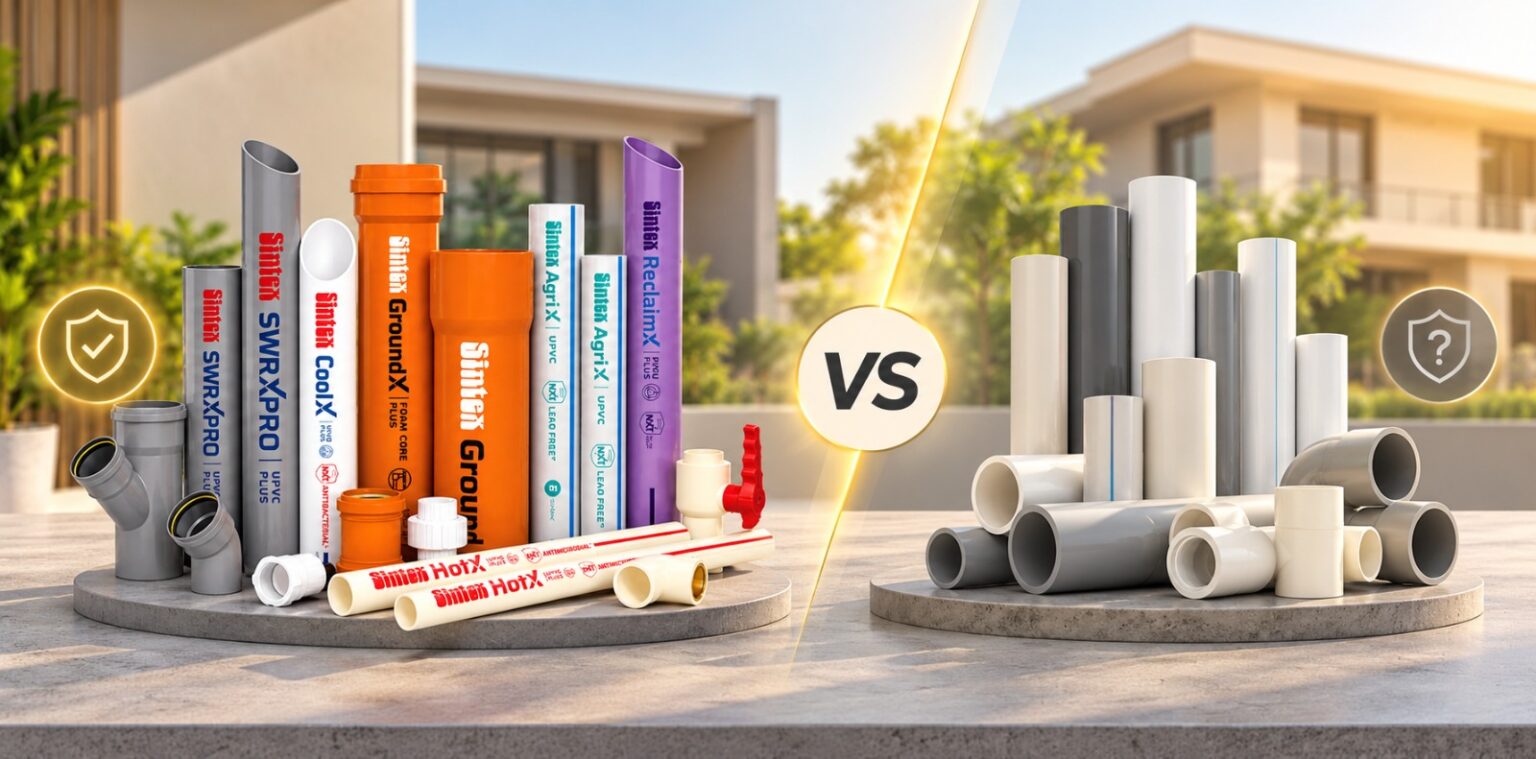
Table of Contents
Choosing pipes for your home isn’t about finding the “best” brand. It is about selecting the right pipe for your plumbing system, water pressure and budget. While Sintex is a well-known name in India, it isn’t the only option available.
This comparison puts Sintex vs other pipes on the factors that decide a plumbing system: material, certification, durability and price. Judge it on your needs, not on marketing claims.
Key Takeaways
- Choose the right pipe material first. CPVC, UPVC, SWR and HDPE each serve different applications.
- Compare more than the brand. Check the IS standard, pressure class and product markings before you buy.
- Sintex offers a broad range of certified pipes with easy-to-verify product details.
- Don’t compare pipes on price alone. The right pipe can reduce maintenance and repair costs over time.
What you should You Look for in a Plumbing Pipe?
Check the factors for plumbing pipes sequentially, based on their importance. Here are more insights into it:
- Material: CPVC carries hot and cold potable water to around 93°C. UPVC suits cold supply and drainage but softens on a hot line. SWR-grade UPVC carries soil and waste by gravity. HDPE pipes are installed underground and joined using heat fusion.
- Class: Select the pipe diameter based on the required flow rate, then choose the appropriate pressure class to handle peak operating conditions. For hot water lines, also account for temperature derating.
- Jointing: Most leaks occur at pipe joints rather than the pipe itself, so always use the solvent cement or joining method recommended for the pipe material.
- Brand: Compare PVC pipe brands only after you’ve finalized the pipe material, diameter and pressure class. Any PVC pipe brands comparison India is guesswork until those three are settled.
Where Sintex Pipes Stand Today
A fair Sintex pipes review starts by separating two things. Sintex has sold water storage tanks in India for around fifty years, and that recognition is genuine. The pipes are much newer. Currently, the product range includes ten pipe series, three of which cover most homes:
- HotX CPVC Plus for hot and cold supply
- CoolX UPVC Plus for cold supply
- SWRX for soil, waste and rainwater.
The CPVC and UPVC lines carry Sintex’s NXT antimicrobial technology, tested under laboratory conditions. The remaining handles greywater, irrigation, underground drainage and infrastructure. More than 900 distributors stock the brand across India.
How Does the Indian Pipe Market Generally Compare?
Walk into a pipe shop, and you find three kinds of brands:
- The old names have made pipes for decades. They are strongest in high-rise and commercial work, and their fittings cover every odd corner of a job.
- Value brands compete on price. Their reach into smaller towns is usually the widest, so they are easy to buy and easy to replace.
- Newer entrants lead in materials, with technologies like PVC-O and multilayer composites. They bring newer science but fewer years in the ground.
Any PVC pipe brands comparison India starts by asking which of the three your project needs.
Sintex vs Other Pipes: What Actually Sets It Apart
When comparing Sintex vs other pipes, it helps to look beyond the brand name. Here are three features that make Sintex different.
- Stronger brass inserts: Most plumbing leaks happen at pipe fittings, not the pipes themselves. If a fitting is tightened too much during installation, the plastic around the brass insert can crack over time. Sintex fittings use brass inserts manufactured as per applicable IS standards and are designed with dual O-rings for enhanced leak-proof performance. The fittings also feature BSP-standard tapered threads to ensure secure and reliable connections.
- Fire Safety: Sintex CPVC and UPVC pipes are manufactured using compounds with a Low Limiting Oxygen Index (LOI), which makes them difficult to ignite under normal conditions. Even if exposed to fire, the material is designed to be self-extinguishing and does not support flame propagation, helping to limit the spread of fire. This is similar to the fire-retardant properties commonly required in electrical cable insulation and is in line with the relevant product standards.
- Easy product verification: Every Sintex pipe comes with a QR code that can be scanned to check product details and warranty information. This helps you confirm that you’re getting a genuine product.
Sintex Pipes Price Comparison: Where Do They Fit?
If you’re searching for a Sintex pipes price comparison, it’s important to know that pipe prices vary based on:
- Material (UPVC, CPVC, SWR or HDPE)
- Diameter
- Pressure class
- Application
Instead of focusing only on the lowest price, compare what you’re getting for the cost.
Sintex isn’t the cheapest pipe on the shelf, and it isn’t meant to be. The brand is designed for customers who look beyond the initial purchase price and value long-term performance, safety, and product quality.
It’s also worth remembering that the pipe is only one part of your plumbing cost. You’ll also pay for fittings, solvent cement, and installation. If a hidden joint leaks later, repairing the wall can cost much more than the money saved on a lower-priced pipe.
Sintex CPVC and UPVC systems also incorporate NXT Antimicrobial Technology throughout the entire pipe and fitting material. This helps inhibit the growth of bacteria, fungi, and algae on the pipe surface, supporting better hygiene and cleaner water conveyance conditions throughout the plumbing system.
For homeowners, this means an added layer of protection beyond regular plumbing performance. The antimicrobial technology helps maintain a cleaner piping environment, reduces the risk of microbial growth within the system, and supports healthier water delivery conditions for everyday use.
In addition, Sintex pipes are manufactured using high-quality virgin compounds, certified raw materials, and stringent quality standards. Features such as antimicrobial protection, IS-standard brass inserts, dual O-ring sealing systems, and reliable joint performance reflect a focus not only on durability but also on customer well-being and long-term peace of mind.
That’s why it’s better to focus on value rather than just price. A pipe that is suitable for the application, delivers long service life, supports hygiene, and helps minimize maintenance costs can provide significantly better value over the life of the building, even if the initial investment is slightly higher.
Sintex Pipes Quality: Certifications, Materials & What to Check
A fair Sintex vs other pipes comparison starts with understanding the quality standards and certifications behind each product:
- Choose the right pipe material for the job:
- CPVC for hot water
- UPVC for cold water supply
- SWR-grade UPVC for drainage
- Check the IS standard printed on the pipe and make sure it matches your application.
- HotX CPVC Plus: IS 17546 & IS 15778
- SWRX: IS 14735 & IS 13592
- AgriX: IS 4985 & IS 7834
- Verify the pressure class stripe on CPVC pipes:
- Red stripe: SDR 11
- Brown stripe: SDR 13.5
- Look for the lead-free marking, especially for drinking water and kitchen plumbing.
- Ask for the BIS license number from the dealer to confirm the product is certified for the relevant Indian Standard.
- Match the pipe markings with what you ordered. If the details printed on the pipe differ from what the dealer told you, clarify before making the purchase.
Which Pipe Type Should You Choose? A Simple Decision Guide
Use this quick guide to compare Sintex vs other pipes. You will find the right pipe based on your application, budget and installation requirements.
| If you need… | Choose | Why |
| Hot water | CPVC | Heat-resistant |
| Lower upfront cost | UPVC on cold lines only | Save on cold, never on hot |
| Underground or borewell lines | HDPE | Leak-resistant heat-fused joints |
| Drainage | SWR UPVC | Built for gravity waste flow |
| High-rise plumbing | Right pressure class | Handles pump and building pressure |
| Agriculture | UPVC Agri Pipe | Built for irrigation |
Common Mistakes Homeowners Make When Comparing Pipe Brands
Avoid the following common mistakes when comparing Sintex vs other pipes to choose the right plumbing solution for your home:
- Comparing brands before fixing the material. Duty decides material, and brand comes last.
- Judging on price per meter, when fittings, cement and rework cost more.
- Reading a certification mark as blanket approval. It applies per standard, per product.
- Mixing brands across pipe, fittings and solvent cement.
- Skipping the pressure test before tiling. A test costs a morning, but re-tiling costs a bathroom.
Also, Read: Difference Between PVC, CPVC, and UPVC Pipes
Conclusion
When it comes to Sintex vs other pipes, there is no single “best” pipe for every home. The right choice depends on where the pipe will be used, the pressure it must handle, and the quality standards it meets. Sintex stands out with a wide product range, published certifications and features that are easy to verify before you buy. Compare your options carefully, choose the right material for the job and explore the Sintex pipe range to find a suitable solution.
The suitability of a pipe depends on the use:
● CPVC suits hot and cold supply
● UPVC suits cold supply
● SWR-grade UPVC handles drainage.
● HDPE handles buried mains
Most homes use a combination.GroundX for Underground drainage and ReclaimX for recycle water supply
No brand leads on every duty. Judge on IS certification for the product, published pressure class, fittings availability, dealer support near you, and whether your plumber joins that system daily
UPVC, CPVC and PVC are widely used pipes in India. UPVC for cold supply and drainage, CPVC for hot lines, SWR-grade UPVC for soil and waste. HDPE is a popular choice for buried main supply
Oriented PVC, or PVC-O, is the strongest in the PVC family. Molecular orientation gives it higher burst strength than standard UPVC at the same wall thickness. For hot water, use CPVC regardless.
Categories
Year
Related blogs