
Different Types of Water Tanks for Homes and Commercial Spaces
Share
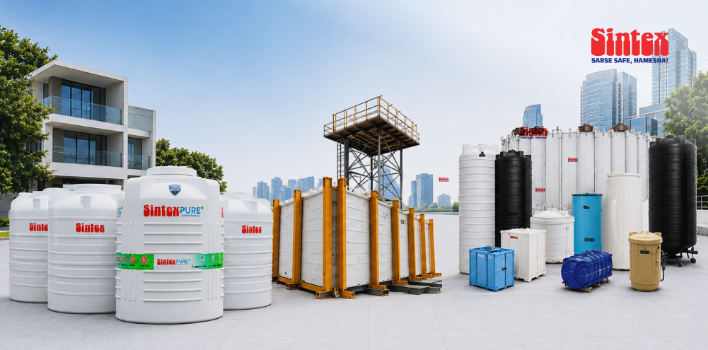
Table of Contents
Water storage isn’t something most people think about until something goes wrong. A tank that’s too small, installed in the wrong spot, or made from the wrong material causes problems that are tedious and expensive to fix after the fact.
The good news is the choice isn’t actually complicated once you understand what’s available. Different types of water tanks exist for genuinely different reasons: a home in Chennai has different storage needs than a hospital in Pune, and a rooftop installation demands different engineering than an underground one. Knowing the options makes the decision straightforward.
Here’s a complete breakdown of the main types of water tanks for homes and commercial spaces, including what each one does well and where it falls short.
Key Takeaways
- Water tanks split into three main placement types: overhead, underground, and loft, and the right one depends on your space and supply situation.
- Material and construction layer count directly affect water temperature, hygiene, and how long the tank holds up under Indian weather conditions.
- Antimicrobial tanks with active protection against bacteria, viruses, fungi, and algae are worth the premium for any household prioritising drinking water safety.
- Commercial water storage is a different scale entirely: FRP underground tanks reach 50,000 litres, while SMC panel tanks scale up to 16,00,000 litres for large communities and industrial facilities.
- Choosing between a concrete, steel, or plastic/FRP tank isn’t just about price upfront; it’s about how much you’ll spend on maintenance over the next few decades.
The Three Main Placement Types
Overhead Tanks
This is the standard setup for most Indian homes and smaller commercial buildings. The tank sits on the rooftop or an elevated structure, and gravity does the job of pushing water down through the plumbing. No pump needed for distribution once the tank is full.
Sizing is fairly predictable. A four-person household uses roughly 900 litres per day, so a 1,000-2,000 litre overhead tank covers most families with room to spare. Larger buildings need larger tanks; Sintex’s overhead range goes up to 20,000 litres, which handles anything from a small house to a substantial apartment block.
The options within the overhead category vary a lot, and that’s where buyers often feel lost. Sintex makes over a dozen overhead tank models including the Titus, Pure Plus, Trupuf, Tatva, Hero, Classic Double Wall, Reno, Neo, and others. Each targets a slightly different need. More on those under the material section below.
Also, Read: How to Select Best Overhead Water Tanks?
Underground Tanks (Sumps)
Underground tanks work differently. They sit below ground level and typically act as primary storage, collecting supply before it distributes to overhead tanks or direct-use points. They’re popular where rooftop space is limited, where large volumes need bulk storage, or where consistent water temperature matters.
The engineering challenge is soil pressure. A tank buried underground faces constant lateral and downward pressure, and if the structure isn’t built for it, cracking and seepage follow.
Sintex’s underground sump range addresses this with a one-piece moulded construction that has no joints or seams. There’s no need for a retaining wall during installation, and the material resists tree root intrusion. The residential sump range covers six capacity options: 1,000, 2,000, 3,000, 4,000, 5,000, and 6,000 litres. For commercial-scale underground storage, Sintex’s FRP (Fiber Reinforced Plastic) underground tanks go considerably larger, reaching 50,000 litres.
Loft Tanks
Smaller tanks designed for indoor placement, usually inside a kitchen loft or overhead storage niche within the home. These typically carry less volume and serve supplemental or localised storage needs, such as maintaining water pressure in a specific part of the building when the overhead supply runs low.
The Sintex Loft tank covers this use case well. It’s compact, durable, and works where a rooftop tank simply can’t be installed.
Types of Water Tanks by Material and Construction
Where the tank goes tells you one part of the story. What it’s made from tells you the rest.
PUF-Insulated Tanks
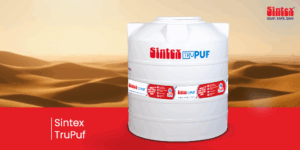
PUF stands for Polyurethane Foam. These tanks take the triple-layer approach and upgrade the insulation significantly. The Sintex Trupuf uses 50mm high-grade PUF insulation, which makes a genuine difference in regions with intense summer heat. If you’ve ever pulled lukewarm water out of a rooftop tank in May, you understand the value here.
Antimicrobial Tanks
Standard plastic tanks resist external contamination fairly well. Antimicrobial tanks go further by incorporating materials that actively suppress the growth of bacteria, viruses, fungi, and algae inside the tank itself.
Sintex offers two standout options here. The Sintex Pure Antimicrobial and Sintex Ace Antimicrobial both use active silver-based technology for continuous internal protection. The Ace model is also notable for something specific: it’s the first side-hatch tank in India, which means the cleaning access point is on the side rather than the top. That’s a practical difference, because cleaning a tank properly matters, and side-hatch access is much easier to manage.
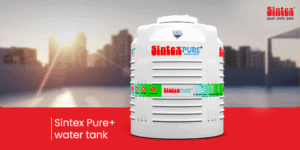
The Sintex Pure Plus takes this further with what Sintex calls 4P protection, targeting bacteria, viruses, fungi, and algae simultaneously. Families with young children or anyone with health concerns about drinking water will find this category worth the extra cost.
FRP Tanks
FRP stands for Fiber Reinforced Plastic, also called GRP (Glass Reinforced Plastic). This material uses glass fibres bonded within a resin matrix. The result is considerably stronger than standard polyethylene, fully corrosion-resistant, and built for long-term commercial or industrial use.
Sintex’s FRP underground tanks carry a 50+ year lifespan and handle underground or above-ground installation at commercial scale. They’re food-grade, leak-proof, and chemical-resistant. Concrete tanks, by comparison, crack over time, require periodic waterproofing, and don’t approach this lifespan.
SMC Panel Tanks
SMC stands for Sheet Moulding Compound. These tanks don’t arrive as a single unit; workers assemble compression-moulded panels on-site into a modular tank structure that can scale to an enormous range of capacities. The Sintex Pure Community Panel Tank can reach 16,00,000 litres, which is enough for a large township or municipal distribution point.
The panels are FDA-approved, algae-resistant, rust-free, and much faster to install than an equivalent RCC tank. Crucially, modular panel construction also means the tank can be relocated or expanded if the project requirements change.
Which Is the Best Water Tank for Home?
Honestly, it depends on what “best” means for your specific situation.
- Daily drinking water for a family of four or five: a triple-layer overhead tank with antimicrobial protection is the strongest all-round choice. The Sintex Pure Plus or Pure Antimicrobial covers this well.
- Limited rooftop space: pair a Sintex underground sump for bulk storage with a smaller overhead tank for day-to-day distribution. It’s a setup that works particularly well for urban plots where roof area is at a premium.
- Apartment or kitchen-only installation: the Sintex Loft tank covers you.
- Extreme summer heat: go with the Sintex Trupuf. The PUF insulation difference is real.
- Tight budget, basic needs: Sintex Neo and Sintex Reno deliver reliable performance without premium features that may go unused.
Water Tanks for Commercial Use
Commercial requirements don’t work at household scale. A hospital can’t operate on a 2,000-litre tank. A hotel with 150 rooms needs a fundamentally different water storage approach than a family home.
Two product categories answer this: FRP tanks and SMC panel tanks.
FRP underground tanks suit large commercial setups where above-ground space is scarce or where the required volume exceeds what standard plastic tanks handle. Sintex’s commercial FRP range covers 5,000 litres at the smaller end, up to 50,000 litres. Hotels, schools, hospitals, and manufacturing facilities all fall within this range. The 50+ year lifespan means these tanks outlast most of the buildings they serve.
SMC panel tanks fill requirements where volume runs into hundreds of thousands or millions of litres. Townships, industrial campuses, and municipal water management facilities use these. The modular build means installation happens in days, not the weeks a comparable concrete structure would require.
Both outperform traditional RCC and steel tanks in maintenance cost, hygiene, and longevity. Steel rusts. Concrete cracks and seeps. Neither happens with FRP or SMC.
| Tank Type | Suited For | Capacity Range |
| Overhead plastic | Home and small commercial use | Up to 20,000L |
| Underground sump | Space-saving home storage | 1,000L-6,000L |
| Loft tank | Indoor supplemental storage | Smaller compact sizes |
| FRP underground | Commercial underground storage | 5,000L-50,000L |
| SMC panel tank | Community and industrial scale | Up to 16,00,000L |
The Bottom Line
Different types of water tanks exist because different needs genuinely require different engineering. There’s no single best tank; there’s only the tank that’s right for a particular space, volume requirement, and water quality priority.
For homes, the decision mostly comes down to placement type, layer count, and whether antimicrobial protection matters enough to justify the premium. For commercial use, FRP and SMC panel tanks are the relevant choices, and the right one depends on whether the project needs underground installation or large above-ground volume. Sintex’s range covers both ends of this spectrum, with residential water storage tanks that handle any household size and commercial solutions that scale up to entire communities.
For most homes, an overhead plastic tank on the rooftop works best. Gravity pushes water through the pipes, so you skip a separate pump for daily use, and food-grade polyethylene keeps water free of rust or metallic taste. Triple-layer tanks with built-in UV protection hold up well under direct sun for years. Bigger homes often add an underground sump for backup storage, but for a simple, low-maintenance setup, the rooftop plastic tank stays the easiest choice.
Water tanks generally split into two broad types, overhead tanks installed on the roof, and underground tanks or sumps set below ground level near the foundation. You'll also find loft tanks for tighter spaces, slimline tanks that fit narrow walls, and both vertical and horizontal cylindrical shapes. Materials vary too, ranging from polyethylene plastic and stainless steel to RCC and fiberglass. Most homes pick a plastic overhead tank for the roof and pair it with an RCC or plastic sump.
Start with your family size, since daily water needs scale directly with the number of people at home. A rough guide many plumbers use is around 135 liters per person per day for drinking, cooking, and washing combined. Multiply that figure by your household size, then add a buffer of a day or two in case the regular supply fails. Also factor in your rooftop space and the structure's load capacity, since a full tank weighs far more.
Multi-layer polyethylene tanks with UV stabilizers hold up the longest for most households, since the plastic resists cracking, doesn't rust, and stays food-safe for years under direct sun. Stainless steel comes close and resists algae growth well, though the higher cost puts it out of reach for many homes. RCC tanks last decades structurally, but cracks and leaks tend to show up over time, and lime can leach into stored water as the inner lining wears down.
Sintex tanks typically last between 15 and 20 years under normal use, sometimes longer with proper care. The food-grade LLDPE plastic won't rust, corrode, or develop the cracks you'd see in cheaper, thinner tanks over time. Built-in UV stabilizers in the outer layer guard against sun damage, which is usually what shortens a plastic tank's life faster than anything else. A flat, stable base and a yearly cleaning push that lifespan toward the higher end.
Categories
Year
Related blogs