
6 Benefits of Using CPVC Pipes and Fittings for Plumbing
Share
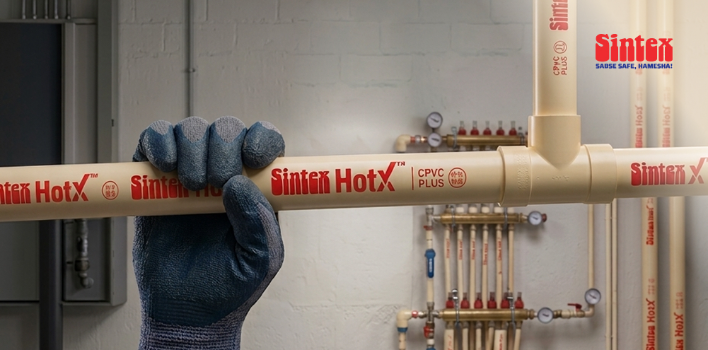
Table of Contents
Galvanised iron dominated Indian plumbing for decades. It still does in older buildings. Walk into any building that has not been replumbed in the last twenty years and the story is usually the same: discoloured water, reduced pressure from scaled pipes, and at least one section that has been patched or replaced. The material gets the blame, but the root cause is simpler. Iron corrodes. It always has.
CPVC does not. That one fact drives most of what follows.
Key Takeaways
- CPVC handles both hot and cold water lines up to 93 degrees Celsius, making it a single-material solution for entire plumbing systems.
- Unlike GI pipes, CPVC does not corrode, scale or narrow over time, keeping water quality and flow pressure consistent for decades.
- Sintex CPVC pipes conform to IS 15778 and are BPA-free, meeting the minimum standard for potable water in homes, hospitals, and commercial buildings.
- Faster installation, lower maintenance, and no recurring repair costs make CPVC the more economical choice over the life of a building
1. CPVC Pipes Work for Both Hot and Cold Water Lines
Standard PVC softens at around 60 degrees Celsius. That is a problem in any building where solar-heated water sitting in rooftop pipework can approach or exceed that temperature before it even reaches a tap. CPVC handles continuous service up to 93 degrees Celsius without losing dimensional stability.
What this means on a project is that a single pipe material covers the full plumbing system. Hot water runs, cold water runs, the connections between them. No switching materials mid-installation, no separate fittings schedule for the hot lines. Sintex CPVC pipes and fittings are rated and tested for this temperature range, which removes a common point of failure in poorly specified systems.
2. No Rust, No Scale, No Bore Reduction Over Time
Pick up a section of galvanised iron pipe that has been in service for eight years. The bore is smaller than the day it was installed. Mineral deposits and rust accumulate on the inner wall, progressively narrowing the pipe and reducing flow. The water coming through it often carries evidence of that process.
CPVC does not react with the water it carries. Hard water, chlorinated municipal supply, mildly acidic groundwater. None of it affects the pipe wall. The bore on day one is the bore twenty years later. This is one of the clearest long-term advantages of CPVC pipes, and it has a direct effect on water quality. What the pipe sheds into the water supply depends entirely on what the pipe wall is made of. With CPVC, the answer is nothing.
3. Certified Safe for Drinking Water
Not every plastic pipe is suitable for potable water. The compound matters. Specifically, what stabilisers and additives were used in its formulation, and whether any of them leach under heat or prolonged contact with water.
Sintex CPVC pipes and fittings conform to IS 15778, the Indian Standard for CPVC piping systems for hot and cold potable water. The compound is BPA-free. For a hospital, a school, a housing society, or a food-processing facility, certification to this standard is the minimum acceptable specification, and Sintex CPVC meets it.
4. Faster to Install Than Metal Pipe
Watch a crew installing GI pipe versus CPVC on the same floor plan. The difference in time is visible within an hour. Metal requires cutting, threading, and assembling with tools. A threading error means a leaking joint. Correcting it means disassembling the run and starting again.
CPVC uses solvent welding. A plumber cuts the pipe, cleans the socket and spigot, applies solvent cement, and holds the joint for a few seconds. That is the entire process. No threading equipment, no open flame, no need for a specialised workforce. A trained plumber working in CPVC completes the same run considerably faster than the equivalent GI work.
For a developer running twenty floors of plumbing across multiple towers, that time difference compounds into a significant labour cost saving. Fewer man-hours per floor, faster handovers, fewer snag items from threaded joint failures. The benefits of using CPVC pipes and fittings show up most clearly at project scale.
5. Light to Handle, Quiet in Operation
A 25mm CPVC pipe weighs a fraction of the equivalent GI. On a site where material moves up staircases by hand across multiple floors, that matters. Mounting brackets carry less load. Supports can be spaced differently. The pipe is easier to cut and reposition if something needs adjusting mid-installation.
The noise point tends to get overlooked. Metal pipe transmits flow noise and water hammer directly through the pipe wall and into whatever structure it is fixed to. CPVC absorbs vibration rather than conducting it. In a residential building where a plumbing riser runs behind a bedroom wall, the difference between a metal system and a CPVC one is audible at night.
6. Lower Running Cost Over the Life of the System
CPVC costs more upfront than standard PVC. Against GI pipe the comparison shifts depending on current metal pricing, but the raw material cost is not the only number that matters.
A GI system in a building with hard water or aggressive supply chemistry will need sections replaced within ten to fifteen years. Descaling, joint maintenance, and corrosion repairs are recurring costs. With CPVC installed correctly, none of those calls happen. No repainting, no anti-corrosion treatment, no insulation required for temperature variation. The system runs without scheduled intervention until a physical damage event requires a repair.
For housing projects, commercial buildings, and hotels where maintenance access is difficult and downtime is expensive, the benefits of using CPVC pipes for plumbing are largely about avoiding costs rather than creating them. Sintex CPVC pipes carry consistent wall thickness and pressure ratings across the range, which also means any future extension or replacement uses identical specification pipe with no guesswork on compatibility.
Where to Use CPVC and UPVC Pipes in Constructions
CPVC and UPVC divide by function rather than compete directly. CPVC covers any line where hot water is involved: residential risers, bathroom and kitchen supply, solar water heater connections, and commercial or institutional buildings that require certified potable water compliance. UPVC handles cold water supply, underground drainage, rainwater downpipes, and irrigation networks where temperature is not a factor. Larger projects typically use both, with CPVC for pressurised internal supply and UPVC for drainage and external runs.
Also, Read: What Are CPVC Pipes?
One Practical Note on Specification
IS 15778 compliance is worth verifying at the batch level, not just the brand. Pressure rating should match the application. Most residential hot water systems run at 10 kg/cm2, and multi-storey or commercial installations often require a higher rating. Fittings and solvent cement should come from the same matched system as the pipe. Mixing pipe from one supplier with fittings from another creates dimensional tolerance risk at the joint, which is where most CPVC failures actually occur.
Sintex supplies pipe, fittings, and compatible solvent cement as a coordinated system, which removes that variable from the procurement process.
For available sizes, pressure ratings, and dealer contacts, visit the Sintex website or speak to your nearest authorised distributor.
CPVC pipes resist corrosion, handle temperatures up to 93 degrees Celsius, and do not scale or narrow over time. They are certified safe for drinking water, lighter and faster to install than metal alternatives, and require no scheduled maintenance. Over the life of a building, the combination of durability and low upkeep makes CPVC more cost-effective than galvanised iron or standard PVC.
Yes, and it is increasingly the preferred material for both hot and cold water plumbing in residential, commercial, and institutional buildings. Its ability to handle high temperatures without losing structural integrity makes it suitable for complete plumbing systems where a single pipe material needs to cover all supply lines, including solar water heater connections and pressurised hot water runs.
CPVC fittings are the connectors, elbows, tees, reducers, and valves used to route and join CPVC pipe runs. They are made from the same chlorinated polyvinyl chloride compound as the pipe and are joined using solvent cement. For a reliable installation, fittings and solvent cement should come from the same matched system as the pipe to ensure dimensional compatibility at every joint.
No specialised tools are needed. CPVC is cut with a standard pipe cutter or fine-tooth saw and joined using solvent cement, which requires no threading equipment, open flame, or heat guns. This makes it significantly simpler to install than metal pipe systems. A trained plumber working with CPVC for the first time can get up to speed quickly without additional equipment investment.
Use a ratchet-style pipe cutter or a fine-tooth hacksaw and cut in a single clean motion rather than sawing back and forth repeatedly. Avoid sharp impact cuts. Cold temperatures make CPVC more brittle, so if you are working in cold conditions, let the pipe warm up before cutting. After cutting, deburr the end cleanly before applying solvent cement to ensure a proper seal at the joint.
Categories
Year
Related blogs